
The short version
- Look for the speed limit sign when you enter a new road, then confirm it with repeater signs and street lighting.
- National speed limit does not mean one speed for every vehicle or every road.
- On a driving test, being safe and legal matters more than reaching the limit.
- If conditions are poor, use a lower speed even when the posted limit is higher.
- Practise speed control by checking mirrors before easing off, braking or changing speed.
What a speed limit really means
A speed limit is the maximum legal speed for that road, not a target. The Highway Code says you must not exceed the maximum speed limit for the road and your vehicle. In real driving, that means you choose a speed that is legal, safe for the conditions, and leaves you enough time to deal with hazards.
What I see most often in the mirror with learners is a small delay: they spot the new limit sign, but they keep the same pressure on the accelerator for another few seconds. At 30 mph, a few seconds is a long distance. In lessons, I drill speed changes before the sign where appropriate: mirrors, ease off, brake if needed, and be at or below the new limit as you pass the sign.
For the test, the examiner is not looking for you to drive at the limit all the time. They are looking for good judgement. Driving at 27-30 mph on a clear 30 road may be fine; doing 30 past parked cars, school children and a narrow gap may not be.
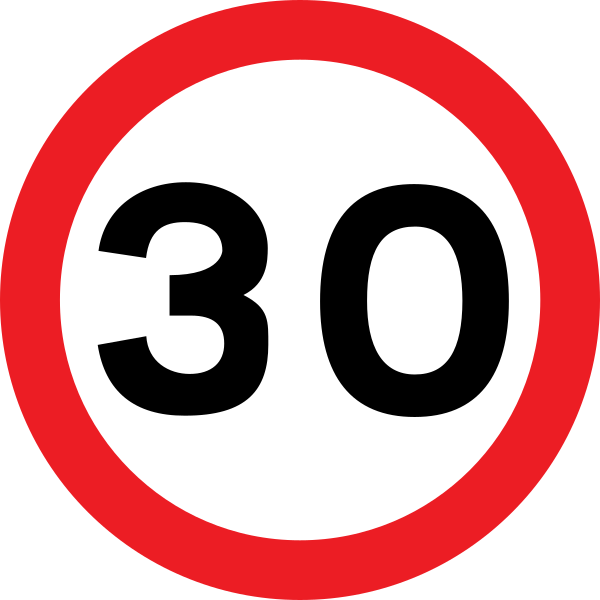
The main UK speed limits for cars
For a car, the common UK speed limits are 20, 30, 40, 50, 60 and 70 mph. Local authorities can set lower limits where needed, so always obey the signs rather than guessing from the type of road.
A 30 mph limit is usually found in built-up areas with street lights, unless signs show otherwise. You may not see many 30 repeater signs on these roads because the system of street lighting itself usually indicates a restricted road. By contrast, 20, 40, 50 and other limits normally use repeater signs to remind you.
For cars and motorcycles, the national speed limit is 60 mph on a single carriageway and 70 mph on a dual carriageway or motorway, unless signs show a different limit. A dual carriageway is defined by a central reservation separating the directions of traffic, not by the number of lanes.
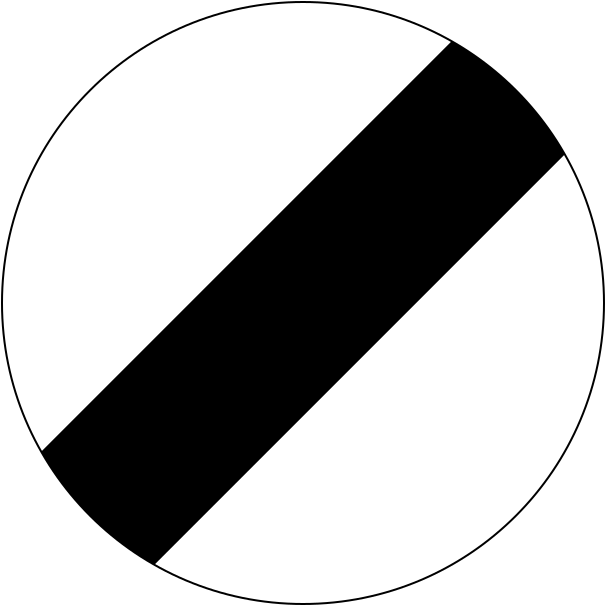 National speed limit appliesWhat it means
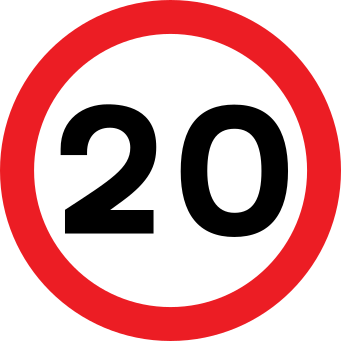 20 mph speed limitWhat it means
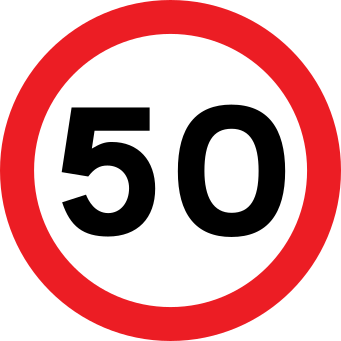 50 mph speed limitWhat it means
- 20 mph: common in residential streets, near schools and in many Welsh restricted roads, plus local 20 zones elsewhere.
- 30 mph: the usual built-up area limit where there are street lights, unless signs say otherwise.
- 40 or 50 mph: often used on main urban routes, ring roads and roads with more hazards than open national speed limit roads.
- 60 mph: national speed limit for cars on single carriageways, unless signs show otherwise.
- 70 mph: national speed limit for cars on dual carriageways and motorways, unless signs show otherwise.
National speed limit signs and what they mean
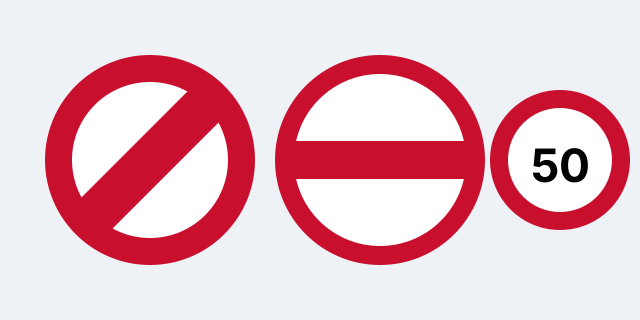
The national speed limit sign is a white circular sign with a black diagonal stripe. It does not simply mean 60 mph. It tells you to use the national speed limit for your vehicle and the type of road you are on.
This catches learners out on dual carriageways. If there is a central reservation, the national limit for a car is 70 mph. If there is no central reservation, even if there are two lanes in your direction, it is still a single carriageway and the national limit for a car is 60 mph.
On lessons, I ask learners to say out loud, ‘national sign, what road type?’ That short question prevents the common mistake of treating every national speed limit sign as the same speed.
- 1Identify the sign: white circle with a black diagonal stripe.
- 2Check the road type: single carriageway, dual carriageway or motorway.
- 3Apply the car limit: 60 mph on a single carriageway, 70 mph on a dual carriageway or motorway.
- 4Then adjust for bends, junctions, traffic, weather, visibility and your stopping distance.
How to read speed limit signs properly
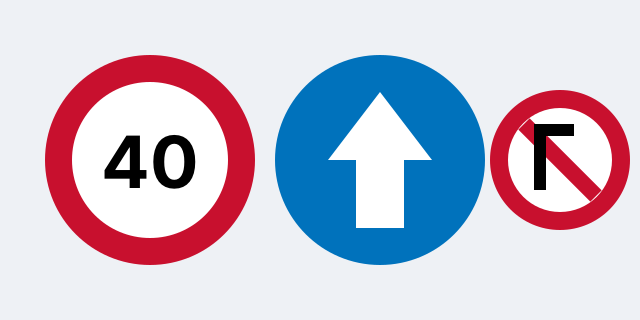
Speed limit signs are circular with a red border when they give a maximum speed, such as 20, 30 or 40. The new limit starts at the sign. If you are entering a lower limit, you should already be slowing so that you do not pass the sign too fast.
Repeater signs are smaller signs placed along the road to remind you of the current limit. They are especially useful after side roads, long gaps and changes in scenery. If you miss a terminal sign at the start of a new limit, repeaters can help you recover, but the responsibility is still yours.
Temporary limits are just as enforceable as permanent ones when correctly signed. Roadworks, smart motorways and temporary traffic management can all use lower limits. On a test, ignoring a temporary limit is treated the same way as ignoring any other legal limit.
- A red-ring number sign sets a maximum speed.
- The limit begins at the sign, not after it.
- Street lights usually mean 30 mph unless signs show a different limit.
- Yellow-backed signs make a speed sign more visible, but the red-ring number is what sets the limit.
- Variable motorway signs must be obeyed when displayed in a red ring.
Speed choice: legal is not always safe
A good driver is not just asking, ‘What is the limit?’ They are asking, ‘What speed gives me time to stop?’ That is why you may need to be below the limit near parked cars, bends, junctions, horses, cyclists, pedestrians, standing water, ice or poor visibility.
The official stopping distance at 30 mph is 23 metres, made up of thinking distance and braking distance. At 70 mph it is 96 metres. These Highway Code figures are a useful guide, but in poor conditions your stopping distance can increase significantly, especially on wet or icy roads.
In the passenger seat, I am listening for engine note and watching your eyes. If your eyes are fixed far ahead but you are not checking near hazards, you may hold too much speed into a developing situation. The cure is simple but not easy: look earlier, plan earlier, and lose speed before the hazard rather than during it.
Speed on the practical driving test
The driving test is not a race and there is no mark for reaching the speed limit. The examiner wants to see that you make normal progress when it is safe, and that you slow down in good time where it is not. You can be marked for driving too slowly if you hold up traffic without good reason, but learners worry about this more than they need to.
The more common serious problem is entering a lower speed limit too fast or failing to respond to a changed limit. Another common fault is braking sharply because the learner notices a camera or sign late. Smooth speed planning looks much better and feels safer to everyone in the car.
What does not matter for the test is whether you sit exactly at 30 mph by the speedometer. Speedometers are not laboratory instruments, and normal small variation is expected. What matters is that you do not exceed the limit, you make suitable progress, and your speed matches the road and traffic conditions.
- Examiners expect you to notice speed limit changes without prompting.
- They will not encourage you to break the limit to keep up with traffic.
- They may direct you onto roads with several limit changes to see how you plan.
- They judge your speed together with mirrors, positioning, braking and hazard awareness.
How we drill speed limits in lessons
At Fast Track Driving Lessons, intensive courses are usually 10 to 40 hours, so speed awareness has to be built into every drive rather than treated as a separate topic. We charge £61.23 per hour, and the aim is to use that time on habits that transfer straight to independent driving and the test route.
A typical drill is ‘sign, mirror, speed, gear’. You identify the sign early, check mirrors before changing speed, set the correct speed, then choose the gear that keeps the car under control. On a 30 to 20 change, for example, that may mean easing off early, braking gently, then selecting second or third depending on the car and road.
If theory knowledge is weak, practical lessons become harder because the learner is trying to decode signs while controlling the car. We provide free theory test practice at /theory, and I encourage learners to use it alongside lessons, especially for speed limits, stopping distances and road signs.
- 1Call out the current speed limit when you enter a new road.
- 2Spot the next speed sign as early as possible.
- 3Check your mirrors before you slow down or speed up.
- 4Be at the new limit by the sign when the limit drops.
- 5Review any missed signs at the roadside or after the lesson while the route is fresh.
Common questions
Can I fail my driving test for driving under the speed limit?
Yes, if you drive unnecessarily slowly and cause problems for other road users, it can be marked as undue hesitation or not making progress. However, you are expected to slow down for hazards, weather, bends and narrow roads. Safe judgement matters more than staying close to the number on the sign.
Does a 30 mph road always have 30 repeater signs?
No. Many restricted roads with street lights do not have 30 repeater signs because the street lighting indicates the 30 mph limit unless signs show otherwise. If the limit is 20, 40 or something else, you should normally see signs telling you.
What is the national speed limit for a car on a dual carriageway?
For a car, the national speed limit on a dual carriageway is 70 mph unless a lower limit is signed. A dual carriageway has a central reservation separating opposing traffic. If there is no central reservation, it is not a dual carriageway for speed limit purposes.
Do speed cameras matter on the driving test?
You should not change your driving just because you see a camera; you should already be within the limit. Braking sharply at a camera often shows you were not planning your speed properly. The examiner is assessing your speed control throughout the drive, not just near cameras.
Are temporary speed limits legally enforceable?
Yes, temporary speed limits can be legally enforceable when they are correctly made and signed, such as at roadworks or on motorways with variable limits. Treat them like any other speed limit. On test, missing a temporary limit can still lead to a serious fault if it is unsafe or clearly illegal.
Should I use cruise control to keep to the speed limit as a learner?
For most learners, it is better to learn speed control with your right foot first. Cruise control does not remove your responsibility to obey limits, slow for hazards or respond to traffic. It is not something you need to use on the driving test.
Browse driving lessons
Reading about it only gets you so far. Our instructors drill this with you in the car, on the roads around your test centre.