
The short version
- Do not assume your test is cancelled just because the weather looks bad.
- The examiner or test centre can cancel if roads, visibility or the car park are unsafe.
- If DVSA cancels your test because of weather, you should not have to pay another test fee.
- If you choose not to attend, you will normally lose your fee.
- Practise bad-weather preparation, but never drive in conditions beyond your ability.
Will my driving test go ahead in snow, fog or ice?
Possibly, yes. A practical driving test does not get cancelled automatically because there is snow on the forecast, fog in the morning or a frost overnight. The DVSA’s position is simple: tests go ahead unless the conditions make the route unsafe or prevent the examiner from assessing you properly. That decision may be made before your appointment, or by the examiner at the test centre on the day.
In real terms, I tell learners to prepare as if the test is going ahead until they are told otherwise. I have seen tests run on cold, wet winter mornings with patches of slush at the kerb, and I have seen tests cancelled when the main roads looked fine but the test centre car park and local side roads were icy. Examiners are not trying to be awkward. They have to consider your safety, their safety, the public, and whether the test can be conducted fairly.
The most common mistake learners make is waiting at home because they have decided the weather is too bad. If DVSA has not cancelled and you do not attend, it is usually treated as a missed test and you normally lose your test fee. If you are unsure, check your booking messages and follow the official DVSA instructions for your test centre.
Who decides if the test is cancelled?
The decision sits with DVSA staff and, on the day, the examiner. Sometimes a test centre cancels a batch of tests because local conditions are clearly unsafe. At other times, one test may go ahead and another later test may not, because conditions have changed. Fog can lift quickly. Ice can melt on main roads but remain dangerous on estate roads. Snow can be cleared on one side of town and untouched on another.
An examiner will think about more than the road immediately outside the test centre. They may consider the planned test routes, hills, country lanes, untreated junctions, visibility, flooding, ice in the car park and whether emergency stops or normal manoeuvres can be carried out safely. If they cannot run a test without creating unnecessary risk, they can cancel it.
A point learners often miss is that a driving test is not just a drive around the block. The examiner must see enough normal driving to decide whether you meet the DVSA standard. If fog is so thick that you cannot safely reach appropriate roads, or snow makes lane markings, kerbs and junction positions unclear, the test may not be a fair assessment.
- Snow: likely to be cancelled if roads are untreated, rutted, icy underneath or routes are blocked.
- Ice: a major concern, especially black ice, shaded roads, hills and test centre car parks.
- Fog: may cancel a test if visibility is too poor for normal progress and safe observation.
- Heavy rain: tests often still run, but surface water, flooding or poor visibility can stop them.
- Strong wind: less common, but fallen trees, debris or unsafe conditions can affect tests.
What should I do on the morning of the test?
Start by checking your phone and email, including junk folders, using the contact details on your DVSA booking. If DVSA cancels your test, they should contact you and rearrange it. However, in fast-changing weather, you may not hear until close to the appointment, so do not leave everything to the last minute.
If there is snow or ice in your local area on the day of your test, GOV.UK advises contacting the test centre using the telephone number on your booking confirmation. Do not ring the general DVSA customer service line for a local weather decision. Test centre staff are the ones who know what is happening on their routes.
As an instructor, my rule is that we make a calm, practical decision early enough to travel safely. If the test centre says attend, we attend. If I believe the journey to the test centre is unsafe before we even get there, I will not put a learner, myself or anyone else at risk. That is different from simply being nervous because the weather is unpleasant.
- 1Check your DVSA booking email or text for cancellation messages.
- 2Look at local conditions, not just a national weather forecast.
- 3If there is snow or ice, phone the test centre number on your booking confirmation.
- 4Allow extra time to travel, but do not rush or take risks to arrive on time.
- 5Clear the car fully before setting off if you are using your own car.
- 6Take your provisional licence as normal.
- 7If the test is cancelled at the centre, wait for DVSA’s rearrangement instructions.
Will I lose my test fee if bad weather stops the test?
If DVSA cancels your practical test because of bad weather, you should not have to pay another test fee. DVSA will rearrange the appointment. The practical car test fee published by DVSA is £62 on weekdays and £75 for evenings, weekends and bank holidays, but fees can change, so always check GOV.UK for the current amount.
If you decide not to attend and DVSA has not cancelled the test, you will normally lose the fee. This is where learners get caught out. They wake up, see frost on the windscreens in the street, assume the test is off and stay home. The examiner may then mark it as a no-show if the test centre was operating.
There are separate DVSA rules for claiming out-of-pocket expenses when a test is cancelled at short notice for certain reasons, but weather is treated differently from DVSA staffing or examiner availability issues. Check the official GOV.UK guidance for the current cancellation and expenses rules, because the wording and process can change.
- DVSA cancels due to weather: your test is normally rearranged without another test fee.
- You do not attend by choice: you will normally lose the fee.
- You are late because you did not allow enough time: the test may not go ahead and the fee is usually lost.
- Your car is not roadworthy because it is iced up or unsafe: the examiner can refuse to conduct the test.
- Official fees and policies should always be checked on GOV.UK before you rely on them.
Using your own car in winter weather
If you use your own car for the test, it must be roadworthy, legal and suitable. In winter, the examiner will notice basic safety problems before you even leave the bay. I have seen learners scrape a small letterbox-sized patch in the windscreen and think that is enough. It is not. If the examiner cannot see properly, or you cannot see properly, the test should not start.
Highway Code rule 229 says you must be able to see, so clear all snow and ice from all your windows. You must also ensure lights are clean and number plates are visible and legible. Snow should be removed from the roof and bonnet because it can slide onto your windscreen or blow into following traffic. This is general guidance, not legal advice.
Do not forget the ordinary test requirements. The car needs a valid MOT if required, insurance for a driving test, road tax, legal tyres, working lights, no warning lights showing a serious fault, an extra interior rear-view mirror for the examiner and L plates if you are still a learner. Bad weather does not relax those rules.
- Clear all windows, mirrors, lights and number plates before the test.
- Remove snow from the roof, bonnet and boot lid.
- Make sure the screenwash is topped up with winter-strength fluid.
- Check tyre tread, pressures and visible damage before setting off.
- Demist the windscreen and rear window properly before moving.
- Bring your provisional licence, even if you have already shown it to your instructor before.
How examiners assess driving in snow, fog or ice
The standard of the test does not become easier because the weather is poor. You are still being assessed on safe, legal and independent driving. What changes is the way you should apply the same rules. The examiner expects you to adapt your speed, separation distance, gear choice, steering, braking and observations to the conditions.
Highway Code rule 227 says stopping distances are at least double on wet roads. Rule 228 says stopping distances can be ten times greater on ice and snow. Those figures are published Highway Code guidance and are the reason I keep telling learners not to drive up to junctions as if it is a dry July afternoon. A late harsh brake on a slippery approach is exactly the sort of fault that makes an examiner doubt your planning.
In fog, Highway Code rule 226 says you must use headlights when visibility is seriously reduced, generally when you cannot see for more than 100 metres. Rule 236 says you must not use front or rear fog lights unless visibility is seriously reduced, and you must switch them off when visibility improves. On test, incorrect fog-light use can show poor judgement, especially if you dazzle or confuse following drivers.
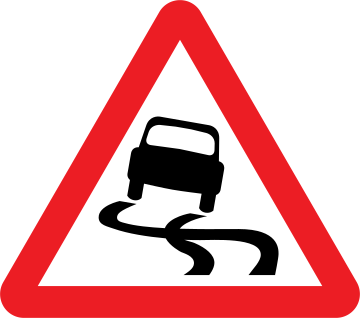
- Approach junctions earlier and slower, especially downhill or on shaded roads.
- Leave a much larger gap behind vehicles ahead.
- Brake gently and progressively rather than late and hard.
- Use dipped headlights in poor visibility, not just daytime running lights.
- Avoid sudden steering, acceleration or braking.
- Keep the windscreen clear throughout the drive, not just at the start.
The faults I see most often in bad weather tests
Bad weather does not usually create brand-new faults. It exposes the habits that were already there. A learner who normally follows a little too close follows dangerously close in spray. A learner who brakes late at roundabouts suddenly has no grip left. A learner who forgets the rear window heater spends half the test peering through a misted screen.
The fault that costs people most often is poor planning. Not one dramatic skid, but repeated small signs that the driver has not adjusted to the conditions: too fast on approach, too close to parked cars when slush is at the kerb, too quick into bends, or moving off with mirrors still fogged. Examiners mark what they see, and repeated driver faults in the same area can become serious if they show a pattern or create risk.
Here is the practical fault table I use when debriefing learners after winter mock tests.
- Following too close: usually marked under use of speed, judgement or following distance, and can become serious if you cannot stop safely.
- Late braking at junctions: shows poor planning and may become serious if you skid, overshoot or force another driver to react.
- Poor visibility through glass: can lead to a serious fault before or during the drive if you cannot observe properly.
- Wrong lights: no dipped headlights in fog or heavy spray, or fog lights left on when not needed, shows weak understanding of conditions.
- Harsh steering or acceleration: can unsettle the car and may show lack of control on ice or snow.
- Driving too slowly without reason: over-caution can also be a fault if you hold up traffic when conditions are safe enough to make normal progress.
Should you practise in snow or fog before your test?
Practising in poor weather can be valuable, but only at the right level and with the right supervision. I do not take a learner into snow for a first experience if they are still struggling with clutch control and normal junctions. I might, however, use a quiet, safe road in light snow to show how early braking, gentle steering and wider gaps feel in the real car.
Fog practice is often more about discipline than car control. Learners need to understand how quickly parked vehicles, cyclists and junctions appear, and why speed must match visibility. New drivers sometimes think the national speed limit sign means they should still aim for that speed. It does not. The speed limit is a maximum, not a target, and in poor visibility the safe speed may be far lower.
If your test is close and severe weather is forecast, speak to your instructor. Sometimes the best preparation is not a dramatic snow lesson, but a focused session on demisting, lights, smoother braking, anticipation, meeting traffic on narrow roads and planning earlier. These are the skills that help whether the test runs or is delayed.
- 1Practise demisting and clearing the car before you are under test-day pressure.
- 2Revise the Highway Code rules on lights, fog, ice and stopping distances.
- 3Drive in light poor weather only if your instructor or supervising driver agrees it is safe.
- 4Work on smooth controls: gentle acceleration, progressive braking and calm steering.
- 5Practise leaving bigger gaps and reading hazards earlier.
- 6Know how to cancel or check your DVSA test properly, but do not assume it will be cancelled.
Common questions
Will my driving test be cancelled if it is snowing?
Not automatically. If the snow is light and the roads on the test routes are safe, the test may still go ahead. If roads are icy, blocked, untreated or visibility is poor, DVSA or the examiner may cancel it.
How will I know if DVSA has cancelled my test because of weather?
Check the phone and email details linked to your booking, including junk folders. If there is snow or ice locally, GOV.UK advises using the test centre phone number on your booking confirmation to check. Do not rely on social media rumours or what happened at another test centre.
Can an examiner cancel the test after I arrive?
Yes. The examiner can cancel at the test centre if they decide the conditions are unsafe or the test cannot be conducted fairly. This can include an icy car park, unsafe local roads, very poor visibility or a car that has not been cleared properly.
Do I need to pay again if my driving test is cancelled due to ice?
If DVSA cancels the test because of bad weather, your test should be rearranged without another test fee. If you choose not to attend when the test centre is operating, you will normally lose your fee. Always check the current GOV.UK rules because fees and processes can change.
Can I use fog lights on my driving test?
Yes, if visibility is seriously reduced, generally when you cannot see for more than 100 metres, in line with the Highway Code. You must switch fog lights off when visibility improves. Using them at the wrong time can dazzle or confuse other road users.
Should I cancel my test myself if bad weather is forecast?
Usually, do not rush to cancel just because bad weather is forecast. Forecasts change, and DVSA may still run tests if local roads are safe. Speak to your instructor, check official messages and follow DVSA guidance for your test centre.
See our pass guarantee
Reading about it only gets you so far. Our instructors drill this with you in the car, on the roads around your test centre.