
The one way sign is a blue rectangular sign with a bold white arrow pointing in the direction traffic must travel, sometimes with the words 'one way' included underneath. It tells you that every vehicle on that stretch of road, in every lane, is travelling the same direction, which changes several assumptions you'd normally make about overtaking, lane positioning, and turning.
Because one-way systems are common in town centres and around complex junctions, the theory test uses this sign to check that you understand traffic can legally pass on either side of you, and that some usual rules about which side to overtake on don't apply in the same way.
What the sign legally means
One way means traffic is permitted to travel in one direction only along that stretch of road. Because every lane runs the same way, vehicles are legally allowed to overtake or move past you on either the left or the right, unlike a normal two-way road where overtaking on the left is generally discouraged.
This changes how you should interpret mirror checks and lane changes on a one-way street: you genuinely need to check both sides rather than assuming traffic will only appear from one particular direction relative to your lane.
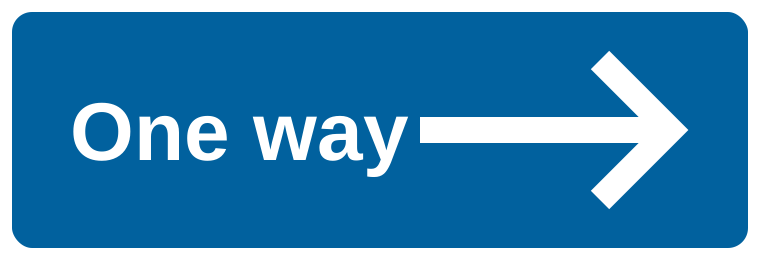
- Traffic moves in one direction only across all lanes of the road.
- Vehicles may legally overtake you on either side, not just the offside.
- Turning left or right from a one-way road follows the normal rules for that specific junction, based on markings and lane arrows.
Recognising the sign
The blue background with a large white directional arrow is part of the family of 'must comply' direction and instruction signs, all using blue backgrounds rather than the red-bordered prohibition or warning signs. It's usually mounted at the entrance to the one-way stretch and often repeated along its length.
Road markings reinforce the sign, typically with white directional arrows painted on the road surface itself at intervals, so even if you miss the sign on entry, the arrows on the tarmac should confirm the direction of travel.
What you do at the wheel
Choose your lane early based on where you plan to exit the one-way system, since some lanes may be restricted to particular turns only, shown by arrows painted on the road. Because vehicles can pass you on either side, check both mirrors and blind spots before changing lanes, rather than relying on habits formed on two-way roads.
When turning off a one-way road, follow the specific lane markings for that junction rather than assuming normal two-way turning rules, since a left-hand lane on a one-way road might be positioned quite differently than it would be approaching a standard junction.
How it comes up in the theory test
The theory test often asks what a solid blue rectangle with a white arrow means, and separately tests understanding of overtaking rules on one-way streets, since the fact that vehicles may pass on either side is a specific, examinable point that differs from general overtaking advice.
Hazard perception may use one-way street scenarios to test whether you're checking mirrors on both sides appropriately, since a developing hazard could reasonably approach from either flank in this specific road layout.
Common mistakes and mix-ups
A common theory test error is assuming general overtaking rules, such as always overtaking on the right, still apply on a one-way road, when in fact traffic legally passes on both sides. Learners sometimes also confuse the one-way sign with other directional arrow signs used for ahead-only lanes at ordinary junctions.
In practical driving, a frequent mistake is failing to check both mirrors before a lane change on a one-way road, out of habit from two-way driving where a check to one side is usually sufficient.
Test yourself on this one
Road and traffic signs is the biggest category in the question bank with 102 questions, and signs turn up inside other categories too. Work through them free, no sign-up needed.
Practise road sign questionsFrequently asked questions
Can vehicles overtake me on the left on a one-way street?
Yes. Because all lanes on a one-way road travel in the same direction, vehicles are legally permitted to pass on either side, not just the offside as on a normal two-way road.
How do I know which lane to use on a one-way system?
Look at the road markings, which show arrows indicating which lane leads to which exit or turn. Choose your lane in good time based on your intended direction rather than waiting until the last moment.
How is the one-way sign different from an ahead-only sign?
Both use a blue background with a white arrow, but the one-way sign is specifically placed at the entrance to a one-way road or street, while ahead-only signs apply to a particular lane or junction approach rather than an entire road.
Do I need to check mirrors differently on a one-way road?
Yes. Since vehicles can approach from either side when changing lanes, you should check both mirrors and blind spots rather than assuming traffic will only be in a predictable position as on a two-way road.