
The give way sign is a red-bordered, point-down triangle, sometimes shown with words underneath and almost always paired with a dashed white line or double dashed lines painted across the road. Unlike a stop sign, it doesn't force you to halt every time; it forces you to yield priority to traffic already on the road you're joining.
That distinction, between an absolute stop and a conditional one, is one of the most heavily tested pieces of sign knowledge in the whole theory syllabus, because it's also one of the most common junction types in the country. Most T-junctions and roundabout approaches you'll ever meet use a give way, not a stop.
What the sign and markings actually require
A give way sign, or the dashed give way line on its own, means you must let traffic on the road ahead pass before you emerge or join it. If the road is genuinely clear, you're allowed to continue without stopping completely, which is the key legal difference from a stop sign.
The Highway Code makes clear that giving way isn't just about not crashing into someone directly in front of you; it includes giving way to pedestrians already crossing the road you're turning into, and to cyclists who may be approaching faster than they appear.
- Slow down on approach and be ready to stop if needed.
- Give priority to traffic, pedestrians and cyclists on the road you're joining.
- Only proceed without stopping if you can see the way is genuinely clear.
Recognising the sign and its markings
The upside-down triangle shape is used across many European countries for the same purpose, and in the UK it's shown either as a standalone triangular sign with a red border, or simply as two dashed lines painted on the road surface without a physical sign at all on quieter junctions.
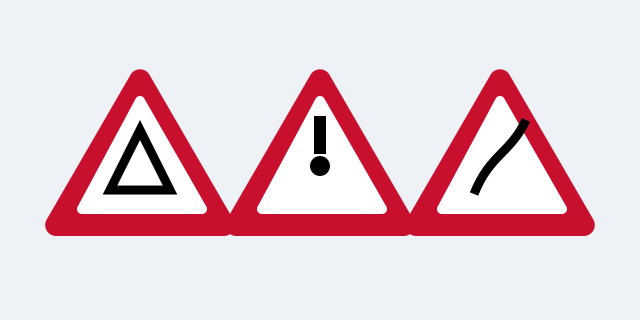
It's easy to confuse in a rush with a warning triangle, which points the same way but has a red border and a black symbol on white, used to warn of hazards ahead rather than assign priority. The give way triangle is usually plain, sometimes carrying the words 'give way' underneath on the sign version.
What you do at the wheel
Treat the approach the same way you'd approach any junction: cover the brake, drop your speed, and look properly before you decide whether stopping is necessary. If there's any doubt about gaps in traffic, speed of approaching vehicles, or restricted visibility, stop. A give way doesn't ban you from stopping, it simply doesn't demand it when the road is clear.
Pay particular attention to the double give way lines you'll find at some roundabout entries and box junctions, which apply the same rule but often catch drivers out because there's more than one thing to check at once, including traffic already going round the roundabout.
How it comes up in the theory test
Sign-recognition questions ask you to identify the give way symbol and distinguish it from stop and from warning triangles pointing the same direction. You'll also meet scenario questions describing a driver approaching a junction with a dashed line, testing whether you understand that stopping is conditional rather than compulsory.
In hazard perception clips, give way junctions are used to test whether you correctly predict that a vehicle emerging might not stop fully, since drivers sometimes misjudge gaps here. You need to react to the possibility of a vehicle pulling out even if it technically shouldn't.
Common mistakes and mix-ups
The classic wrong answer in the theory test confuses give way with stop, choosing 'must always stop' when the correct meaning is 'give priority to traffic on the main road'. The two dashed lines versus one solid line is another detail examiners like to test, since a single broken line at a roundabout has the same legal meaning as the triangle sign.
On the road, the real-world mistake is treating give way as always safe to roll through without properly assessing speed and distance, particularly at mini-roundabouts where approaching vehicles can be closer and faster than they first appear.
Test yourself on this one
Road and traffic signs is the biggest category in the question bank with 102 questions, and signs turn up inside other categories too. Work through them free, no sign-up needed.
Practise road sign questionsFrequently asked questions
Do I always have to stop at a give way sign?
No. You only need to stop if there's traffic, a pedestrian or a cyclist you need to give way to. If the road is clear you can proceed without stopping, which is the main difference from a stop sign.
What's the difference between a give way sign and a give way line?
They mean exactly the same thing legally. A dashed white line painted on the road is used on its own at simpler junctions, while the triangular sign is added where extra emphasis or advance warning is needed.
How is the give way triangle different from a hazard warning triangle?
The give way sign is a plain red-bordered triangle assigning priority, while a warning triangle contains a black symbol on white and warns of a specific hazard ahead. Both point downward, so the border and content are what tell them apart.
What must I give way to besides other vehicles?
Pedestrians already crossing the road you're entering and cyclists approaching on that road both have priority. This is a frequently tested point because learners tend to focus only on car traffic.