
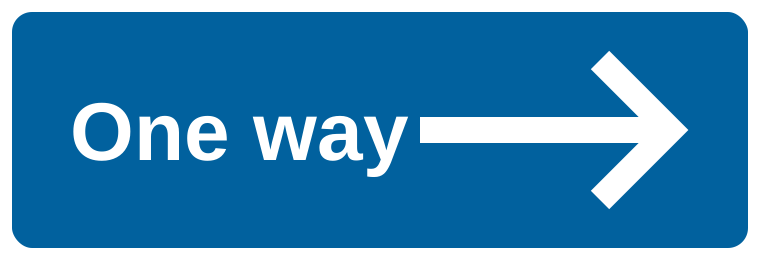
A rectangular blue sign containing a large white arrow pointing upward or sideways indicates a one-way street. All vehicular traffic on this road must proceed solely in the direction indicated by the arrow.
Understanding one-way street signs is essential for safe navigation in urban environments and for choosing the correct lane position when turning off or parking.
What this sign means
This sign informs drivers that traffic flows in a single direction along the road ahead. You will not encounter oncoming traffic unless a specific counter-flow lane exists for buses or cyclists.
It differs from a mandatory turn sign; the rectangular blue background signifies an informational and regulatory status regarding road structure rather than an immediate directional turn instruction at a junction.
What to do when you see it
When entering or driving on a one-way street, select the appropriate lane well before your desired turn.
Follow these key steps:
- Use the left-hand lane if you intend to turn left at an upcoming junction.
- Use the right-hand lane if you plan to turn right, moving right up to the right-hand kerb or boundary.
- Never perform a U-turn or reverse back along a one-way street unless directed by police.
How this sign is tested
Theory test questions often focus on positioning when turning right off a one-way street. Candidates are expected to know that you should position your vehicle in the right-hand lane right up to the junction line before making a right turn.
You may also be asked about reversing rules, confirming that reversing against the flow of traffic on a one-way street is strictly prohibited.
Common mistakes
A frequent error made by learner drivers is remaining in the left-hand lane when preparing to turn right at the end of a one-way street.
Another mistake is confusing the rectangular one-way arrow sign with the circular blue mandatory turn arrow sign.
Test yourself on this one
Road and traffic signs is the biggest category in the question bank with 102 questions, and signs turn up inside other categories too. Work through them free, no sign-up needed.
Practise road sign questionsFrequently asked questions
Can I turn right from the right lane in a one-way street?
Yes. In a one-way street, you should move to the right-hand lane when preparing to turn right.
Am I allowed to reverse into a parking space on a one-way street?
Yes, standard parking manoeuvres like parallel parking or reversing into a bay are allowed, but you cannot reverse for general travel against the traffic direction.
How does this sign differ from a blue circle with an arrow?
A blue circle commands you to turn in the direction shown at a specific junction, whereas the rectangular sign indicates you are on or entering a one-way street.