
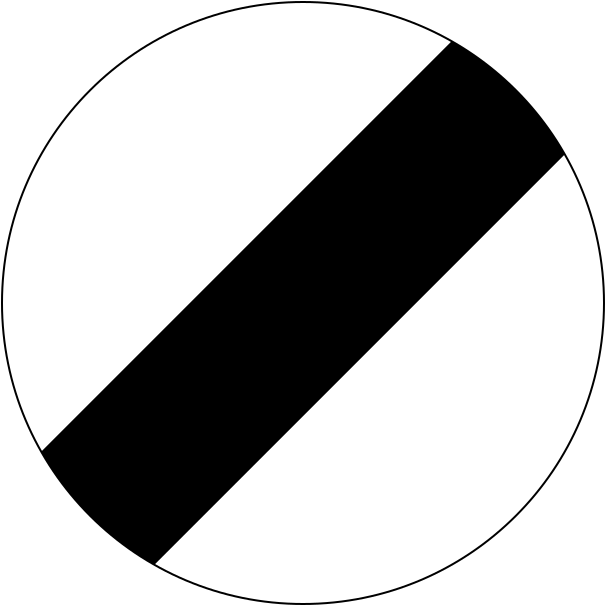
The national speed limit sign, a white circular sign with a single black diagonal band, doesn't actually tell you a number. That's exactly why it causes confusion: it's telling you that the default legal limit for the road you're on now applies, and that default depends on the type of road and the type of vehicle you're driving.
For a car or motorcycle, it means 60 mph on a single carriageway and 70 mph on a dual carriageway or motorway. For larger vehicles, towing, or certain other vehicle classes, the numbers are lower, which is a detail the theory test likes to probe.
What the sign legally means
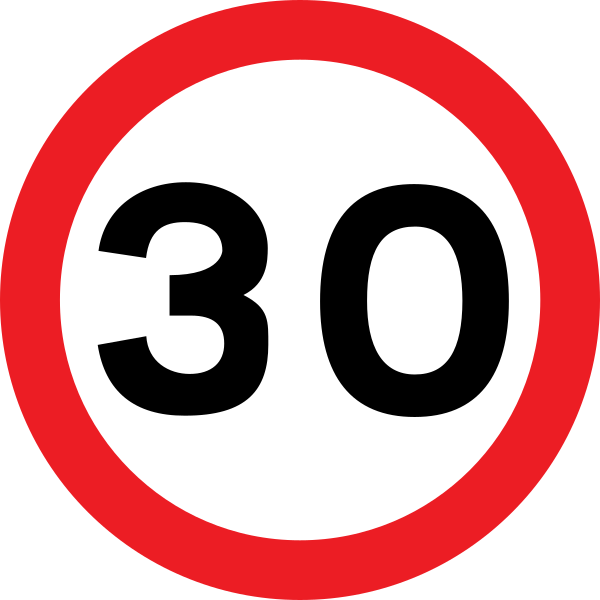
This sign cancels any previous specific limit and tells you the national limit for that class of road now applies. It's most often seen leaving a village or town, where the 30 mph limit ends and the road reverts to the appropriate national limit for its layout.
The key legal point is that 'national speed limit' is not one fixed number. On a single carriageway it's 60 mph for cars and motorcycles, and on a dual carriageway or motorway it rises to 70 mph. Drivers towing a caravan or trailer, or driving larger vehicles, have lower limits applied even under this same sign.
- Single carriageway: 60 mph for cars and motorcycles.
- Dual carriageway or motorway: 70 mph for cars and motorcycles.
- Lower limits apply automatically for vehicles towing or for larger classes such as buses and HGVs, even though the sign looks identical.
Recognising the sign
It's a plain white circle with a single black diagonal stripe running from the top left to the bottom right, with no numbers at all. This makes it visually distinct from every numbered speed limit sign, which shows a black number on a white circle with a red border.
Because it carries no number, drivers sometimes assume it means no limit at all, especially newer drivers glancing quickly. It's worth remembering that a blank-looking circular sign with a diagonal bar is never 'no limit', it's always a specific number depending on the road.
What you actually do at the wheel
The moment you see this sign, you need to instantly assess the road type, not just glance at the sign and assume top speed is fine. A narrow, winding single carriageway with a 60 mph national limit rarely means it's safe or sensible to drive at 60; the limit is a ceiling, not a target.
If you're towing or driving a vehicle with a different national limit than a standard car, you need to know your own vehicle's limit rather than relying on general road signs, since the sign doesn't change to reflect what you're driving.
How it comes up in the theory test
The theory test frequently asks what the national speed limit is for cars on a dual carriageway versus a single carriageway, and expects you to know both numbers rather than one generic figure. Questions also test recognising the sign itself among a set of similar circular signs.
Hazard perception uses this sign at the exit from villages to signal that traffic may now be travelling faster, which is relevant to how you judge closing speed when planning an overtake or reacting to a hazard ahead.
Common mistakes and mix-ups
The most frequent theory test error is quoting a single number for the national speed limit rather than distinguishing single carriageway from dual carriageway and motorway. Some learners also wrongly believe the sign means the road is unrestricted, when it simply defers to a default figure.
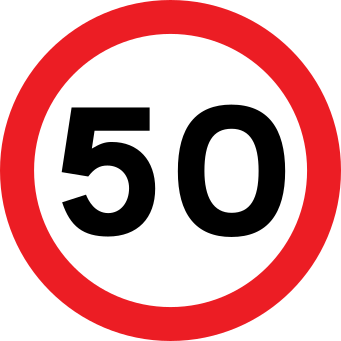
Drivers newly qualified sometimes forget that towing changes their applicable limit under this same sign, continuing at 60 mph on a single carriageway when 50 mph applies to a car towing a trailer.
Test yourself on this one
Road and traffic signs is the biggest category in the question bank with 102 questions, and signs turn up inside other categories too. Work through them free, no sign-up needed.
Practise road sign questionsFrequently asked questions
What speed can I actually drive at under a national speed limit sign?
For a car, that's 60 mph on a single carriageway road and 70 mph on a dual carriageway or motorway. The exact figure depends entirely on the road type, not the sign, which stays the same regardless.
Does the national speed limit sign mean there's no limit at all?
No. It means the default limit for that road and vehicle type applies, it never means unrestricted driving. This is one of the most common misunderstandings learners have.
Is the national speed limit different if I'm towing a trailer?
Yes. Cars towing a caravan or trailer are limited to 50 mph on a single carriageway and 60 mph on a dual carriageway or motorway, even though the sign displayed is identical.
Where will I typically see this sign?
Most commonly at the edge of a village or town, cancelling a lower limit like 30 mph as you leave the built-up area. It also appears after temporary limits, such as roadworks, have ended.