
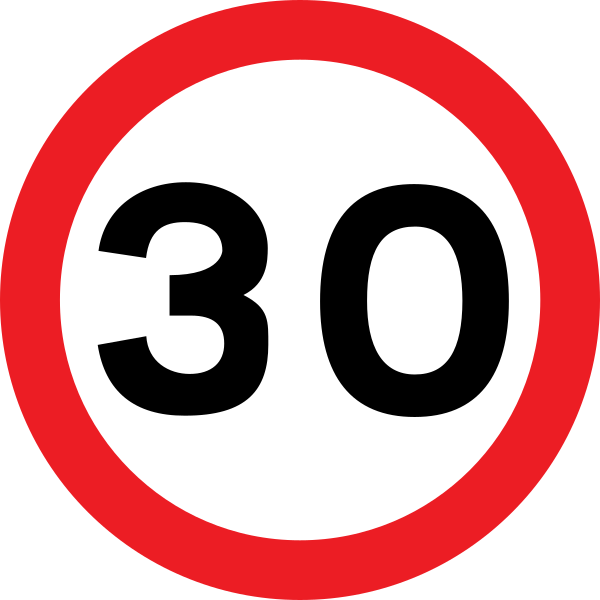
The 30 mph speed limit sign is a white circle with a red border and the number 30 in black, and it's the default limit you'll meet most often as a driver, since it applies automatically on any road with street lighting unless signs say otherwise.
That last point is the one the theory test really wants you to know: you don't always need to see a physical 30 sign to know a 30 mph limit applies. Regularly spaced street lights are, in law, treated as an indicator of a 30 mph limit unless a different limit is specifically signed.
What the sign and rule legally mean
Where you see a 30 sign, the maximum speed permitted is 30 mph, and it's a legal limit, not a recommendation. Beyond the physical signs, the Highway Code explains that a road with street lighting is generally subject to a 30 mph limit unless signs indicate a different one, which is why you don't always see repeater signs along every stretch of a 30 zone.
This means judgement is needed on unfamiliar roads: if you're driving past regularly spaced street lights and haven't seen a sign suggesting otherwise, the safe legal assumption is 30 mph, not whatever speed feels comfortable for the road's width or straightness.
- 30 mph is a legal maximum, enforceable the same way as any other speed limit.
- Street lighting at regular intervals generally implies a 30 mph limit even without a repeated sign.
- A change of limit is always shown with a sign, so absence of a lower-limit sign after lighting begins usually means 30 applies.
Recognising the sign
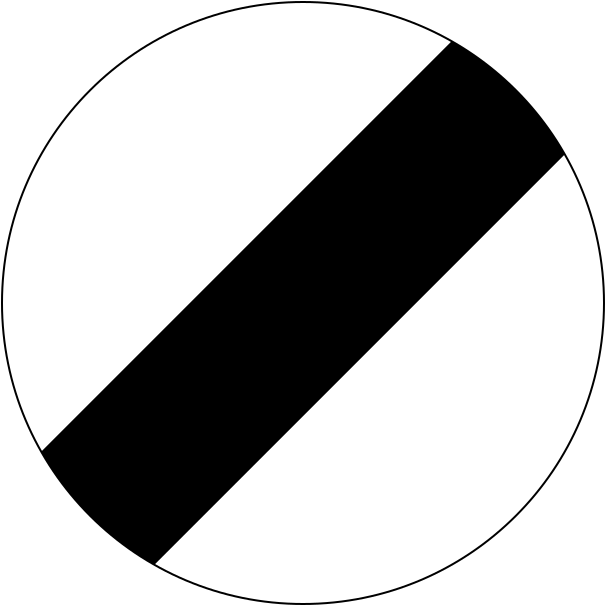
It follows the standard format for all numbered speed limits: white circle, red border, black number, no diagonal bar. This is instantly different from the national speed limit sign, which has no number at all, just a black diagonal stripe.
You'll usually see it on entry to a village, town, or built-up area, sometimes alongside other village entry signs, and it's often repeated periodically along a long stretch of 30 mph road as a reminder, particularly after a junction.
What you do at the wheel
Treat 30 mph as the ceiling, not the target speed for every 30 zone. Many 30 mph roads, particularly ones lined with parked cars, pedestrians, or side roads, require a lower actual speed for safety even though the legal limit permits 30.
On unlit rural roads where you see a 30 sign specifically posted, apply the same rule: it's the legal limit for that stretch regardless of how open or empty the road looks, and speed cameras or average speed checks are commonly placed on exactly these transitions.
How it comes up in the theory test
Direct recognition questions ask you to identify the 30 sign among a set of numbered speed limit signs, but the more testing questions ask what speed limit applies on a road with street lighting and no speed limit signs visible, expecting the answer 30 mph.
Hazard perception uses 30 mph zones, often with pedestrians and parked vehicles, to test whether you moderate your speed appropriately for the environment rather than simply driving up to the legal limit regardless of hazards present.
Common mistakes and mix-ups
Learners often assume a speed limit sign is always physically present wherever a limit changes, missing the rule that street lighting alone can imply 30 mph. This is a frequently tested and frequently missed point in mock exams.
Another common error is treating 30 mph as safe to drive at all times within the zone, when the theory test and Highway Code both emphasise adjusting speed downward for conditions such as pedestrians, parked cars, or poor visibility, even within a legal limit.
Test yourself on this one
Road and traffic signs is the biggest category in the question bank with 102 questions, and signs turn up inside other categories too. Work through them free, no sign-up needed.
Practise road sign questionsFrequently asked questions
Do I always need to see a sign to know a 30 mph limit applies?
No. A road with regularly spaced street lighting is generally subject to a 30 mph limit even without a posted sign, unless a different limit is specifically signed. This is a commonly tested theory test point.
Is 30 mph always the appropriate speed to drive at in a 30 zone?
No, it's the legal maximum, not a target. Around pedestrians, parked cars, schools or poor visibility, a lower speed is often necessary even though 30 mph is permitted.
How do I tell a 30 sign apart from the national speed limit sign?
The 30 sign is a white circle with a red border and a black number 30, while the national speed limit sign has no number at all and shows only a black diagonal stripe.
Where does a 30 mph limit typically start and end?
It usually begins at village or town boundary signs and ends where a different sign, often the national speed limit sign, is displayed as you leave the built-up area.