
The stop sign is deliberately the odd one out on British roads. Every other regulatory sign is round, but stop is an octagon, red with white letters and a white border, so that even from behind, or through fog, or with the face obscured by mud or a badly parked van, you can still recognise the shape and know what it demands.
It's placed at junctions the Highway Code and local authorities consider too dangerous for a simple give way, usually because visibility is poor in one or both directions. There's a solid white STOP line painted across the road to go with it, and the two work together: the sign tells you the rule, the line tells you exactly where you must stop.
What the sign legally requires
A stop sign means you must bring the vehicle to a complete halt, with the wheels stationary, at the stop line. It isn't a suggestion and it isn't satisfied by slowing right down to walking pace while still creeping forward. The Highway Code is explicit that you must stop, whether or not you can see traffic approaching, and only move off when it's safe to do so.
This is different from a give way, which only requires you to stop if there's traffic to give way to. At a stop sign, the requirement to halt applies every single time, regardless of how empty the junction looks. That's the entire point of the sign: the layout of the junction has been judged unsafe enough that a rolling glance isn't considered adequate.
- Come to a complete stop at the white stop line, not just near it.
- Stop even if the road looks completely clear in both directions.
- Only proceed when you can see it's safe, using the full width of the junction to check.
Recognising the shape and colour
The octagon is unique in UK signage precisely so it can be read from unusual angles. Red backgrounds are reserved for signs that prohibit or command, so red plus a unique shape is a deliberate double signal that this is not one to misjudge in bad light or when a sign is partially hidden by hedges.
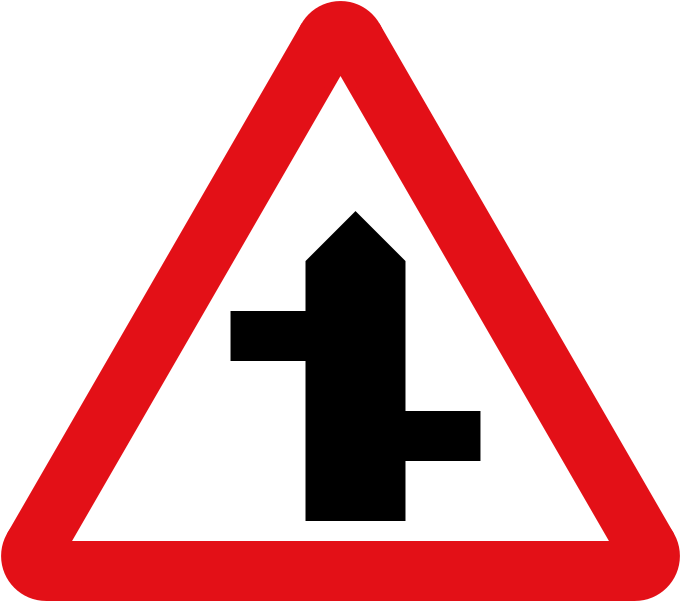
You'll sometimes see a smaller stop sign used temporarily, for example held by a road worker, or a stop sign combined with a give way further along the same road at a staggered junction. The shape stays constant even when the size or context changes, which is exactly why the DVSA expects you to know it cold.
What you actually do behind the wheel
Approach at a controlled speed, select an appropriate gear, and come to rest with the vehicle stationary at the line, not the sign itself, which may be set back or off to one side. From a full stop you then need a proper look, moving your head, not just your eyes, because the whole reason a stop junction exists is usually restricted visibility.
Don't creep forward while still checking; get the full stop first, then edge out if you genuinely can't see. Handbrake use isn't compulsory but it's often sensible on an incline so you're not relying on the clutch biting point while you're trying to look both ways.
How it comes up in the theory test
Multiple-choice questions typically show the sign and ask what it means or what a driver must do, and the correct answer is always framed around a compulsory, complete stop rather than caution or giving way. Examiners also test the shape recognition itself, asking why the sign is octagonal rather than round or triangular.
In hazard perception, a stop-controlled junction is used to see whether you anticipate that another driver is obliged to stop, so you shouldn't assume they will pull out just because there's a gap. Clips sometimes show a vehicle failing to stop properly, which is exactly the real-world error the sign is designed to prevent.
Common mistakes and mix-ups
The most common theory test error is confusing stop with give way, particularly picking an answer that says 'stop only if necessary'. That answer describes a give way triangle, not the octagon. Learners also sometimes assume a stop sign only applies to major junctions, when in practice they're used wherever visibility is genuinely restricted, including some minor rural junctions.
On the road, the real mistake examiners and instructors see most is the 'rolling stop', where a driver slows to a crawl but never actually stops. This fails a driving test outright and is treated as a serious safety point precisely because the sign exists for junctions where a proper look is essential.
Test yourself on this one
Road and traffic signs is the biggest category in the question bank with 102 questions, and signs turn up inside other categories too. Work through them free, no sign-up needed.
Practise road sign questionsFrequently asked questions
Do I have to stop at a stop sign even if the road is empty?
Yes. The stop sign requires a complete stop every time, regardless of what you can see. This is different from a give way sign, which only requires stopping if there's traffic to give way to.
Why is the stop sign octagonal instead of round or triangular?
The unique eight-sided shape means it can be recognised from behind, at odd angles, or when partly obscured, unlike other signs which rely on colour and symbol being fully visible. It's the only sign in the UK given this shape.
Where exactly do I need to stop?
At the solid white stop line painted across the road, not level with the sign post itself, which is often set back from the line. If there's no line, stop at the junction with the major road.
Does a rolling stop count as stopping?
No. Slowing to a crawl without the wheels becoming fully stationary does not satisfy the sign and is marked as a fault on the driving test. Examiners are specifically trained to watch for this at stop-controlled junctions.