
The short version
- You must not hold and use a phone while driving, including when stopped in traffic.
- The standard penalty is £200 and 6 penalty points, according to GOV.UK.
- Learner drivers and supervising drivers can both be penalised.
- Hands-free is only legal if you stay in proper control and do not hold the device.
- On test, touching or being distracted by a phone can easily become a serious fault.
Using a phone at the wheel: what the law says
If you are a learner or newly qualified driver, the short answer is this: do not hold your phone while driving, and do not interact with it unless you are safely parked. The law in Great Britain makes it an offence to use a hand-held mobile phone, or similar interactive communication device, while driving. This includes learners on lessons, private practice and the driving test.
The offence sits in the Road Vehicles (Construction and Use) Regulations 1986, regulation 110, as amended. The Highway Code also makes the position clear in Rule 149: you must exercise proper control of your vehicle at all times and must not use a hand-held mobile phone or similar device when driving, except to call 999 or 112 in a genuine emergency where it is unsafe or impractical to stop.
In instructor terms, I teach pupils to treat the driver’s seat as a no-phone zone. If the phone is in your hand and you are driving, you are putting yourself at risk of prosecution, points and a possible test fail. “I was only checking the time” or “I was just moving it” is not a safe defence to rely on at the roadside.
This article is general guidance, not legal advice. If you are facing a prosecution or have received a notice, you should get advice from a qualified legal professional or speak to the relevant authority.
What counts as “using” a phone while driving?
A common misunderstanding is that the law only covers texting or making calls. That used to be how many drivers thought about it, but the law was tightened in 2022 to cover a much wider range of hand-held use. In practical terms, if you are holding the phone and doing something with it, assume you are breaking the law.
I see learners get caught out by “quick” actions. They pick the phone up from the centre console to reject a call, tap the screen to stop music, check a notification at traffic lights, or unlock it to see who has messaged. Those are exactly the tiny habits that police officers and examiners notice, because your eyes and hands leave the driving task.
The device does not have to be a traditional mobile phone. The rules can apply to similar devices capable of interactive communication, such as tablets. A phone is also treated as hand-held if it is held at any point during the use, so balancing it on your lap or picking it up for one tap is still the wrong side of safe driving practice.
- Making or answering a call while holding the phone.
- Reading, writing or sending a text or message.
- Taking photos or videos, including at a crash scene.
- Scrolling music, social media, maps or notifications.
- Checking the time, unlocking the screen or rejecting a call while holding it.
Does it still count at traffic lights or in a queue?
Yes, it can. This is one of the biggest surprises for learners. If you are stopped at red lights, waiting at a level crossing, sitting in a queue or held in traffic with the engine running, you are still driving for this purpose. Stop-start technology does not magically turn a traffic queue into a parking space.
On lessons, I sometimes see a pupil relax at a long red light and glance down towards the cup holder where the phone is buzzing. That moment matters. You still need to watch the lights, pedestrians, cyclists, motorcyclists filtering through, and the position of the vehicle ahead. Looking down at a screen is enough to miss the change in traffic or roll forward by mistake.
If you need to use the phone, pull up somewhere safe and legal first. That means not on zig-zags, not on double yellow lines unless loading or other rules allow it, not blocking a driveway, not in a bus stop, and not on the motorway hard shoulder unless it is a genuine emergency. Put the vehicle into a secure parked state before you touch the phone.
- 1Find a safe and legal place to stop, such as a suitable parking bay or quiet side road.
- 2Check mirrors and signal if needed before pulling in.
- 3Stop close to the kerb where appropriate and secure the car with the handbrake or parking brake.
- 4Select neutral in a manual car, or park in an automatic, and switch the engine off if you are stopping to use the phone.
- 5Use the phone only once you are safely parked and not causing danger or obstruction.
- 6Before moving away, put the phone away, check mirrors and blind spots, then rejoin safely.
Penalties for learners, new drivers and supervisors
According to GOV.UK, the standard penalty for using a hand-held mobile phone while driving is a £200 fixed penalty and 6 penalty points. Published penalties and fees can change, so always check the latest GOV.UK information if you need the current position. If the matter goes to court, GOV.UK says you can be banned from driving or riding and receive a maximum fine of £1,000, or £2,500 if you are driving a lorry or bus.
For a learner, those points go on your provisional licence. Passing your test does not wipe them clean. Points on a provisional licence can carry over to your full licence, which is why I warn pupils that a phone offence before the test can still damage their first years of driving.
For new drivers, the risk is even sharper. Under the Road Traffic (New Drivers) Act 1995, a licence can be revoked if a driver reaches 6 or more penalty points within the first two years after passing their first driving test. In practice, one hand-held phone offence after passing can be enough to trigger revocation, meaning you have to apply again and pass both theory and practical tests again.
Supervising drivers must also take this seriously. If you are supervising a learner, you are not a passenger in the ordinary sense. The mobile phone rules apply to a person supervising a provisional licence holder, so a parent or friend sat beside a learner can commit an offence by using a hand-held phone while supervising.
- Learner driver: points can be put on the provisional licence.
- New driver: 6 points within the first two years can lead to licence revocation.
- Supervising driver: hand-held phone use while supervising can be an offence.
- Court outcome: possible higher fine or disqualification, depending on the case.
- Insurance: convictions and points can affect what you pay, although prices vary by insurer.
Hands-free, Bluetooth and mounted phones
Hands-free use is not automatically illegal, provided you do not hold the device while driving. You may use Bluetooth, voice control, a dashboard mount or an integrated car system, but only if you remain in proper control. The Highway Code warns that hands-free equipment can still distract you, and police can stop you if they believe you are not in control.
This is where learners often misjudge it. A phone in a cradle is better than a phone in your hand, but it is not a licence to start tapping through menus. If your steering drifts, your speed creeps up, you miss a mirror check or you react late because you are dealing with the screen, the problem is still your driving. You could be dealt with for not being in proper control or careless driving, depending on what happens.
From a teaching point of view, I prefer learners to set everything before the car moves. Pair the phone, set the route, choose the playlist and put the device on Do Not Disturb. Once you are moving, your job is observation, control, anticipation and decision-making. The phone should not be part of that workload.
- Legal does not always mean safe.
- Do not hold the phone at any point while driving.
- Set music, calls and navigation before you move off.
- Use voice prompts rather than looking at the screen.
- If a call becomes distracting or emotional, end it or pull over safely.
Using a phone as a sat nav
You can use a phone as a sat nav if it is properly mounted and you are not holding it while driving. It must not block your view of the road, mirrors or traffic. Highway Code Rule 150 tells drivers to avoid distractions such as trying to read maps, inserting media or making adjustments while driving, and the same principle applies to sat nav screens.
On lessons, the usual fault is not the mount itself, it is the fiddling. A learner misses a lane sign because they are trying to zoom the map. They drift towards parked cars while checking the next turn. They slow suddenly because the screen instruction surprises them. The examiner will not mark “phone use” as a separate category on the driving test sheet, but they will mark the driving fault it causes, such as control, response to signs, lane discipline, mirrors or planning.
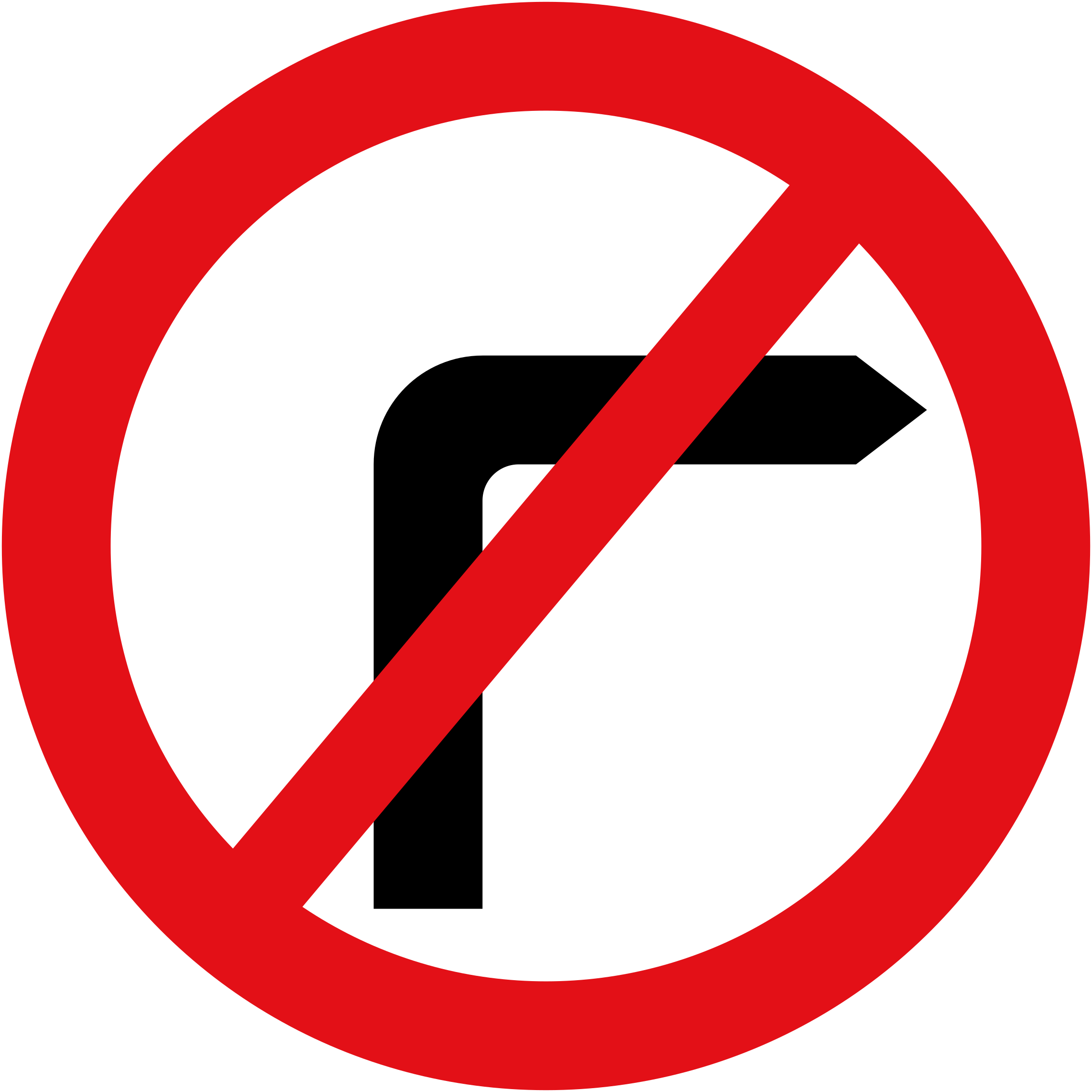
If the route is wrong, keep driving safely and correct it legally when you can. A sat nav instruction is never more important than road markings, signs, traffic lights or a police officer’s signal. If it says turn right and a sign says no right turn, you follow the sign.
- 1Fit the mount before you drive and check it is secure.
- 2Place it low enough not to obstruct your view, but high enough to glance at safely.
- 3Enter the destination before moving off.
- 4Turn on voice guidance so you are not relying on the screen.
- 5Do not type, zoom or search while driving.
- 6If you need to change the route, stop safely and legally first.
What happens on the driving test?
On a practical driving test, using a hand-held phone is about as bad an idea as it gets. If you pick up or operate a phone while driving, you are risking a serious fault, a dangerous fault and a breach of the law. The examiner’s priority is safety and legality, not giving you the benefit of the doubt because it was only for a second.
Your phone should be switched off, on silent or on Do Not Disturb before the test starts. If it rings during the test, leave it alone. If the noise is genuinely causing a distraction, the safest response is to say to the examiner that the phone is distracting you and ask whether you may pull up safely to deal with it. Do not reach for it while the car is moving.
Remember that examiners mark the effect on the drive. If a notification makes you miss a mirror check before changing lanes, that is a mirror fault. If you hesitate badly because you are thinking about a call, that may become undue hesitation. If you brake late because your attention went to the phone, it could become serious or dangerous.
- Phone rings and you ignore it: usually no issue if your driving stays safe.
- You glance down and drift: likely marked under control or road position.
- You miss a signal, sign or hazard: can become a serious observation or response fault.
- You hold or operate the phone: expect a very serious outcome and possible legal consequences.
- Your mounted sat nav distracts you: the examiner marks the driving fault it causes.
A simple no-phone driving routine
The safest habit is boring and consistent: sort the phone before the journey, then forget it exists. This is especially important for new drivers because you do not yet have spare mental capacity. You are still building judgement around speed, space, junctions, pedestrians, cyclists and other drivers’ mistakes.
I tell learners to build a cockpit drill that includes the phone, just like mirrors, seat, seatbelt and head restraint. If the phone is loose on the passenger seat or in your lap, it will become a temptation or a missile under braking. If it is in a bag, glovebox or secure cradle with Do Not Disturb active, you are far less likely to make a stupid one-second decision.
If you are driving with friends, set the expectation before you move off. Ask them to handle music or messages only if it does not distract you, or simply say the phone stays away. Confident drivers are not the ones who multitask, they are the ones who protect their attention.
- Before moving off: phone on silent, Do Not Disturb or switched off.
- Navigation: destination set and voice guidance on before the car moves.
- Storage: phone secured in a bag, glovebox or fixed mount, never on your lap.
- Calls: let them go to voicemail unless you are safely parked.
- Passengers: ask them not to show you screens or read distracting messages.
- Emergency: only call 999 or 112 while driving if it is a genuine emergency and stopping is unsafe or impractical.
Common questions
Can a learner driver use a phone at traffic lights?
No, not if they are holding and using it. Being stopped at red lights or in a traffic queue still counts as driving for mobile phone purposes. Wait until you are safely and legally parked before touching the phone.
Can my supervising driver use their phone while I drive?
They must not use a hand-held phone while supervising you. The rules apply to someone supervising a provisional licence holder, because they need to be able to watch, advise and take appropriate action. They can receive points and a fine if they break the law.
Is it legal to use my phone as a sat nav as a learner?
Yes, if it is fixed in a suitable mount, does not block your view and is set before you drive. Do not hold it, type into it or adjust it while moving. If you need to change the route, pull over safely and legally first.
Will 6 points for using a phone make a new driver lose their licence?
It can. Under the New Drivers Act, reaching 6 or more penalty points within two years of passing your first driving test can lead to your licence being revoked. One hand-held mobile phone offence carries 6 points according to GOV.UK, so it is a major risk for new drivers.
Can I touch my phone if it is in a cradle?
You should avoid touching it while driving. A mounted phone is not hand-held, but if tapping or adjusting it affects your control, observation or attention, you can still be stopped or marked on test for the driving fault it causes. Set it up before the journey.
What if I need to call 999 while driving?
The law includes an emergency exception for calling 999 or 112 where it is unsafe or impractical to stop. That does not cover ordinary calls, messages or non-urgent problems. If you can stop safely, stop first.
Browse driving lessons
Reading about it only gets you so far. Our instructors drill this with you in the car, on the roads around your test centre.