
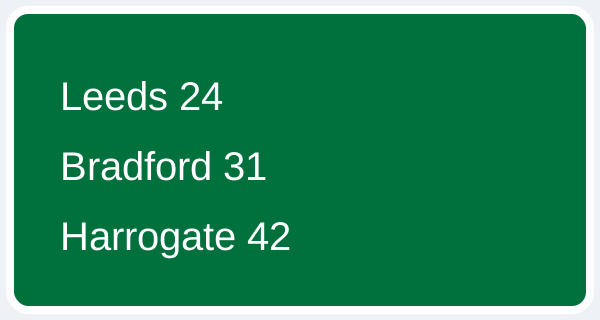
Just after a major junction you will often see a sign listing destinations with distances in miles. This is a route confirmatory sign, and its job is to reassure you that you took the right exit.
It also gives route numbers so you can confirm which road you are on.
What this sign means
You are on the road shown, and the listed places lie ahead at the distances given in miles.
Destinations are listed in order of distance, nearest first.
What to do when you see it
Glance at it to confirm your route, then return your attention to the road.
- Check the road number matches your intended route.
- Use the mileage to plan fuel and rest stops.
- If the destinations are wrong, find a safe place to turn round.
- Do not slow abruptly to read the whole sign.
How this sign is tested
Questions ask what the sign confirms and whether distances are in miles or kilometres. In Britain they are in miles.
It is also used to test the difference between advance and confirmatory signing.
Common mistakes
Assuming the distances are kilometres, which they are not on British roads.
Reading the sign as a set of turnings rather than as places straight ahead.
Test yourself on this one
Road and traffic signs is the biggest category in the question bank with 102 questions, and signs turn up inside other categories too. Work through them free, no sign-up needed.
Practise road sign questionsFrequently asked questions
Are the distances in miles or kilometres?
Miles. British direction signs use imperial distances.
Where are confirmatory signs placed?
Shortly after a major junction on the route you have joined.
Why is the nearest place listed first?
Signs list destinations in increasing order of distance so the layout is predictable.