
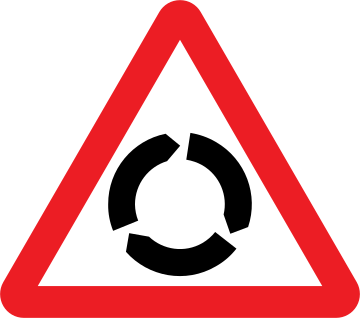
The roundabout ahead sign is a red-bordered triangle containing three curved black arrows arranged in a circular pattern, warning that a roundabout junction is coming up. Like all warning triangles, it's advance notice rather than an instruction, giving you time to plan your approach, lane position and speed before you reach the roundabout itself.
Roundabouts are one of the more heavily tested junction types in the theory syllabus because they combine several separate skills at once, lane positioning, signalling, observation, and give way rules, and this sign is the first prompt that all of them are about to be needed together.
What the sign means and what follows
This sign simply warns that a roundabout lies ahead; the give way rule itself comes from the dashed give way line and, in some cases, a give way sign at the roundabout entry. The Highway Code advises using the road ahead as your guide to plan your position early, choosing your lane based on which exit you intend to take.
At most roundabouts you'll also see advance direction signs shortly before or alongside this warning triangle, showing exit numbers or destinations, which help you decide your lane position well before arriving at the give way line rather than making a last-second decision.
- The triangle warns that a roundabout is ahead; it doesn't itself instruct you to stop or give way.
- Priority at the roundabout is set by the give way line and markings at the entry.
- Advance direction signs near this warning help you choose your lane in good time.
Recognising the sign
The three curved arrows chasing each other in a circle are a clear visual match for the roundabout's actual traffic flow, making the symbol easy to identify even at a glance. It follows the standard warning triangle format shared with all other advance hazard signs.
It's occasionally combined with a plate below showing the distance to the roundabout, particularly on faster roads such as dual carriageways, where extra warning distance is needed for drivers travelling at higher speed to plan safely.
What you do at the wheel
On seeing the sign, start planning: identify which exit you need, choose your lane accordingly, and check your mirrors before signalling appropriately, generally left if taking the first exit, no signal if going straight ahead until you pass the exit before yours, and right if taking a later exit or going full circle.
As you approach the give way line, look right to check for traffic already on the roundabout, since traffic already circulating has priority over vehicles entering, and you should only proceed when there's a safe gap, adjusting your speed well before the line rather than braking sharply at the last moment.
How it comes up in the theory test
Recognition questions ask you to identify the roundabout ahead triangle among other warning signs, and scenario questions test whether you understand that traffic on the roundabout has priority over traffic entering it. Lane discipline and signalling rules for roundabouts are also commonly tested as separate questions linked to the same topic.
Hazard perception clips often use roundabout approaches to test whether you correctly anticipate traffic crossing from the right, since a common developing hazard is misjudging a gap or another driver failing to signal correctly as they exit.
Common mistakes and mix-ups
A frequent theory test mistake is assuming the warning triangle itself grants or removes priority, when priority is actually determined at the roundabout entry by the give way markings, not by this advance sign. Learners sometimes also confuse the roundabout ahead symbol with signs for other circular road features.
In practical driving, the common error is leaving lane and signal decisions too late, arriving at the roundabout still deciding which exit to take rather than having already positioned the car correctly after seeing the advance warning sign and any direction signs.
Test yourself on this one
Road and traffic signs is the biggest category in the question bank with 102 questions, and signs turn up inside other categories too. Work through them free, no sign-up needed.
Practise road sign questionsFrequently asked questions
Does the roundabout ahead sign tell me to give way immediately?
No, it's an advance warning that a roundabout is coming up, giving you time to plan your lane and speed. The actual give way requirement comes from the markings and, where fitted, the sign at the roundabout entry itself.
Who has priority on a roundabout?
Traffic already on the roundabout, generally approaching from your right, has priority over vehicles entering it. You should only join when you can see a safe gap in that traffic.
How should I decide which lane to use approaching a roundabout?
Use advance direction signs and road markings to identify your exit early, then choose your lane in good time based on that exit, rather than waiting until you're at the roundabout itself to decide.
What signals should I use going around a roundabout?
Generally signal left for the first exit, no signal until passing the exit before yours if going straight ahead, and signal right if taking a later exit, adjusting to signal left once you're ready to leave at your chosen exit.