
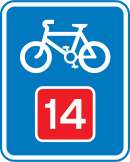
The National Cycle Network is a signed network of long distance cycle routes across the United Kingdom. Its signs carry a small red panel with the route number.
Routes use a mix of quiet lanes, traffic-free paths and shared-use pavements, so drivers meet them regularly on rural roads.
What this sign means
The numbered route continues in the direction of the arrow. A blue background indicates a traffic-free section on some signs.
For drivers, it signals a road that carries a concentrated flow of cyclists.
What to do when you see it
Expect groups of riders and plan overtakes carefully.
- Anticipate riders two abreast on narrow lanes.
- Wait for a clear straight before overtaking.
- Leave at least 1.5 metres when passing.
- Slow down at path crossings on the route.
How this sign is tested
Cycle route signing appears in the road and traffic signs category and in vulnerable road user questions about safe passing distance.
Common mistakes
Squeezing past a group of cyclists on a narrow signed route.
Assuming a numbered cycle route is entirely traffic free.
Test yourself on this one
Road and traffic signs is the biggest category in the question bank with 102 questions, and signs turn up inside other categories too. Work through them free, no sign-up needed.
Practise road sign questionsFrequently asked questions
What does the red number mean?
It is the National Cycle Network route number.
Are these routes traffic free?
Partly. Many sections share ordinary roads.
How much room should I give?
At least 1.5 metres at lower speeds, and more at higher speeds.