
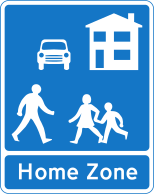
A home zone is a residential street designed so that people, children and vehicles share the same space. The entry sign shows a street scene with people and a car together.
The layout usually has no conventional kerb line, so the whole surface reads as shared space.
What this sign means
Pedestrians have priority over the whole width of the street and may use any part of it, including for play where the local order allows.
Drivers are expected to move at little more than walking pace.
What to do when you see it
Slow right down and expect people anywhere on the surface.
- Drive at walking pace throughout the zone.
- Give way to pedestrians, including children playing.
- Park only in the marked bays provided.
- Watch for reversing and manoeuvring in the shared surface.
How this sign is tested
Questions ask who has priority in a home zone and what speed is appropriate.
It is also used to test recognition of shared space design.
Common mistakes
Driving at the general 20 mph limit rather than at walking pace.
Parking outside the marked bays and blocking the shared surface.
Test yourself on this one
Road and traffic signs is the biggest category in the question bank with 102 questions, and signs turn up inside other categories too. Work through them free, no sign-up needed.
Practise road sign questionsFrequently asked questions
Who has priority in a home zone?
Pedestrians. Drivers must give way across the full width of the street.
Is there a speed limit sign?
There may be a 20 mph limit, but drivers are expected to travel far slower than that.
Can I park anywhere in a home zone?
No. Park only in the bays provided.