
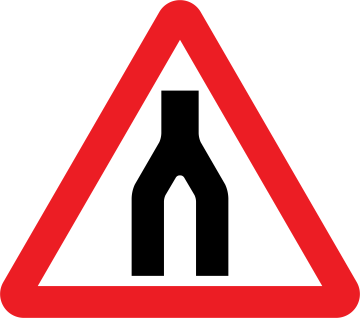
This sign warns drivers that the physical central reservation separating opposing flows of traffic is coming to an end. The road ahead transitions into a standard single carriageway road.
Recognising this sign early allows drivers to adjust speed, complete overtaking manoeuvres safely, and prepare for oncoming traffic in close proximity.
What this sign means
The sign displays two opposing vertical arrows converging around a narrowed central block, symbolising the end of the divided roadway.
It warns that opposing traffic will no longer be separated by a physical barrier, grass verge, or central reservation ahead.
What to do when you see it
Prepare to adjust your driving style for single carriageway conditions as you approach the end of the dual carriageway:
Key actions include:
- Complete any overtaking manoeuvres promptly and return to the left-hand lane.
- Reduce your speed to match single carriageway speed limits (60 mph national speed limit for cars).
- Increase your focus on oncoming traffic approaching from the opposite direction.
How this sign is tested
In the theory test, questions assess your understanding of national speed limits transitioning from dual carriageway (70 mph) to single carriageway (60 mph for cars), as well as hazard awareness regarding oncoming vehicles.
You may also be tested on lane discipline when approaching the merge point.
Common mistakes
Attempting to start an overtaking manoeuvre just as the central reservation ends is a dangerous and common mistake.
Another error is assuming the speed limit remains 70 mph when transitioning onto a single carriageway road.
Test yourself on this one
Road and traffic signs is the biggest category in the question bank with 102 questions, and signs turn up inside other categories too. Work through them free, no sign-up needed.
Practise road sign questionsFrequently asked questions
Does the speed limit automatically drop when a dual carriageway ends?
On roads subject to the national speed limit, the maximum speed for cars drops from 70 mph on a dual carriageway to 60 mph on a single carriageway.
What defines a dual carriageway?
A dual carriageway is defined by a central physical reservation separating opposing lanes, regardless of how many lanes exist in each direction.
Can I overtake after passing this sign?
You should avoid overtaking once warned that the central reservation is ending, unless you can comfortably finish the manoeuvre well before the dual carriageway terminates.