
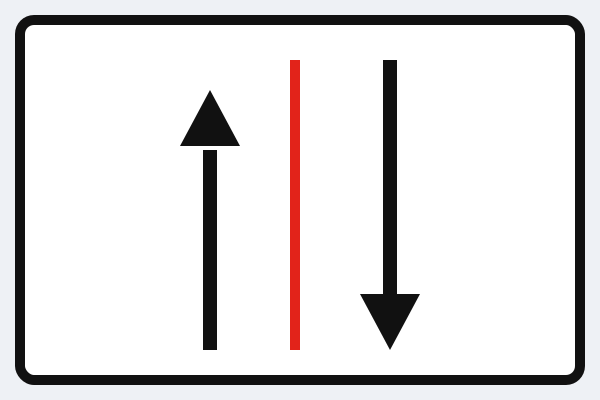
A contraflow moves one or more lanes of traffic onto the opposite carriageway so that a full carriageway can be closed for work. Signs give plenty of advance warning because the layout feels unfamiliar.
Contraflows are common on motorway resurfacing and bridge schemes.
What this sign means
Traffic in your direction will cross onto the other side of the road and run alongside oncoming traffic, separated only by cones or a temporary barrier.
Lanes are narrower than normal and a reduced speed limit will be in force.
What to do when you see it
Get into the correct lane early and keep your speed down.
- Choose your lane before entering the contraflow, as changing inside it may be prohibited.
- Keep a longer gap than usual to the vehicle in front.
- Stay central in the narrow lane and avoid drifting towards the barrier.
- Do not overtake unless the layout clearly allows it.
How this sign is tested
Questions ask what a contraflow is, why lane discipline matters inside one, and what the reduced speed limit is for.
Large vehicles are sometimes banned from the outside lane in a contraflow, which is another common question.
Common mistakes
Entering a contraflow in the wrong lane and then having to change inside the narrow section.
Driving too close to the barrier, which unsettles other drivers and leaves no recovery room.
Test yourself on this one
Road and traffic signs is the biggest category in the question bank with 102 questions, and signs turn up inside other categories too. Work through them free, no sign-up needed.
Practise road sign questionsFrequently asked questions
Can I change lanes inside a contraflow?
Only where the markings allow it. Choose your lane before you enter.
Why are speed limits lower in a contraflow?
Lanes are narrow, there is no hard shoulder and oncoming traffic is very close.
Are lorries restricted in contraflows?
Often yes, wide vehicles are directed into the nearside lane.