
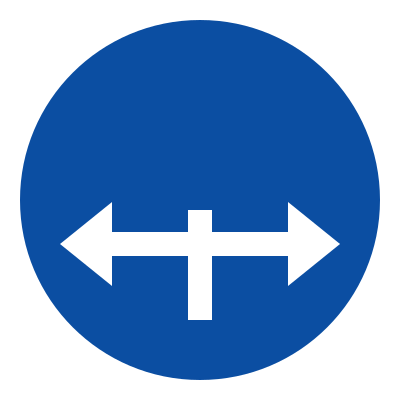
A circular blue sign with white arrows pointing left and right instructs drivers that they must turn in one of those two directions.
It is usually positioned opposite approach roads at T-junctions or central reserves where driving straight ahead is impossible or prohibited.
What this sign means
Drivers must turn either left or right at the junction.
Proceeding straight ahead is strictly prohibited as no road exists directly ahead.
- Blue circular sign featuring dual horizontal white arrows.
- Mandatory left or right turn.
- Positioned directly opposite approach lanes at T-intersections.
What to do when you see it
Decide early whether you intend to turn left or right.
Signal your chosen turn, slow down, and yield to main-road traffic before turning.
How this sign is tested
Theory exams present T-junction diagrams asking which vehicle movements are permitted when this sign is visible.
Questions test whether candidates understand that continuing straight ahead is prohibited.
Common mistakes
Failing to signal directional intention early enough when approaching a T-junction.
Confusing 'Turn Left or Right' with 'Pass Either Side' signs (which feature downward-angled arrows).
Test yourself on this one
Road and traffic signs is the biggest category in the question bank with 102 questions, and signs turn up inside other categories too. Work through them free, no sign-up needed.
Practise road sign questionsFrequently asked questions
How does Turn Left or Right differ from Pass Either Side?
Turn Left or Right (horizontal arrows) commands a turn at a T-junction; Pass Either Side (downward arrows) guides traffic past an obstruction.
Where is this sign typically placed?
Directly opposite the stem of a T-junction or at central reservation barriers.
Do I need to indicate at a Turn Left or Right sign?
Yes, you must signal left or right depending on which direction you intend to take.