
The short version
- Slow early and identify the roundabout type before you choose a lane.
- Use MSPSL: mirrors, signal, position, speed and look before every roundabout.
- Do not enter unless your path is clear and you can see it is safe to go.
- Signal left to leave once you have passed the exit before the one you want.
- If you get the wrong lane, follow it safely rather than cutting across.
Why roundabouts feel difficult at first
Roundabouts ask you to do several things at once: read signs, choose a lane, adjust speed, judge gaps, signal and watch other road users. That is why learners often feel rushed. The skill is not to be quicker; it is to make the approach earlier and calmer.
The Highway Code says you should use the Mirrors, Signal, Manoeuvre routine and give priority to traffic approaching from your right, unless road markings or signs show otherwise. In the car, I teach it as MSPSL: mirrors, signal, position, speed and look. If one part is late, the rest usually becomes untidy.
On test, examiners are not looking for a perfect textbook performance at every unusual roundabout. They are looking for safe, legal decisions, good observation and correct response to road markings, signs and other traffic. A missed opportunity to go is less serious than entering when it is not safe.
Choosing the correct lane
Your lane choice starts before the give-way line. Look for the direction sign, road markings and lane arrows. On a standard roundabout, the usual guide is simple: left lane for left or straight ahead, right lane for right or full circle, unless signs or markings tell you otherwise.
The phrase “straight ahead” normally means an exit at about 12 o’clock. If the exit is beyond 12 o’clock, treat it as a right turn unless lane markings say different. Many real roundabouts, especially on dual carriageways and near retail parks, have their own arrows, so road markings beat general habit.
What I see most often in the mirror is a learner staring at the island and missing the writing on the road. We drill this by calling the exit early: “second exit, A1234, left lane marked ahead.” That builds the habit of using evidence rather than guessing.
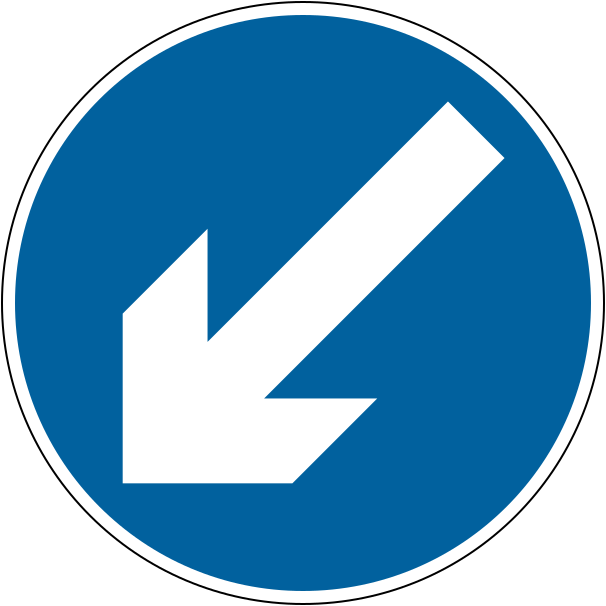
- Left turn: normally approach in the left lane and keep left.
- Ahead: normally use the left lane unless signs or road markings show another lane.
- Right turn: normally use the right lane and move left only when it is safe as you leave.
- Multiple lanes: follow the arrows and destination names, not just the shape of the roundabout.
- Wrong lane: take the lane’s permitted route and recover later safely.
Signals: what to show and when
Signals are there to help others, not to decorate the manoeuvre. Signal left for a left turn before you reach the roundabout. For straight ahead, normally do not signal on approach, then signal left after you have passed the exit before the one you want. For right turns, signal right on approach, keep it on while going round, then signal left to leave after passing the exit before yours.
Timing matters. If you signal left too early, a driver waiting at the next entrance may think you are leaving before them and pull out. If you signal late or not at all, the traffic behind may not understand your plan. The examiner will not mark you for failing to signal where nobody could benefit, but on most roundabouts somebody can benefit, including drivers waiting to enter, pedestrians, cyclists and following traffic.
Mini-roundabouts are the one learners often overcomplicate. You still signal by intention, but everything happens faster and with less space. Keep the speed low enough that you can steer accurately around the painted central marking, unless your vehicle size makes that impracticable.
- 1Identify your exit before you signal.
- 2Check mirrors before signalling, especially the relevant side mirror.
- 3Signal left on approach for a left turn.
- 4Signal right on approach for a right turn or going full circle.
- 5Change to a left signal to leave, after passing the exit before yours.
Observation and judging gaps
At the give-way line, your main danger is usually from the right, but that does not mean you only look right. You must know what is ahead, what is coming from the right, what is already on the roundabout, and whether anyone on your left is stepping out, cycling through, or about to enter unpredictably.
Good observation is a moving scan, not a fixed stare. On approach, reduce speed early enough to keep the car rolling if it is safe. A rolling first or second gear approach gives you more control than arriving too fast, braking hard and trying to judge a gap under pressure.
In lessons, I often cover the dual controls lightly and ask the pupil to say “go” only when they can explain why: “blue car leaving, white van continuing, safe after the van.” This teaches judgement. A gap is not just space; it is space plus time, speed and direction.
- Look well ahead for signs, lane arrows and traffic flow.
- Check centre and side mirrors before changing speed or lane.
- Look right early, then ahead, then right again before entering.
- Watch front wheels and signals, but do not trust signals alone.
- Check your left mirror before leaving, especially for cyclists and motorcyclists.
Positioning on and leaving the roundabout
Once you enter, hold your lane. Do not drift across the lane lines or cut the centre because the island looks empty. On a larger roundabout, lane discipline is often what separates a calm drive from a serious fault. If you need to move left to leave from an inner lane, use mirrors, signal and a gentle angle only when the space is clear.
A common learner mistake is looking at the exit too late. Your hands tend to follow your eyes. As soon as you know you can safely continue, look towards the lane you need next and steer smoothly. Avoid sudden steering corrections, especially where there are two exit lanes.
If another driver blocks you from leaving, do not force your way across. Continue round if necessary. It is not elegant, but it is safer and normally acceptable if done under control with correct observation. Cutting across another vehicle because “that was my exit” can be dangerous and is the sort of thing examiners must act on.
Mini, spiral and traffic-light roundabouts
Mini-roundabouts have the same priority rule unless signs or markings say otherwise: give way to traffic from the right. You must pass round the central marking, not drive over it, unless the vehicle’s size makes that unavoidable. Learners often fail mini-roundabouts by treating them as a normal junction and not showing clear priority or position.
Spiral roundabouts are designed to move you outwards towards your exit. The important point is to join in the correct lane and then follow the lane markings. Do not make your own lane change unless it is necessary and safe. If the road markings are worn, use signs, traffic flow and a slower speed to buy time.
Traffic-light controlled roundabouts can confuse learners because the lights change the priority at that point. If your light is green, you may proceed if your exit path is clear, but you still need lane discipline and observation. Stop at red lights on the roundabout as you would at any other signal.
How we drill roundabouts in lessons
With intensive courses at Fast Track Driving Lessons, I do not start by throwing a nervous learner at the biggest multi-lane roundabout in town. We build it. First, quiet mini-roundabouts for priority and steering. Then medium roundabouts for signals and gaps. Then multi-lane and spiral roundabouts once the routine is reliable.
A useful drill is the “commentary approach”. The pupil says what they see and what they will do: “second exit, left lane, mirrors, no approach signal, slowing, looking right, safe after the silver car, left signal to leave.” It sounds simple, but it stops the silent panic that causes late lane changes and missed mirrors.
Our intensive courses are usually 10 to 40 hours, charged at £61.23 per hour at the time of writing. Prices can change, but the teaching method does not: short explanation, demonstration if needed, repeated practice on real local roundabouts, then independent driving so you can make decisions without being talked through every metre.
What matters on the driving test
For the practical test, roundabouts are assessed like any other road situation: observation, judgement, positioning, signals, control and response to signs and road markings. The examiner will normally give directions in good time, such as “at the roundabout, follow the road ahead, second exit.” They are not trying to trick you, but they will expect you to read the road.
What does not matter is taking the exact route you expected if you have made a safe legal choice. If you accidentally take the wrong exit safely, the examiner will redirect you. What matters is not swerving, not cutting lanes, not forcing other vehicles to brake or steer, and not entering without proper observation.
The calm rule I give pupils is this: if you are unsure, slow down, keep your lane, and choose the safe option. A hesitant pause may be marked if it affects others, but a dangerous rush is far worse. Roundabouts reward early planning and punish last-second decisions.
Common questions
Do I always signal right when going straight ahead at a roundabout?
No. For a normal straight-ahead exit, you would usually not signal on approach. Signal left after passing the exit before the one you intend to take, unless road layout or markings make a different signal helpful.
Who has priority at a UK roundabout?
You normally give way to traffic approaching from your right and to traffic already on the roundabout. Signs, road markings or traffic lights can change how priority works, so always read the specific junction.
What if I am in the wrong lane on my driving test?
Follow the lane safely and legally, even if it takes you the wrong way. The examiner will redirect you. Cutting across lanes to rescue the route is much more likely to cause a serious fault.
Should I stop at every roundabout?
No. You should slow and be prepared to stop, but if it is clearly safe and your view is good, you may continue without stopping. Arriving slowly enough to judge the gap is the key skill.
Can I fail for not signalling to leave a roundabout?
You can be marked if a signal was necessary and you failed to give it, or gave it so late that it did not help anyone. The seriousness depends on the situation and whether other road users were affected or misled.
How do I practise roundabouts between lessons?
Use DVSA theory material and real-road practice with a suitable supervising driver if you are insured and legally allowed to drive. Fast Track Driving Lessons also provides free theory test practice at /theory, which helps you recognise signs, lanes and priority before you meet them on the road.
Browse driving lessons
Reading about it only gets you so far. Our instructors drill this with you in the car, on the roads around your test centre.