
The short version
- Check effectively, not theatrically: mirrors and observations must affect what you do next.
- Treat every junction as a decision-making exercise, not just a steering exercise.
- A serious fault is often one missed safety check at the wrong moment.
- Practise test routes under pressure, including normal driving between manoeuvres.
- Do not chase perfection; aim for safe, legal and independent driving.
How the examiner marks the practical test
On a UK practical driving test, the examiner is not looking for a perfect drive. They are looking for a safe, legal and independent standard of driving. You can pass with up to 15 driving faults, sometimes called minors, as long as you do not make a serious or dangerous fault. One serious or dangerous fault is enough to fail.
A serious fault is something potentially dangerous. A dangerous fault involves actual danger to you, the examiner, another road user or property. The same basic mistake can be marked differently depending on what is around you. For example, forgetting a mirror check with nobody nearby may be a driving fault; doing it before changing lane when a vehicle is affected is much more serious.
What I see most often in the mirror is not learners doing wildly unsafe things. It is small routines breaking down under pressure: a missed right mirror, a late look at a junction, drifting position while thinking about directions, or rushing away after a hesitation.
Poor observations at junctions
The most common test problem I deal with is weak observation at junctions. This regularly appears in DVSA lists of common reasons for failing the car driving test. It is not just about looking left and right. It is about looking early enough, looking far enough, judging speed correctly and not emerging until it is safe.
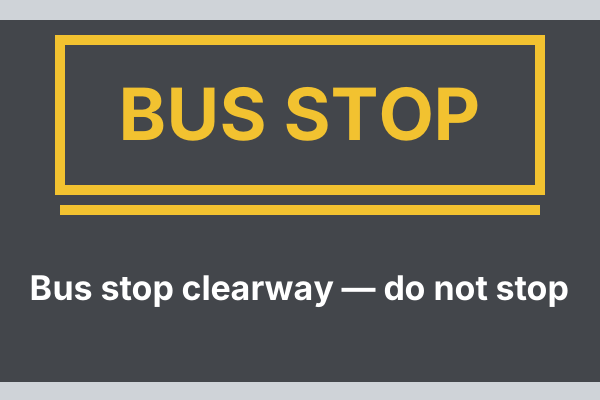
Learners often fail here because they treat a familiar junction as automatic. They roll up, glance, and go because it has been clear in previous lessons. On test, the examiner is watching whether your decision matches the view you actually had. If a parked van, hedge, bend, bus stop or bright sun blocks your view, you must creep and peep until you can see properly.
In lessons, I drill junctions by asking pupils to say what they can see, what they cannot see, and what they are going to do about it. That builds decision-making, not just a head movement. The examiner does not care if your head turns dramatically; they care whether you have made a safe decision.
- Approach at a speed that gives you time to look both ways properly.
- Use the correct gear before the junction, not while steering out.
- If the view is blocked, creep forward slowly with effective clutch and brake control.
- Check for cyclists and pedestrians as well as cars, especially when turning left.
- Do not go just because the driver behind is waiting.
Missing mirrors before changing speed or direction
Mirror faults are another major reason learners fail. The key phrase is effective observation. A mirror check is only useful if it happens at the right time and changes your plan if needed. Looking after you have already signalled, braked or moved is too late.
The mirror checks that catch people out are often simple ones: centre mirror before slowing, right mirror before moving out around parked vehicles, left mirror before returning to the left, and mirrors before changing lanes on a dual carriageway. I also see pupils forget mirrors when following sat nav instructions because they focus on the voice rather than the road.
A good instructor will not ask you to do a mirror routine for show. We will link it to risk. If you are about to brake, who is behind? If you are about to steer right, who might be overtaking? If you are moving left, is there a cyclist or motorbike there? That is the habit the examiner wants to see.
- 1Identify the change: speed, position or direction.
- 2Check the relevant mirrors before you act.
- 3Signal only if it would help another road user.
- 4Act smoothly, then re-check if the situation changes.
- 5If the mirror check shows a risk, wait or adjust your plan.
Moving off unsafely or without control
Moving off sounds basic, but it fails a lot of tests. You may be asked to pull up on the left several times, move off again, move off at an angle from behind a parked vehicle, and possibly move off on a hill. Each time, the examiner is looking for control and safety.
The classic fail is missing the blind spot before moving away. Mirrors alone do not cover the area beside and just behind the car. If you move off and a cyclist, car or pedestrian is close enough to be affected, that can become a serious fault very quickly. The other common issue is control: rolling back, stalling repeatedly, or swinging out too sharply.
What does not matter is whether the move-off feels elegant. A small stall is not automatically a fail if you deal with it safely. Secure the car, restart calmly, check again if needed and move away when safe. Panic causes more test failures than the stall itself.
- Before moving off, check all around, including the blind spot on the side you are moving towards.
- Signal if someone would benefit from it, not as a fixed ritual.
- Use a positive but controlled bite point, especially on hills.
- If you stall, brake, secure the car, restart and re-observe before moving.
- Do not rush because the examiner has given the instruction.
Incorrect positioning and lane discipline
Positioning faults often build gradually. A pupil may drive slightly too close to parked cars, sit too far left on a narrow road, cut a right turn, or choose the wrong lane at a roundabout. One small positioning fault may not matter. Repeating it, or causing another road user to brake or change direction, can lead to a fail.
Roundabouts are where lane discipline is tested hardest. You need to plan early from signs and road markings, choose the correct lane, stay in it, and check before exiting. If you realise you are in the wrong lane, the safest answer is usually to follow the lane you are in, even if that means taking a different exit. Forcing the car across late is far worse than going the wrong way safely.
In intensive courses, we spend a lot of time on normal driving between the obvious hazards. That is where positioning habits are formed. Fast Track Driving Lessons courses, from 10 to 40 hours at £61.23 per hour, are often used by learners who can drive but need repeated practice under test-style pressure. The aim is not to memorise one route; it is to make correct positioning feel normal on any route.
Responding badly to traffic lights, signs and road markings
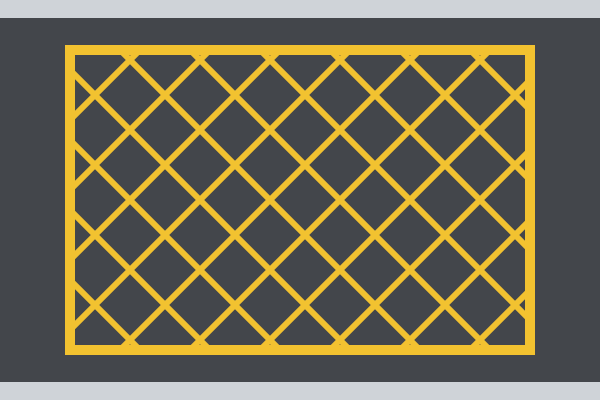
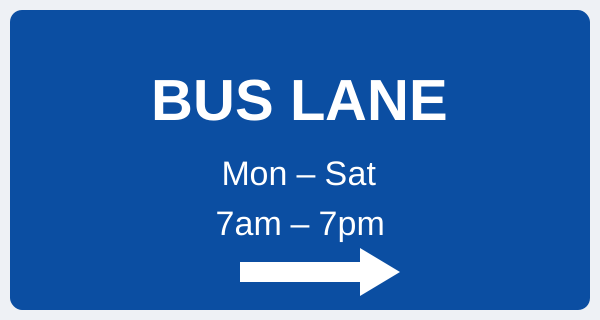
Examiners see many failed tests because the learner reacts late or incorrectly to signals. This includes going through a red light, stopping suddenly for an amber when it is unsafe, missing a stop line, entering a yellow box junction without a clear exit, or ignoring lane arrows and bus lane signs.
Amber means stop if you can do so safely. It does not mean accelerate, and it does not mean slam the brakes on without checking what is behind. Road markings matter just as much as upright signs: stop lines, give way lines, box junction markings, lane arrows and hatch markings all tell the examiner whether you are reading the road.
In lessons, I get pupils to lift their vision. Many test faults happen because the learner stares at the car in front or the sat nav and sees the traffic light too late. Look well ahead, then scan back to your own position. That gives you time to make calm decisions.

- Look for signs and markings early, especially on unfamiliar roads.
- Treat a STOP sign properly: stop fully before the line where you can see.
- Do not enter a yellow box junction unless your exit is clear, except when waiting to turn right and prevented by oncoming traffic or other vehicles waiting to turn right.
- Check mirrors before braking for lights or queues.
- If you are unsure of a bus lane time plate, stay out unless you have clearly read that you may use it.
Manoeuvres: what matters and what does not
The current car practical test can include one reversing manoeuvre: parallel park at the roadside, bay park, or pulling up on the right and reversing for about two car lengths before rejoining traffic. You may also be asked to do an emergency stop. The manoeuvre is not marked on beauty; it is marked on control, observation and safety.
Learners sometimes worry about being perfectly straight in a bay or exactly one kerb width away after a parallel park. That is not the main issue. You can usually correct the car if it is safe and controlled. The bigger problem is staring at the mirrors or camera and forgetting to look around. Reversing cameras may be used if fitted, but you must still make effective all-round observations.
When I drill manoeuvres, I use reference points first, then deliberately vary the starting position. That stops pupils becoming dependent on one exact kerb, one exact bay or one exact car. On test, the examiner will choose the place; your method has to survive real conditions.
- 1Prepare the car slowly and choose reverse gear when ready.
- 2Observe all around before moving, including pedestrians and vehicles approaching from either direction.
- 3Move at walking pace or slower, using clutch and brake control.
- 4Pause and re-observe whenever the situation changes.
- 5Correct the position if needed, but only after checking it is safe.
Nerves, hesitation and taking the test too early
Nerves do not fail tests on their own. Unsafe decisions made because of nerves do. Some learners hesitate too long at open junctions, then rush when a gap is no longer suitable. Others drive faster than usual to prove confidence. The examiner is not looking for boldness; they are looking for judgement.
Taking the test too early is also common, especially when waiting times are long. DVSA test fees and waiting times can change, so always check GOV.UK for current booking information. A cancellation can be useful only if you are genuinely ready. Passing a mock test with your instructor, including independent driving and unfamiliar roads, is a better guide than simply reaching a certain number of hours.
Before test, practise the parts that expose pressure: pulling up and moving off repeatedly, busy roundabouts, meeting traffic, hill starts, and following sat nav instructions. If theory knowledge is shaky, hazard perception and road sign understanding will affect practical driving too. Fast Track Driving Lessons includes free theory test practice at /theory, which can help you keep rules fresh while preparing for the practical.
- Book or move your test when you can drive safely without your instructor prompting you.
- Ask for mock tests where your instructor stays quiet and marks faults realistically.
- Practise at different times of day, not only on quiet roads.
- Do not rely on memorising test routes; roadworks, traffic and examiner choices change.
- Sleep, food and arriving early help, but they do not replace proper preparation.
Common questions
How many minor faults can I get and still pass?
You can pass the UK car practical test with up to 15 driving faults, provided you do not make any serious or dangerous faults. If you keep making the same type of driving fault, the examiner may judge it as a serious fault because it shows a pattern.
Is stalling an automatic fail on the driving test?
No. A stall is not automatically a fail if you deal with it safely and do not create danger. Brake, secure the car if needed, restart calmly, check around again and move off when safe.
Will I fail if I go the wrong way?
Not if you go the wrong way safely and legally. Examiners understand that learners can misunderstand directions. A safe wrong turn is much better than a late lane change, harsh braking or forcing your way across traffic.
Do examiners have quotas for passes and fails?
No. DVSA examiners mark against the standard of the test, not a quota. Your result depends on the faults recorded during your drive and whether they are driving, serious or dangerous faults.
Can I use parking sensors or a reversing camera on test?
Yes, if the car is fitted with them, but they must not replace proper observations. You still need to look around, check blind spots and respond to pedestrians, cyclists and vehicles while reversing.
What is the best way to stop making the same test fault?
Ask your instructor to recreate the situation repeatedly until the correct routine becomes automatic. For example, if you miss right mirror checks before passing parked cars, practise a road with repeated parked vehicles and have your instructor stay quiet unless safety requires help.
See our pass guarantee
Reading about it only gets you so far. Our instructors drill this with you in the car, on the roads around your test centre.