
The short version
- Highway Code Rule 264 says you should keep in the left lane unless overtaking.
- Middle-lane hogging can be dealt with as careless or inconsiderate driving.
- Police can issue a fixed penalty of £100 and 3 penalty points, although courts can impose more serious penalties.
- On test, poor lane discipline is usually marked under positioning, mirrors, judgement or progress.
- The safest habit is mirror, signal if needed, move out to overtake, then return left when safe.
Middle-lane hogging: the rule and the penalty
Middle-lane hogging is when you sit in lane 2, or another outer lane, when the lane to your left is clear and you are not overtaking. On a three-lane motorway, that usually means staying in the middle lane for convenience rather than moving back to lane 1. The rule is not complicated: in normal driving you use the left-hand lane, move out to overtake, then return left when it is safe.
The main Highway Code rule is Rule 264, which says you should always drive in the left-hand lane when the road ahead is clear, and if you are overtaking a number of slower-moving vehicles, you should return to the left-hand lane as soon as you are safely past. Although the Highway Code uses both ‘must’ and ‘should’, ignoring a ‘should’ rule can still be used as evidence if your driving falls below the expected standard.
The penalty people search for is usually the fixed penalty. Police can deal with lane hogging as careless or inconsiderate driving, commonly by a fixed penalty notice of £100 and 3 penalty points. These figures are published government/DVLA and police enforcement figures and can change, so always check current official guidance. More serious cases can go to court, where careless driving can lead to a fine, 3 to 9 penalty points, or a discretionary disqualification depending on the circumstances.
This article is general driving guidance for learners and new drivers, not legal advice. If you have received a notice or court paperwork, read it carefully and take proper legal advice if you are unsure.
What the Highway Code actually expects
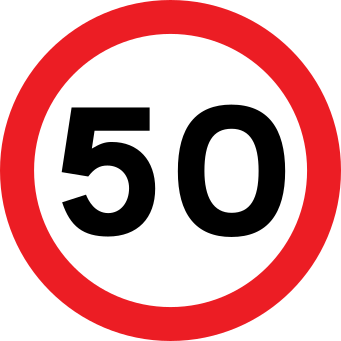
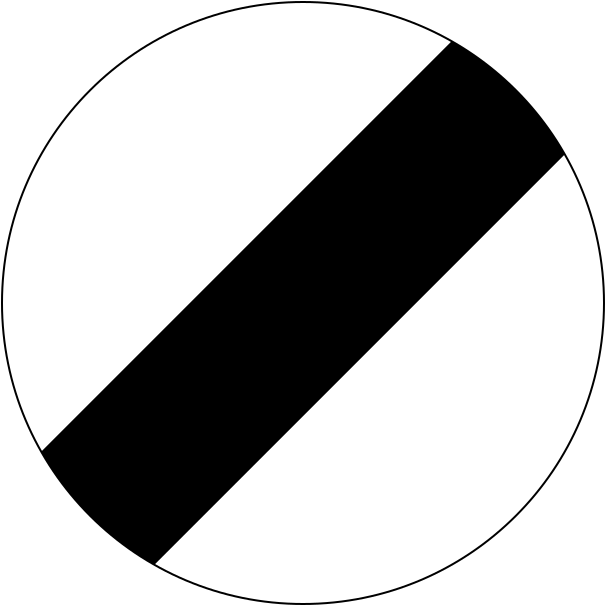
Highway Code Rule 264 is the key one for motorway lane discipline. It says the left-hand lane should be used for normal driving, and the other lanes are for overtaking. That applies whether the motorway is quiet or busy, and whether you are doing 50 mph, 60 mph or the national speed limit where permitted.
Rule 267 also matters because it tells drivers to overtake only on the right, move back to the left when safe, and not cut in. Rule 268 warns against overtaking on the left, although it recognises that in congested conditions, traffic in left lanes may sometimes move faster than traffic to the right. In normal flowing traffic, your poor lane position can tempt other drivers into undertaking, which increases risk even if they are also making a bad decision.
Learners sometimes tell me, ‘I’m doing 70, so nobody should need to pass me.’ That is not how lane discipline works. The speed limit is a maximum, not a reason to occupy a lane unnecessarily. You do not police the speed of other drivers by blocking a lane; you keep the correct position and let traffic flow around you.
Why middle-lane hogging is risky, not just annoying
From the passenger seat, the biggest problem I see is that learners treat the middle lane as the ‘easy’ lane. They think it avoids slip roads, lorries and lane changes. In reality, it creates more work for everyone else because faster traffic has to move across more lanes to pass, then back again. One driver sitting unnecessarily in lane 2 can turn a three-lane road into a two-lane road.
It also affects your observation. If you sit in lane 2 for too long, you stop actively planning. You are no longer asking, ‘What am I overtaking? Is the left lane clear? What is behind me?’ That lazy scan is what leads to late mirror checks, drifting speed, and sudden lane changes when a faster vehicle appears behind.
There is also the undertaking problem. If lane 1 is clear and you are holding lane 2, some drivers will pass on your left. That does not make your lane hogging safe simply because someone else behaved badly. On a busy road, the safest drivers reduce temptation and confusion by making their intentions obvious and keeping left unless there is a proper reason not to.
What counts as a good reason to stay out
You do not have to dive left into every small gap. The Highway Code expects you to return left when it is safe, not instantly. If you are overtaking a line of slower vehicles and moving left would mean braking sharply or immediately moving out again, it is often better to maintain a steady course until you are past the group.
Good lane discipline is a balance. I teach learners to ask whether they are still overtaking, whether the gap to the left is long enough to settle into safely, and whether moving left would help the traffic flow. If the answer is yes, move back. If the answer is no because the next lorry is only a few seconds ahead, hold your lane, keep checking mirrors, and complete the overtake cleanly.
Speed matters too. If you are in lane 2 overtaking at 60 mph while lane 1 is doing 58 mph, you may technically be passing, but you can still create a long obstruction behind. Sometimes the better plan is to ease off and stay left until a clearer overtaking opportunity appears, rather than crawling past for half a mile.
- Stay out if you are genuinely overtaking and will pass within a reasonable time.
- Stay out if moving left would put you too close behind a slower vehicle.
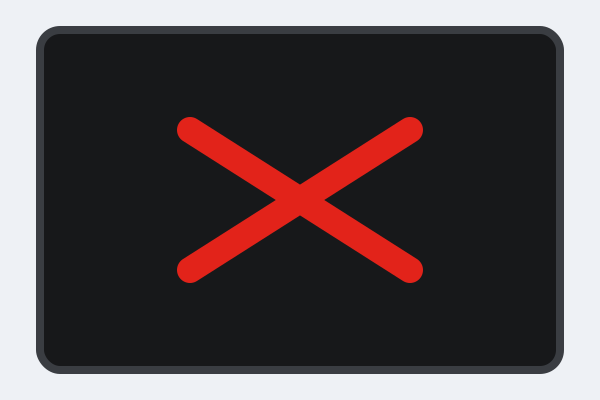
- Stay out if a lane to the left is closed or unsafe, for example because of a red X, obstruction or breakdown.
- Move left if the lane is clear for long enough to drive there normally.
- Move left if vehicles are queuing behind you and you are no longer passing anything.
How police deal with middle-lane hogging
Middle-lane hogging is usually treated under careless or inconsiderate driving rather than as a separate offence called ‘middle-lane hogging’. The legal test for careless driving is broadly whether the standard of driving falls below what would be expected of a competent and careful driver. Holding the wrong lane for no good reason can fit that, especially if it affects other road users.
In straightforward cases, police may issue a fixed penalty notice. The commonly stated fixed penalty for careless driving is £100 and 3 penalty points. If the driver does not accept it, or if the case is considered more serious, it can be referred to court. In court, careless driving can carry 3 to 9 points, a fine, and possible disqualification, depending on the evidence and seriousness.
For new drivers, the points matter a lot. Under the Road Traffic (New Drivers) Act, if you get 6 or more penalty points within two years of passing your first driving test, the DVLA will revoke your licence. That means you go back to learner status and must apply for a provisional licence again, then pass both theory and practical tests before driving unsupervised. The DVLA publishes this rule and it is one of the reasons I push lane discipline hard with newly qualified drivers.
What an examiner would mark on a driving test
A standard car practical test will not use a motorway, but it can use dual carriageways and faster multi-lane roads. Learners can have motorway lessons with an ADI in a dual-control car, but the DVSA practical test itself is not a motorway test. The same lane discipline principles still apply on dual carriageways: keep left unless overtaking or following signs and road markings.
On test, the examiner is not looking for the phrase ‘middle-lane hogging’. They are assessing the driving fault it creates. It may appear as normal driving position, lane discipline, mirrors before changing direction, planning, undue hesitation, progress, or judgement when overtaking. If your position causes another driver to brake, change lane unnecessarily, or pass you on the left because you have not moved back, it can quickly become serious.
The specific fault I see costing learners is staying in the right-hand lane after overtaking on a dual carriageway. The learner passes a slower vehicle, relaxes, and forgets the left mirror. Then a car appears behind, closes the gap, and the learner either stays out too long or swerves left late. The examiner sees poor planning first, not just the final lane change.
- Driving fault: you take slightly too long to move left, but do not affect anyone.
- Serious fault: you unnecessarily hold an outer lane and cause another driver to slow, change position or become boxed in.
- Serious fault: you move left late without proper mirror checks after realising someone is behind.
- Dangerous fault: your lane change forces another vehicle to brake or swerve.
- Repeated faults: several small lane discipline errors can add up to a fail.
The safe routine for overtaking and returning left
Good lane discipline starts before the overtake. Do not wait until you are on the bumper of a lorry or slower car. Look well ahead, compare speeds early, and decide whether the overtake is actually worth it. If you are gaining very slowly, you may need more space and better timing, or you may decide to stay left.
When you do move out, your mirrors are not a ritual; they are the evidence for your decision. I want to see centre mirror, right mirror, and sometimes a right shoulder check depending on the road and blind spot risk. Signal if it would benefit anyone, move out smoothly, maintain a legal and appropriate speed, then keep assessing what is happening behind and to your left.
Returning left is where many new drivers go wrong. They either cut back too soon, which intimidates the vehicle they have passed, or they forget to return at all. A useful guide is to wait until you can see the front of the vehicle you have passed clearly in your interior mirror, then check left mirror, signal if useful, and move back smoothly if the lane is clear.
- 1Look well ahead and decide whether you need to overtake.
- 2Check mirrors early, especially for faster traffic already overtaking.
- 3Signal if it will help another road user understand your plan.
- 4Move out smoothly and keep a safe following distance from the vehicle ahead.
- 5Complete the overtake without exceeding the speed limit.
- 6Check that the left lane is clear and the vehicle you passed is not too close.
- 7Return left smoothly when safe, then cancel any signal and reassess.
Learner checklist: avoiding middle-lane hogging
The best motorway and dual carriageway drivers look calm because they are constantly making small decisions early. They are not reacting to pressure from behind; they are already in the correct lane. If you build this habit as a learner, it becomes automatic after you pass, when there is no instructor next to you prompting ‘left mirror’ every few minutes.
Use this checklist in lessons, private practice on suitable roads, and after you pass. It is especially useful when you are nervous on faster roads, because nervous drivers often cling to an outer lane to avoid dealing with joining traffic. The answer is not to hide in the middle; it is to improve planning, observation and timing.
Remember that keeping left is not about being timid. It is about being predictable. Predictable drivers give others room, avoid unnecessary conflict, and make better progress because their lane choices make sense.
- Ask yourself every 10 seconds: ‘Why am I in this lane?’
- If the answer is not overtaking, signs, lane closure or safety, plan to move left.
- Do not move left into a gap that is too short or unsafe.
- Do not sit out just because another overtake may happen later.
- Use mirrors before every change of lane, not as an afterthought.
- If faster traffic is building behind, reassess early rather than reacting late.
Common questions
Is middle-lane hogging illegal in the UK?
There is not usually a separate offence called middle-lane hogging. It can be dealt with as careless or inconsiderate driving if you stay in an outer lane unnecessarily and your driving falls below the expected standard. Highway Code Rule 264 says you should keep left unless overtaking.
What is the penalty for middle-lane hogging?
Police can issue a fixed penalty for careless driving, commonly £100 and 3 penalty points. More serious cases can go to court, where careless driving can lead to 3 to 9 points, a fine, or a discretionary disqualification. Official penalty figures can change, so check current DVLA or government guidance.
Can I stay in the middle lane if I am doing 70 mph?
No, not if the lane to your left is clear and you are not overtaking. The 70 mph national speed limit for cars on motorways is a maximum, not permission to occupy the middle lane. You should still return left when safe.
How long can I stay in the middle lane when overtaking lorries?
You can stay out while you are genuinely overtaking and it would be unsafe or pointless to move left between vehicles. If there is a clear gap long enough to settle into lane 1 safely, you should move back left. Do not cut in close to a lorry just to prove you are keeping left.
Will I fail my driving test for poor lane discipline?
You can fail if poor lane discipline creates risk or affects another road user. On a practical test this is more likely on dual carriageways than motorways, because tests do not use motorways. The fault may be marked under positioning, mirrors, judgement, progress or lane discipline.
Is it undertaking if traffic in the left lane passes a middle-lane hogger?
Highway Code Rule 268 says you should not overtake on the left in normal conditions. In congested traffic, lanes may move at different speeds and left-lane traffic may pass traffic to the right. In free-flowing traffic, deliberately passing on the left is risky, but that does not excuse someone sitting unnecessarily in the middle lane.
Browse driving lessons
Reading about it only gets you so far. Our instructors drill this with you in the car, on the roads around your test centre.