
The short version
- Examiners mark effective observation, not theatrical head movement.
- Most junction faults come from looking too early, too briefly or in the wrong place.
- Pedestrians and cyclists matter as much as vehicles when you turn or emerge.
- A blocked view means slow down, creep and reassess before committing.
- If another road user has to brake, swerve or hesitate because of you, expect a serious fault.
Why examiners watch observation at junctions so closely
If you are searching for observation at junctions, the direct answer is this: on the driving test, your examiner is checking whether you can gather enough information before entering, crossing or turning at a junction, and whether you act on what you see. They are not looking for a rehearsed left-right-left performance with no thought behind it. They want safe, timely decisions.
In the passenger seat, I see learners fail at junctions for one main reason: they make the decision before the observation is finished. The car is already rolling, the clutch is coming up, and only then do they glance right. If a vehicle, cyclist or pedestrian appears at that moment, the learner has no calm option left. The examiner sees that as poor planning and poor observation, not bad luck.
DVSA driving test marking is based on risk. A small delay or a slightly untidy routine might be a driving fault. But if your observation causes another road user to slow, stop, swerve or feel uncertain, it can become a serious fault. If actual danger is created, it can become a dangerous fault. At junctions, the difference between a pass and a fail is often one missing final check.
- The examiner watches your eyes, but marks the safety of your decision.
- Your speed on approach must give you time to look properly.
- You must check for pedestrians, cyclists, motorcyclists and vehicles.
- You must not rely only on what your instructor would normally prompt.
- You must reassess if the view changes or another road user appears.
What effective observation actually means
Effective observation means looking in the right places, at the right time, for the right hazards, then making a safe decision. It is not just ‘mirrors, signal, manoeuvre’ said out loud. At a junction, your checks need to answer clear questions: Who has priority? Is anyone crossing? Is there a vehicle approaching too quickly? Is my exit clear? Can I go without affecting anyone?
A common test mistake is to look correctly but too early. For example, a learner turning left checks right while still five metres from the give way line, then concentrates on the steering. By the time the front of the car reaches the junction, the traffic situation has changed. The examiner may mark that as ineffective observation because the useful check was not close enough to the decision point.
Another mistake is looking but not seeing. I often ask learners after a junction, ‘What colour was the car on your right?’ If they cannot tell me whether there was even a car, the glance was probably a habit, not observation. On test, examiners are good at spotting that. They look for the link between your observation and your action.
- Look early to plan, then look again late to decide.
- Move your eyes before you move the car into danger.
- Check the near pavement and cycle lane, not only the carriageway.
- Confirm the exit is clear before entering a box or busy junction.
- If you are not sure, wait, but keep observing rather than staring at one gap.
Approaching a junction: slow enough to see
Good observation starts before the give way line. If you approach too quickly, your brain has to deal with steering, gears, braking, signs, pedestrians and traffic all at once. That is when learners miss the cyclist on the left or the car hidden behind a parked van. The best junction drivers create time before they need it.
On approach, read the road layout: road markings, traffic lights, signs, parked vehicles, bus stops, pedestrian crossings, cycle lanes and the shape of the kerb. Mirrors matter here too. Before you slow, you need to know what is behind you. If someone is close behind, you still must slow safely, but you should brake progressively and avoid sudden, unexplained stops where possible.
The Highway Code is important here. Rule 170 says to take extra care at junctions and watch out for pedestrians, cyclists and motorcyclists. Rule 171 says you must stop behind the line at a STOP sign. Rule 172 covers giving way at give way lines. This article is general driving guidance, not legal advice, and you should check the current Highway Code for the latest wording.
- 1Identify the junction type as early as possible: open, closed, traffic light controlled, crossroads or roundabout.
- 2Check your mirrors before slowing, especially the interior mirror and the mirror on the side you are moving towards.
- 3Adjust speed so you can stop if the view is poor or the priority is unclear.
- 4Select a suitable gear before the decision point, so you are not looking down or rushing the clutch.
- 5Scan pavements, cycle lanes and the road you are entering, not just the traffic from one direction.
- 6Make a fresh final check before the car crosses the give way line or enters the new road.
Emerging left and right from a side road
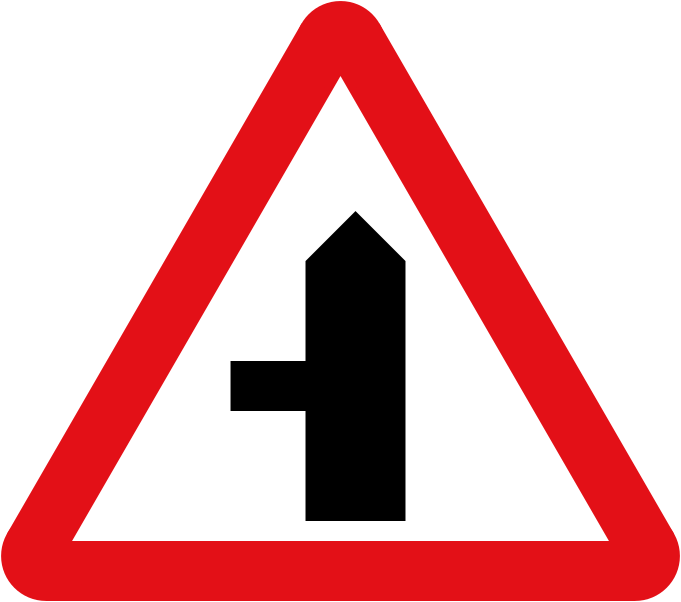
Emerging is where observation faults show most clearly. When turning left, many learners only look right because that is where the main danger seems to be. But you also need the left check: pedestrians crossing the mouth of the junction, cyclists on the near side, parked vehicles narrowing your exit, or a vehicle turning into the side road you are leaving. If you turn left without that check, you can cut across someone you should have seen.
When emerging right, the workload is higher because you are crossing one stream of traffic and joining another. You need enough space from the right, enough space from the left, and a clear path into your lane. I teach learners to look both ways more than once, because traffic speed and gaps change quickly. The final check is usually towards the greatest immediate danger, but it must fit what is happening in front of you.
At closed junctions, do not guess. Edge forward slowly, with the car under control, until you can see. The skill is to creep without committing. A serious fault often happens when the learner’s front wheels roll too far out before they can see, forcing traffic to react. If the view is blocked, your speed should be walking pace or less, and you should be ready to stop instantly.
- Turning left: check left for pedestrians and cyclists, then right for traffic, then left again if needed.
- Turning right: check left and right repeatedly until both lanes and your exit are safe.
- Closed junction: edge forward slowly, stop if the view is still not safe, then reassess.
- Open junction: do not treat a clear view as permission to rush.
- Give way line: your final decision should happen at or very near the point of entry.
Turning into a side road: the hidden observation fault
Learners often think observation at junctions only means emerging. Turning into a side road is just as important. Before turning left, you need mirrors, signal if useful, speed reduction and a check of the road you are entering. The most common fault I see is a learner turning left while looking mainly at the kerb. They miss the pedestrian about to cross or the cyclist coming up on the inside.
The Highway Code’s hierarchy of road users and Rule H2 place particular responsibility on drivers to reduce danger to pedestrians, cyclists and horse riders. Rule 170 also says you should give way to pedestrians crossing or waiting to cross a road into which or from which you are turning. In practical test terms, if you turn across a pedestrian’s path when you should have waited, the examiner is unlikely to treat it as a minor issue.
Turning right has its own trap. A learner checks ahead, checks the oncoming car, then starts turning without checking the new road. If there is a pedestrian in the side road, a cyclist, a vehicle emerging, or a blocked lane, the turn becomes unsafe. The examiner wants to see that you are not simply aiming the car into the road, but checking that the road is available.
- Before turning left, check the left mirror for cyclists and motorcyclists.
- Before turning right, check the interior and right mirror before positioning.
- Look into the new road before steering into it.
- Give way to pedestrians crossing or waiting to cross where the Highway Code requires it.
- Do not let steering accuracy take all your attention from observation.
Crossroads, traffic lights and filter arrows
Crossroads catch learners out because there may be several possible conflicts at once. You can have oncoming traffic, vehicles turning across you, pedestrians crossing, cyclists filtering and drivers who misunderstand priority. At an unmarked crossroads, nobody has automatic priority. On lessons, I remind pupils that ‘I think they will stop’ is not a safe plan. You need eye contact where possible, clear positioning, and a speed that lets you stop.
At traffic lights, some learners switch off because the lights are doing part of the job. That is risky. A green light means proceed if the way is clear, not ignore the junction. You still check for late runners, emergency vehicles, pedestrians finishing a crossing and blocked exits. At a right turn with a filter arrow, you should understand what the arrow permits, but you still need to check the path you are taking.
A frequent serious fault at lights is entering a junction when the exit is not clear, especially in traffic. The learner is worried about holding people up behind, so they follow the car in front and end up stuck across the junction or pedestrian crossing. Examiners mark that because it affects other road users and shows poor forward planning.
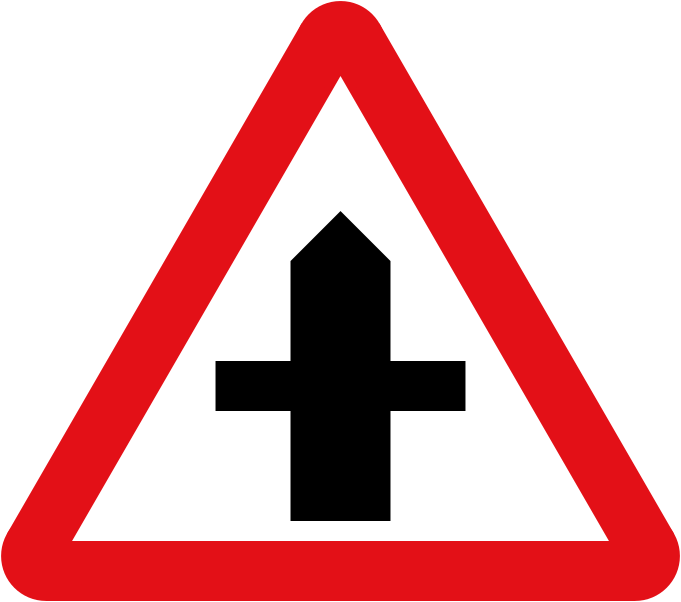

- 1On approach, identify whether the junction is controlled by signs, markings, lights or police direction.
- 2Check mirrors before changing speed or position.
- 3Look for pedestrians and cyclists even when your traffic light is green.
- 4Before turning right, judge oncoming traffic and make sure your exit is open.
- 5If waiting in the junction to turn right, keep your wheels straight until you are ready to turn.
- 6Do not enter a congested junction unless your exit is clear, except where waiting to turn right and not blocking.
Roundabouts are junctions too
Roundabouts are often taught separately, but the observation principle is the same: gather information, decide, and move only when it is safe. The Highway Code Rule 186 says to give priority to traffic approaching from your right unless signs, road markings or traffic lights direct otherwise. It also says to watch out for all other road users already on the roundabout.
The classic learner fault is staring right for a gap and forgetting the front of the car. A pedestrian may be crossing the approach, the vehicle in front may stop, or a cyclist may be taking a different line. I have had learners find a perfect gap to the right while gently rolling towards the bumper ahead. That is not observation, because it ignores the immediate hazard.
Another common issue is committing to a gap without checking whether the vehicle on the roundabout is actually leaving. Indicators help, but they are not guarantees. Look at the vehicle’s speed, position and wheel angle. If you cannot tell, wait. On test, a short safe wait is far better than pulling out and making the driver on the roundabout brake.
- Look right for priority traffic, but keep checking ahead.
- Watch lane position and speed, not just indicators.
- Check for pedestrians at zebra crossings near roundabout exits.
- Use mirrors before exiting, especially for cyclists and motorcyclists.
- If your lane choice or exit becomes unsafe, continue safely rather than swerving.
The junction faults that cost people the test
Examiners do not need perfection, but they do need safety. A driving fault might be a slight hesitation after you have observed properly, or a minor timing error that does not affect anyone. A serious fault is more likely where your observation is missing, late or ineffective and another road user is affected or could reasonably have been put at risk.
The painful part is that many junction fails are preventable. The learner knew the routine, but did not apply it under pressure. That is why practice should include commentary driving: say quietly what you are checking and why. For example, ‘Closed view, creeping, pedestrian left, car right, exit clear.’ It trains the brain to search rather than just glance.
Here is the fault table I use with learners after a mock test. If one of these sounds familiar, practise it deliberately rather than hoping it disappears.
- Fault: looking right once at a give way, then moving. Why it costs: the traffic picture changes before you enter.
- Fault: no left check when turning left. Why it costs: you may miss pedestrians, cyclists or a vehicle entering the side road.
- Fault: rolling over the line at a closed junction. Why it costs: you make traffic react before you can see properly.
- Fault: staring right at a roundabout. Why it costs: you may hit the vehicle in front or miss a pedestrian.
- Fault: turning into a road without checking the new road. Why it costs: the exit may be blocked or occupied by a vulnerable road user.
- Fault: following traffic through lights into a blocked junction. Why it costs: you obstruct crossings, side roads or opposing traffic.
A simple routine to practise this week
The best routine is simple enough to use when you are nervous. Do not make it a chant. Make it a sequence of questions. What is behind me? What type of junction is this? Who has priority? What can I not see yet? Who is most vulnerable here? Is my exit clear? What is my final check before moving?
Practise at different speeds and on different roads. Quiet estate junctions are useful for building the habit, but they do not prepare you for busy school roads, parked vans, cycle lanes and impatient traffic unless you add those situations later. New drivers should keep practising this too, because passing the test does not remove the risk at junctions.
When you get it right, junctions feel calmer. You approach at a speed that lets you think, your eyes move with purpose, and your decision is based on what is actually there. That is exactly what an examiner wants to see.
- 1On every approach, check mirrors before slowing.
- 2Identify the priority and any signs or road markings.
- 3Scan pavements, cycle lanes, the main carriageway and the road you will enter.
- 4If the view is poor, slow right down and creep only when necessary.
- 5Make a fresh final check at the decision point.
- 6Move only when your path and exit are clear.
- 7After the junction, check mirrors and rebuild normal driving speed safely.
Common questions
Can you fail the driving test for not moving your head enough at junctions?
You can fail if the examiner judges your observations were not effective, but it is not a head movement contest. If your eyes clearly check the right areas and your decision is safe, that is what matters. Bigger head movement can help the examiner see what you are doing, especially at closed junctions, but it must match real observation.
What is the correct order to look at a junction when emerging?
There is no single order that fits every junction, because the danger changes with the layout. As a guide, look both ways early, assess pedestrians and cyclists, then make a fresh final check towards the most immediate traffic danger before moving. If the view is blocked, creep forward slowly and repeat the checks.
Should I always stop at a give way line on my driving test?
No, not if the view is open and it is clearly safe to continue at an appropriate low speed. You must be prepared to stop and you must give way where required. At a STOP sign, Highway Code Rule 171 says you must stop behind the line.
Why do instructors keep saying ‘look into the road you are turning into’?
Because the new road may contain the hazard that fails the test: a pedestrian, cyclist, parked vehicle, oncoming car on your side, or queue of traffic. Learners often focus on the steering point and forget to check the space they are about to enter. The examiner wants to know the turn is safe, not just neat.
How do I avoid hesitation at busy junctions?
Hesitation usually comes from late observation or uncertainty about the size of the gap. Approach slower, decide where you need to look, and keep scanning rather than freezing on one direction. Do not take a gap that is unsafe just to avoid waiting, as that is far more serious than a brief safe pause.
Do I need to check mirrors at every junction?
You should check mirrors before changing speed, position or direction, so junctions usually require mirror checks. The exact mirrors depend on what you are doing: interior before slowing, left before turning left, right before turning right or moving right. Mirror checks do not replace looking ahead and to the sides at the junction itself.
Browse driving lessons
Reading about it only gets you so far. Our instructors drill this with you in the car, on the roads around your test centre.