
The short version
- Six points can revoke a new driver’s licence within two years of passing.
- Mobile phone use is especially risky for new drivers because it carries six points.
- No insurance usually means at least six points and can also invalidate other cover.
- Speeding, red lights and careless driving are common test-fail behaviours as well as offences.
- Penalty figures can change, so always check GOV.UK or DVLA for the latest rules.
Quick answer: nine common driving offences and penalties
The nine common driving offences learners and new drivers ask me about most are speeding, going through a red light or ignoring traffic signs, using a mobile phone, driving without insurance, driving otherwise than in accordance with a licence, careless or inconsiderate driving, drink or drug driving, seat belt and child restraint offences, and driving an unsafe vehicle such as with defective tyres or no MOT. Penalties vary, but they can include fixed penalties, penalty points, court fines, disqualification, vehicle seizure and, for the most serious offences, prison.
As an instructor, I see the same pattern in the car. Learners often think offences are only about being caught by police. In reality, the habits that lead to offences are the same habits examiners mark on test: missing speed limit changes, rolling over the stop line on amber turning red, checking a phone at traffic lights, or driving a friend’s car without checking insurance. On test, one unsafe or illegal act can be a serious or dangerous fault.
This is general guidance, not legal advice. Penalty amounts and procedures can change, and Scotland and Northern Ireland can differ in some areas. The figures below are based on published GOV.UK, DVLA and Highway Code information, so check the official sources if you are dealing with a live offence or fixed penalty notice.

- Speeding: usually at least £100 and 3 points if dealt with by fixed penalty, according to GOV.UK speeding penalties.
- Mobile phone use: usually £200 and 6 points, which can revoke a new driver’s licence.
- No insurance: usually £300 and 6 points by fixed penalty, with higher court penalties possible.
- Drink or drug driving: normally a minimum 12-month ban if convicted of driving or attempting to drive over the limit.
- Unsafe vehicle offences: penalties depend on the defect, but defective tyres can mean 3 points per tyre and a fine.
Why penalty points matter more when you are new
Penalty points are endorsements placed on your driving record. GOV.UK lists endorsement codes such as SP for speeding, CU for construction and use offences, IN for insurance, LC for licence offences and DR or DG for drink and drug offences. The length of time an endorsement stays on your record depends on the offence, and some stay visible much longer than others.
For a new driver, the big rule is the Road Traffic (New Drivers) Act. If you get six or more penalty points within two years of passing your first practical test, DVLA can revoke your licence. That is not the same as a court ban. You go back to learner status, must apply for a provisional licence again if needed, and must pass both the theory and practical tests again before driving unaccompanied.
A point many learners miss is that points gained on a provisional licence do not disappear when you pass. If you pass with points already on your record, they come with you. I have had pupils shocked to learn that one mobile phone offence after passing could be enough to lose their new licence because the offence carries six points.
- Twelve or more points within three years can lead to a totting-up disqualification.
- Six points within two years of first passing can lead to new driver revocation.
- Provisional licence points carry over after you pass.
- A fixed penalty is still a real endorsement, not just an admin fine.
1 to 3: speeding, red lights and mobile phone use
Speeding is the offence I correct most often in lessons, especially on roads where the limit changes from 40 mph to 30 mph, or where a learner follows the traffic rather than reading the signs. Highway Code Rule 124 sets out national speed limits and reminds drivers that street lights usually mean a 30 mph limit unless signs say otherwise. GOV.UK states that the minimum speeding penalty is normally a £100 fine and 3 penalty points, although court fines can be higher, with maximums of £1,000 on most roads and £2,500 on motorways. Those figures can change.
Red traffic lights and mandatory signs catch out learners who are late making decisions. Highway Code Rule 176 says you must not move forward over the white stop line when the red light is showing. The usual fixed penalty for contravening a red light is £100 and 3 points, but a court can deal with more serious cases. In test terms, the costly fault is not just crossing on red. I also see serious faults for braking dangerously late because the pupil tried to ‘make it’ through amber.
Mobile phone use is one of the most damaging offences for a new driver. Highway Code Rule 149 says you must exercise proper control and must not use a hand-held mobile phone or similar device when driving or riding, including when stopped in traffic. The published fixed penalty is £200 and 6 points. If you have just passed, that can be enough on its own for DVLA to revoke your licence.
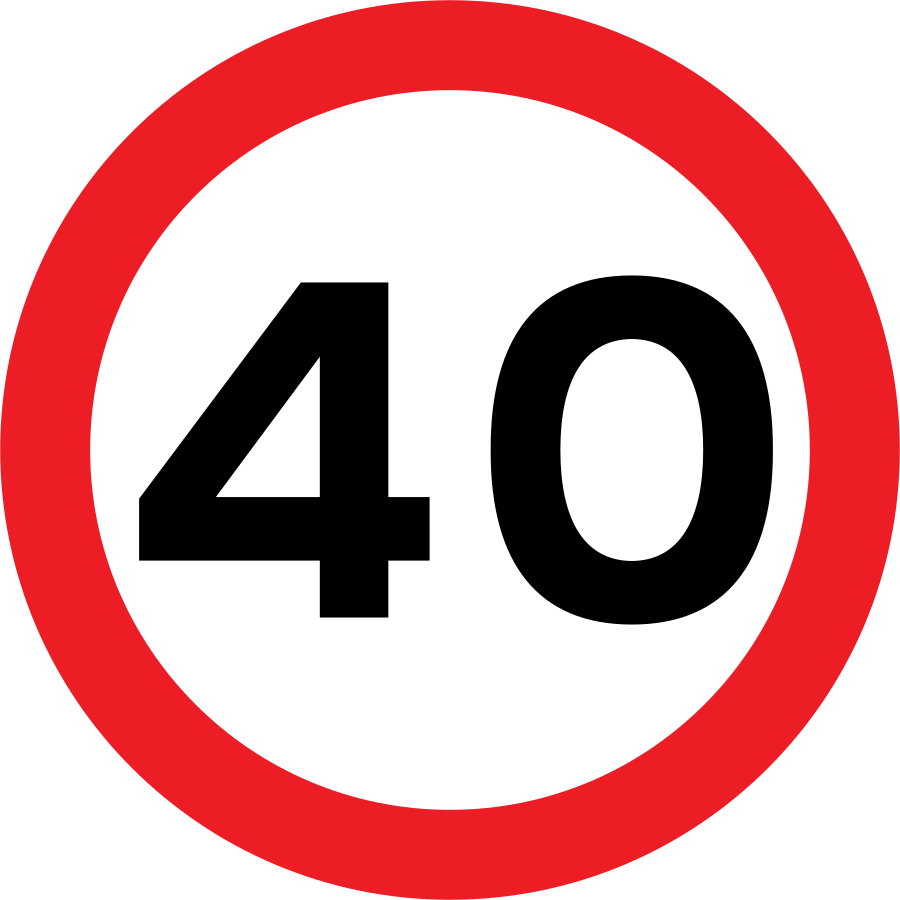
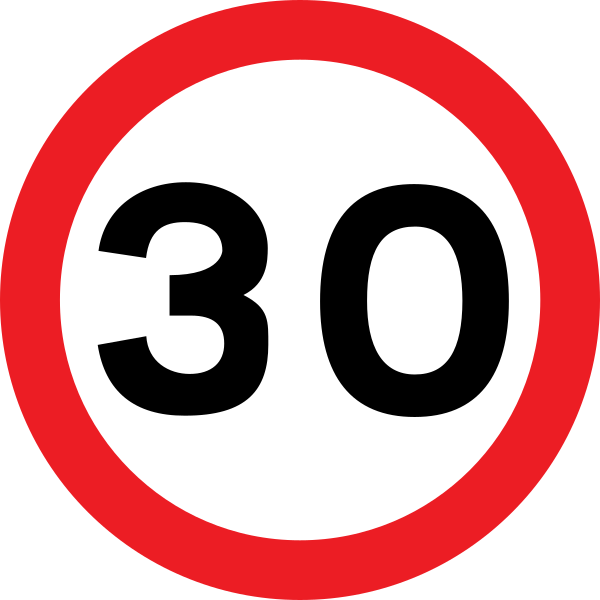
- Speed limit fault I see: missing a 30 mph change because the road still feels wide.
- Red light fault I see: accelerating at amber instead of preparing to stop safely.
- Mobile fault I see: touching the phone while stationary in a queue or at lights.
- Examiner view: an illegal or unsafe action can become a serious or dangerous fault.
4 and 5: no insurance and licence offences
Driving without insurance is a serious offence and it is easier to commit than many new drivers realise. Borrowing a parent’s car, driving a friend’s car, or assuming ‘fully comprehensive’ cover lets you drive any car can all go wrong. GOV.UK states that the fixed penalty for using a vehicle without insurance can be £300 and 6 penalty points. If the matter goes to court, the fine can be unlimited and you can be disqualified.
Highway Code Rule 97 says you should ensure you have a valid licence and insurance before driving. The police also have powers to seize a vehicle being driven without insurance. From an instructor’s point of view, the practical mistake is assuming somebody else has sorted it. The driver is responsible. If your name is not on the policy, or you do not meet the policy conditions, you may not be covered.
Driving otherwise than in accordance with a licence includes learner-specific problems: driving unsupervised, not displaying L plates correctly, riding or driving a category you are not entitled to, or using a motorway as a learner without the correct conditions. A learner on a motorway in England, Scotland or Wales must be with an approved driving instructor in a dual-controlled car. Licence offences can carry 3 to 6 points depending on the exact endorsement code, and there may be insurance consequences too.
- Check the vehicle is insured for you, not just insured for someone.
- Check you have the right licence category for the vehicle.
- Learners need proper supervision unless driving on private land not accessible to the public.
- L plates must be clearly visible from the front and rear.
- Do not assume a parent’s policy covers you automatically.
6: careless or inconsiderate driving
Careless driving is driving that falls below the standard expected of a competent and careful driver. Inconsiderate driving is driving without reasonable consideration for other road users. This is a broad area, and it often covers the real-world errors I see when learners rush: cutting up a cyclist, forcing another driver to brake, emerging from a junction without enough gap, or splashing pedestrians through a puddle.
For less serious careless driving, police may issue a fixed penalty, commonly £100 and 3 points, or require a court hearing depending on the facts. Court outcomes can involve more points, a fine and possible disqualification. DVLA endorsement code CD10 for driving without due care and attention carries 3 to 9 points. Dangerous driving is a more serious offence again and can involve a mandatory disqualification, an extended retest and, in the worst cases, custody.
On a driving test, the wording is different but the behaviour overlaps. The examiner is not issuing legal penalties, but they are assessing safety. If your move makes another road user alter speed or direction sharply, you are in serious-fault territory. The common fault that costs people is emerging because they feel pressured by traffic behind, rather than because the gap is safe.
- Typical careless-driving behaviour: pulling out when the approaching vehicle is too close.
- Typical inconsiderate behaviour: blocking a crossing or junction unnecessarily.
- Test danger sign: another road user has to brake, swerve or stop because of you.
- Best defence: slow planning, early observations and no rushed decisions.
7: drink driving and drug driving
Drink and drug driving penalties are deliberately severe. GOV.UK states that if you are convicted of driving or attempting to drive while above the legal alcohol limit or unfit through drink, you may get a minimum 12-month driving ban, an unlimited fine and up to 6 months in prison. The ban is longer for repeat offences. Being in charge of a vehicle while over the limit is a separate offence and can still lead to points, a ban, a fine or prison depending on the case.
The alcohol limits differ within the UK. GOV.UK publishes the limits for England, Wales and Northern Ireland as 80 milligrammes of alcohol per 100 millilitres of blood, 35 microgrammes per 100 millilitres of breath, or 107 milligrammes per 100 millilitres of urine. Scotland has lower limits: 50 milligrammes in blood, 22 microgrammes in breath and 67 milligrammes in urine. Do not try to calculate your own limit because body size, food, sleep, medication and time all affect impairment.
Drug driving includes illegal drugs and some prescription or over-the-counter medicines if they affect your ability to drive, or if specified drug limits are exceeded. Highway Code Rules 95 and 96 warn about alcohol, drugs and medicines. My advice to learners is simple: if the label says it may cause drowsiness, or you feel light-headed, slow or unfocused, do not drive until you have checked with a pharmacist or doctor.
- A ‘morning after’ drive can still be over the limit.
- Prescription medicine can still make you unfit to drive.
- A short journey is not a defence to impairment.
- A conviction can affect insurance, work and future licence applications.
8 and 9: seat belts, child restraints and unsafe vehicles
Seat belts are not optional. Highway Code Rule 99 says adults must wear a seat belt where fitted, with limited exemptions, and drivers must ensure children use the correct child restraint or seat belt. A driver can be fined if a child under 14 is not properly restrained, and adults are usually responsible for their own belt. GOV.UK guidance commonly refers to fines up to £500 for seat belt offences, although fixed penalty arrangements can vary.
On lessons, I do not move off until everyone is belted. That is not just because of the law. It tells me whether the pupil has a proper pre-drive routine. On test, failing to deal with an unsafe passenger or moving away while distracted by a belt problem can lead to faults. The fix is simple: doors closed, seat adjusted, mirrors set, belts on, then start the engine and prepare.
Unsafe vehicles are another common new-driver problem because cheap first cars often come with worn tyres, weak bulbs or neglected servicing. Highway Code Rule 97 says the vehicle must be roadworthy and have a current MOT if required. No MOT can lead to a fine of up to £1,000, according to GOV.UK guidance, although it does not usually carry points by itself. Defective tyres are more serious for your licence: a tyre below the legal standard can attract 3 points and a fine, and penalties can apply per defective tyre.
- Seat belts: check yourself and any passengers before moving off.
- Child restraints: the driver is responsible for children under 14.
- MOT: check the expiry date before you drive the car.
- Tyres: check tread, pressure, cuts, bulges and obvious damage.
- Lights: check brake lights, indicators and headlights regularly.
What to do before every drive: learner offence-avoidance checklist
The best way to avoid offences is not to memorise penalties after something has gone wrong. It is to build a routine that catches problems before you move. This is what I coach learners to do in the first two minutes of a lesson, because calm preparation prevents rushed, illegal decisions later.
If you receive a notice of intended prosecution, fixed penalty notice or court paperwork, do not ignore it. Check the details, note the deadline and get proper advice if you are unsure. Missing the admin deadline can create a bigger problem than the original allegation.
- 1Check you are fit to drive: no alcohol, drugs, unsafe medication, extreme tiredness or distraction.
- 2Check your entitlement: correct licence, supervision if you are a learner, and L plates if required.
- 3Check insurance: you personally are covered for that vehicle and that journey.
- 4Check the car: MOT if required, tyres, lights, mirrors, fuel or charge, and warning lights.
- 5Check the road rules: speed limit, signs, lanes, bus lanes and any local restrictions.
- 6Put the phone away before you start, ideally out of reach or in driving mode.
- 7Drive to what you can see, not to pressure from passengers or traffic behind.
Common questions
Can a learner driver get penalty points before passing the test?
Yes. A provisional licence holder can receive penalty points, and those points can remain on the record after passing. If the total reaches six or more within the first two years after passing the first practical test, DVLA can revoke the licence under the new driver rules.
Will one mobile phone offence make a new driver lose their licence?
It can. Hand-held mobile phone use normally carries 6 points and a £200 fixed penalty, according to GOV.UK guidance. Six points within two years of first passing can trigger DVLA revocation.
Is speeding always 3 points and £100?
No. GOV.UK states the minimum speeding penalty is usually £100 and 3 points if dealt with by fixed penalty, but more serious cases can go to court. Court fines, points and possible disqualification depend on the speed, road, circumstances and sentencing guidelines.
Can I drive someone else’s car if I have comprehensive insurance?
Not automatically. Some policies include driving other cars cover, but many do not, and it may have age, vehicle and emergency-use conditions. Always read the certificate and policy wording before driving, because no insurance can mean 6 points, a fine and possible vehicle seizure.
What happens if I do not stop after a minor accident?
Failing to stop or report an accident can be a serious offence, even if the damage looks minor. Highway Code Rule 286 explains the duty to stop and provide details where injury or damage is involved, and to report to police within the required time if details are not exchanged. Penalties can include points, a fine, disqualification and in serious cases custody.
Do no MOT offences give penalty points?
Driving without a valid MOT when one is required can lead to a fine, commonly up to £1,000 according to GOV.UK guidance, but it does not usually carry points by itself. However, if the vehicle also has dangerous defects such as illegal tyres or faulty brakes, separate offences may carry points and higher penalties.
Browse driving lessons
Reading about it only gets you so far. Our instructors drill this with you in the car, on the roads around your test centre.