
The short version
- Choose a safe, legal gap on the right with enough room to leave again.
- Check mirrors, signal if helpful, then cross the road slowly under control.
- Reverse about two car lengths using all-round observations, especially for approaching traffic.
- Stop and wait if anyone is affected; safety matters more than keeping the car moving.
- Before moving off, check thoroughly because you are rejoining from the opposite side of the road.
What this manoeuvre is and why it is on the test
The DVSA calls this exercise “pull up on the right and reverse”. On the practical driving test, the examiner may ask you to pull up on the right-hand side of the road, reverse for about two car lengths, then rejoin the traffic. It was introduced because real drivers sometimes need to stop on the right, for example outside a house on a quiet street, and then leave safely.
It is not about showing off a perfect parking position. The examiner is looking for safe judgement, good control, and proper observation when you cross to the opposite side of the road and when you move away again. In my lessons, the pupils who lose marks here usually do so because they rush the decision, not because they are a few inches from the kerb.
This manoeuvre should only be done where it is safe, legal and convenient. The Highway Code advises that you should not park facing against the traffic flow at night unless in a recognised parking space, and you must not stop where it would be dangerous or cause an obstruction. On test, the examiner will choose the area, but you still need to show you can assess what is happening around you.
How the examiner will ask for it
A typical instruction is: “Pull up on the right when it is safe to do so, please.” Once you have stopped, the examiner will then say something like: “I’d like you to reverse back for about two car lengths, keeping reasonably close to the kerb.” After that, they will ask you to move off when you are ready.
They are not measuring two car lengths with a tape. In a normal learner car, two car lengths is roughly 8 to 10 metres. If you reverse a little more or a little less, that alone is not usually the issue. What matters is whether the car is controlled, whether your observations are effective, and whether other road users have to react because of you.
You can take your time. The test is not scored on speed. What I see most often in the mirror is a learner hearing the instruction, panicking, and moving right before they have properly checked the road ahead, behind and into the right blind spot. Treat it like any other moving-off and stopping decision: look, decide, act.
Choosing a safe place on the right
You normally want a quiet road with good visibility, no junction immediately opposite or close behind, and no vehicles likely to be trapped by your position. Avoid bends, crests, bus stops, zig-zag markings, keep clear areas, driveways in use, dropped kerbs, and places where your car would narrow the road badly.
On test, the examiner will not ask you to do it somewhere clearly unsuitable, but the final responsibility for safety is still yours. If a cyclist is approaching, a pedestrian is stepping out, or a vehicle is coming towards you, wait. You are allowed to pause and let the situation clear before you cross the road.
A useful reference point is to look for a straight section where, once stopped on the right, you can still see well ahead and behind. If the road is too narrow for traffic to pass safely, it is not a good choice. If parked cars on your left and right create a squeeze, delay until there is a better gap.
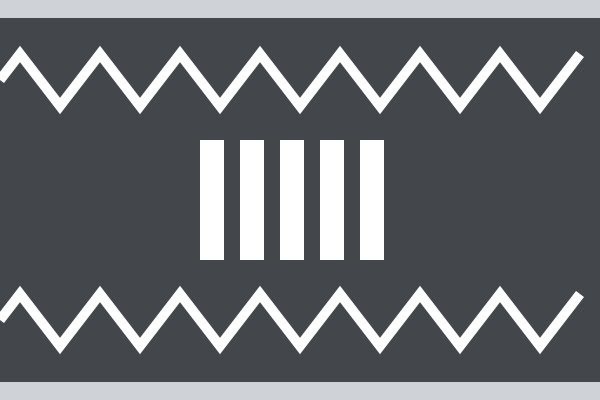
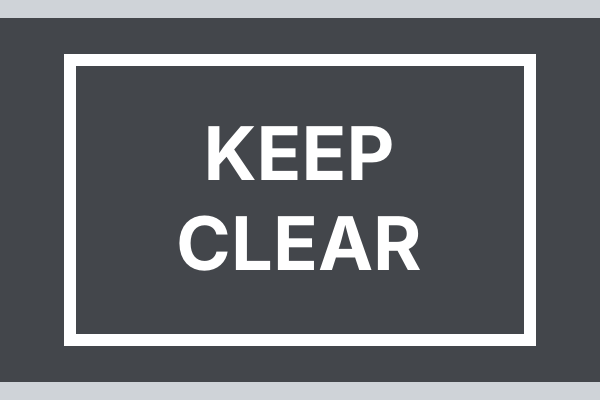
- Pick a straight, quiet section with good visibility.
- Leave enough room in front to rejoin the correct side of the road.
- Avoid stopping opposite a parked vehicle if it creates a narrow channel.
- Do not stop across driveways, dropped kerbs or near junctions.
- If unsure, slow down early and reassess rather than commit late.
Step-by-step: pulling up on the right
Approach the chosen place at a slow, steady speed. You are effectively crossing the path of oncoming traffic, so your checks must be clear and timely. A signal to the right is not always needed if nobody would benefit, but if there is anyone behind or ahead who may need to know your intention, signal in good time.
Steer across gently rather than cutting sharply. Aim to finish parallel with the kerb, reasonably close, and with the wheels straight. You do not need to be touching the kerb or within a tiny distance. In a lesson, I usually drill this first at walking pace so the pupil can feel how little steering is needed once the car is lined up.
- 1Check interior mirror, right mirror and right blind spot before moving across.
- 2Look well ahead for oncoming traffic and pedestrians.
- 3Signal right if it would help another road user understand your plan.
- 4Move across slowly, keeping the car under full control.
- 5Straighten the wheels as the car becomes parallel with the right kerb.
- 6Stop reasonably close to the kerb and secure the car if needed.
Reversing two car lengths safely
Before reversing, look all around: front, rear, both sides and blind spots. Then select reverse and begin slowly. You should mainly be looking through the rear window, but you must keep checking all around because traffic can appear from either direction. Remember, you are on the opposite side of the road, so vehicles approaching from ahead are now very close to your side of the car.
Keep the car slow enough that you can stop immediately. If a vehicle, cyclist or pedestrian appears, stop and wait. This is not hesitation; it is correct. The examiner would rather see you stop three times for genuine hazards than reverse continuously while someone is being affected.
For steering, make only small corrections. If the kerb appears to move away from the car in your rear view, steer slightly towards it; if you are getting too close, steer slightly away. Do not stare at the kerb. The common fault is becoming so interested in kerb distance that the learner misses a car approaching from the front.
- 1Prepare the car in reverse and find the biting point or use gentle automatic creep.
- 2Complete full all-round observations before the car moves.
- 3Reverse slowly, mainly looking through the rear window.
- 4Check the front regularly for oncoming vehicles, as they are nearest to you.
- 5Pause if anyone could be affected, then continue only when safe.
- 6Stop after about two car lengths and apply the brake firmly.
Moving off from the right-hand side
This is the part many learners underestimate. You are parked on the wrong side of the road and need to cross back to the left, so your observations must be excellent. You need to know what is coming from behind you, what is coming towards you, and whether anyone is overtaking, crossing or emerging nearby.
Use mirrors and blind spots before you move. A left signal is often useful because you are moving back across the road, but only signal when it will help and not confuse. If a vehicle is approaching from either direction, wait. You do not have priority just because you have finished the reversing part.
Move away positively but not aggressively. Get the car straightened on the left side of the road as soon as it is safe. In practice sessions, I often make pupils verbalise “front, back, blind spot, go or wait” because it slows the brain down and stops the rushed pull-away that causes serious faults.
- Check ahead for oncoming traffic before anything else.
- Check interior and left mirror, then left blind spot before moving.
- Do not swing out if a vehicle is close behind or approaching from ahead.
- Signal left if another road user would benefit.
- Cancel the signal once you are back on the left and driving normally.
What counts as a fault on the driving test
A small correction is not a problem. Being slightly wide from the kerb is not automatically a fail. Reversing a little more than two car lengths is not the main issue. Examiners are trained to assess safety, control and judgement, not whether your bumper stopped at an exact mark.
A driving fault may be recorded for things like weak observation, poor control, stopping too far from the kerb, or taking too long when it affects progress. A serious or dangerous fault is more likely if you cause another road user to slow, stop or change direction, move off without proper checks, mount the kerb, or reverse when someone is close behind you.
Be honest about priorities. It does not matter if your hands do not stay in a textbook position. It does not matter if you pause during the reverse. It does matter that the car is slow, the steering is controlled, and you know what is happening around you at all times.
- Safety is the first priority.
- Observation must be active, not a quick glance.
- Control should be slow and smooth.
- Accuracy is required, but not to centimetre-perfect parking standards.
How to practise it in lessons
I teach this manoeuvre in layers. First, we practise pulling up on the right without reversing, just to build judgement when crossing the road. Then we add a short reverse, then the full two car lengths, then the move-off. Once the pupil can do it on a quiet road, we practise with normal traffic so they learn when to wait.
A good drill is to repeat the same stretch three or four times, changing only one thing each attempt: kerb distance, observation rhythm, or moving-off decision. Trying to fix everything at once usually makes the driver tense. If you are taking an intensive course, this manoeuvre fits well into a focused session because it combines meeting traffic, reversing control and safe judgement.
Fast Track Driving Lessons provides intensive courses from 10 to 40 hours at £61.23 per hour, and learners can use free theory test practice at /theory. Prices can change, so always check the current course information before booking. Whatever course length you choose, this manoeuvre should be practised until it feels calm rather than lucky.
Common questions
Do I have to signal when pulling up on the right?
Signal if it would help another road user understand what you are doing. If there is nobody to benefit, a signal is not essential. What matters is that you check properly and do not mislead anyone.
How close should I be to the kerb?
You should be reasonably close and parallel, but it does not need to be perfect. A large gap may show poor control, and touching or mounting the kerb can be marked as a fault. Aim for a normal parking distance rather than a centimetre-perfect finish.
What if a car comes while I am reversing?
Stop and wait. If the vehicle passes safely, continue when it is clear and after checking all around again. If the driver waits for you, be careful: do not assume it is safe until you have checked for other road users as well.
Can I use the reversing camera or parking sensors?
You may use reversing aids if the car has them, but you must not rely on them. The examiner needs to see effective all-round observations, especially through the rear window and towards approaching traffic. Cameras and sensors do not replace looking.
Will I fail if I reverse more than two car lengths?
Not automatically. The examiner is not measuring it exactly, but you should respond sensibly to the instruction. Reversing a long way unnecessarily, especially if it affects traffic or shows poor control, can lead to a fault.
Is pulling up on the right illegal?
It is not automatically illegal in daylight where stopping is permitted and safe. However, the Highway Code says you should not park facing against the traffic flow at night unless in a recognised parking space. You must also avoid places where stopping is prohibited, dangerous or obstructive.
Book manoeuvre practice
Reading about it only gets you so far. Our instructors drill this with you in the car, on the roads around your test centre.