
The short version
- At night you see less detail, so you need more time and space.
- Use dipped headlights correctly and avoid dazzling other road users.
- Slow earlier for junctions because judging gaps is harder in the dark.
- Glare is managed by looking ahead and to the left, not by staring at headlights.
- Learners should practise night driving before driving alone after passing.
What changes when you drive at night?
Driving at night changes three big things straight away: what you can see, how early you can see it, and how confidently other people can see you. As an instructor, the first thing I notice with learners after dark is that they often drive as if it is still daylight. They keep the same following distance, approach junctions at the same pace and leave decisions until the same point. That is usually where the trouble starts.
In daylight, you pick up clues from colour, movement, eye contact and the shape of the road. At night, many of those clues disappear or arrive late. A pedestrian in dark clothing, a cyclist without bright clothing, a parked car on an unlit road or a bend hidden beyond a pool of headlight can all be missed until you are much closer. Your dipped headlights only show you a limited area, so your speed must fit what you can actually see, not what you know the road is like in daytime.
The main skill is creating more thinking time. That means easing off earlier, scanning further ahead, leaving bigger gaps and being more deliberate with mirrors and signals. Nervous learners often grip the wheel and stare into the brightest lights ahead. Better night drivers keep their eyes moving, use the left-hand kerb line and road markings as guides, and make every approach calmer than it needs to be.
Lights, the law and what examiners expect
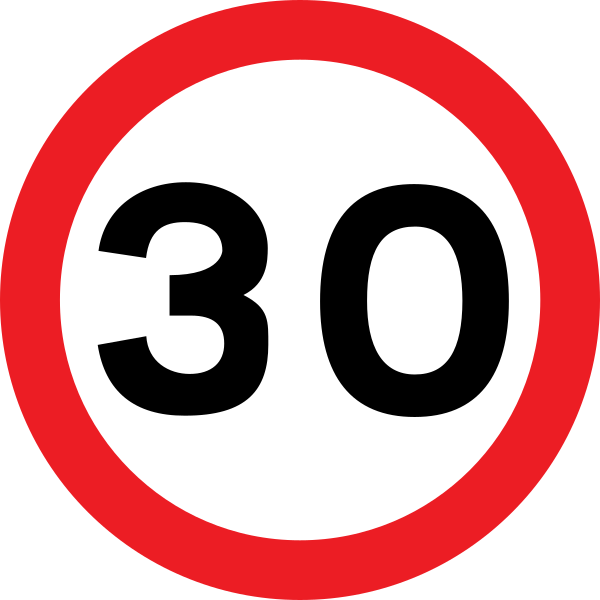
This is general guidance, not legal advice. The Highway Code says you must use headlights at night, except on roads with lit street lighting, which are generally restricted to 30 mph unless signs say otherwise. Rule 113 covers lighting requirements, Rule 114 says you must not use lights in a way that dazzles other road users, and Rule 115 gives guidance on using dipped headlights in built-up areas and in dull daytime weather. The wording and law can change, so always check the current Highway Code and GOV.UK.
On test, examiners do not reward you for knowing the rule number, but they do mark the result of poor light use. If you forget to switch lights on, leave full beam on towards traffic, or fail to use lights when visibility is poor, the fault is not just technical. It affects safety, judgement and consideration for others. I have seen good drivers make themselves look unprepared simply because they set off from a well-lit car park and did not realise their lights were not properly on.
Know your own car. Many modern cars have automatic lights, but you are still responsible for them. Automatic systems may not put rear lights on in some daytime running light settings, and they can be slow to react in fog, heavy rain or tunnels. Before a night lesson, I ask pupils to show me side lights, dipped beam, main beam, fog lights, hazard warning lights and the dashboard symbols. If they cannot, we sort it before moving off.
- Use dipped headlights at night when required and whenever they help others see you.
- Use main beam only where it is safe and dip it before you dazzle oncoming traffic or a vehicle ahead.
- Check your dashboard symbol so you know whether dipped beam or main beam is on.
- Keep lights, number plates, mirrors and windows clean because dirt causes glare and reduces visibility.
- Use fog lights only when visibility is seriously reduced, usually below 100 metres, as covered by Highway Code Rule 226.
Speed and stopping distance after dark
The posted speed limit is not a target. That matters even more at night. Highway Code Rule 126 reminds drivers to leave enough space to stop safely and gives the usual two-second rule in dry conditions, doubled in the wet. At night, I want learners thinking beyond the rule: can you stop within the distance you can see to be clear? If the answer is no, you are too fast for the conditions.
A common test fault is approaching a dark bend, parked vehicles or a junction at a speed that forces a late brake. The examiner is not sitting there with a stopwatch. They are judging whether your speed gives you time to deal with a hazard smoothly. If the car ahead brakes sharply and you have to stab the brake because your following gap was still a daytime gap, that can become a serious fault depending on the risk created.
Good night speed control starts with early easing off. Come off the gas before you need the brake. Let the car settle before turns. On country roads, assume there may be mud, deer, cyclists, horse riders, broken-down vehicles or pedestrians just beyond your lights. On urban roads, assume someone may step out between parked cars without you seeing their face or clothing until late.
- Ask yourself whether you can stop in the lit area ahead.
- Leave more space behind larger vehicles because they block your view.
- Brake earlier and lighter so following drivers get more warning.
- Reduce speed before bends, not once you are already in them.
- Treat shiny road surfaces with caution because wet roads reflect light and hide markings.
Junctions, roundabouts and judging gaps
Judging speed and distance is harder at night because you often see lights before you see vehicles. A pair of headlights can look closer or further away than it really is, especially on a bend or brow of a hill. New drivers sometimes pull out because the lights seem slow, then realise the vehicle is travelling faster than expected. If you are not sure, wait. A safe hesitation is better than a rushed emerge.
At roundabouts, learners often fixate on the nearest set of headlights and forget the bigger picture. You still need the same routine: mirrors, signal where needed, position, speed and look. But your final decision should be made at a lower approach speed, giving you time to judge lane position, indicators and the movement of vehicles already on the roundabout. Do not trust an indicator alone, especially at night when side positioning is harder to read.
At T-junctions, creep and peep becomes more important where parked vehicles, walls or hedges block your view. Creep slowly with the car under control, looking both ways more than once. I teach pupils to listen as well as look after dark. You may hear an engine, a cyclist on gravel, or a vehicle approaching before you fully see it. Listening never replaces observation, but it adds another clue.
- 1Approach earlier and slower than you would in daylight.
- 2Take a first look to build the picture, not to make the decision.
- 3Check mirrors and position so your intentions are clear.
- 4Look again for unlit cyclists, pedestrians and vehicles partly hidden by parked cars.
- 5Only move when you can complete the manoeuvre without making another road user change speed or direction harshly.
Dealing with glare and dazzling headlights
Glare is one of the biggest night-driving complaints from learners and new drivers. Some vehicles sit higher, some lights appear very bright, and wet roads can turn every headlight into a reflection. The mistake I see most is staring straight at the oncoming lights. Your eyes are drawn to them, but staring reduces your ability to see the edge of the road and recover afterwards.
The better technique is to look well ahead and slightly to the left, using the nearside kerb, verge or lane markings to keep your course. Keep your speed steady if it is safe, and ease off if you are losing detail. Do not retaliate with your own main beam. That creates danger for both drivers and would be marked very badly on test if it affected safety.
Your mirrors matter too. If a vehicle behind is dazzling you, use the anti-dazzle setting on the interior mirror if fitted. Keep exterior mirrors clean and properly adjusted. A dirty windscreen, inside or out, makes glare much worse. I have had pupils think they cannot cope with night driving, then improve immediately after cleaning the inside of the screen and adjusting the mirror correctly.
- Do not stare at oncoming headlights.
- Use the left edge of the road or lane markings as a guide.
- Slow down if glare means you cannot see enough detail.
- Dip your main beam early for oncoming traffic and when following another vehicle.
- Clean the inside of the windscreen because smears multiply glare.
Pedestrians, cyclists and parked vehicles
Vulnerable road users can be much harder to spot at night, particularly in rain or on roads with uneven street lighting. Learners often look for cars first because car lights stand out. The safer habit is to scan for spaces where people could appear: bus stops, takeaways, pubs, crossings, gaps between parked cars, school entrances after events, and driveways. The danger is not always the person you can see. It is the person hidden behind the vehicle you are passing.
Highway Code Rule 170 reminds drivers to watch out for pedestrians crossing a road into which you are turning. At night, this is a common place for faults. A learner turns left neatly, but their eyes are already looking into the new road for car hazards and they miss a pedestrian stepping from the kerb. Examiners watch your head movement and, more importantly, whether the car is slow enough for you to give way if needed.
When passing parked vehicles, give doors, mirrors and pedestrians enough space. If you cannot give space because of oncoming traffic, hold back. At night, do not assume a parked car is empty. Interior lights, exhaust fumes, brake lights or a slight wheel angle can warn you that it may move. Cyclists may be visible only by a small light or reflector, and some may be poorly lit despite the legal requirements.
- Slow near crossings, bus stops and rows of parked cars.
- Check the pavement as well as the carriageway when turning.
- Leave room for car doors and people stepping out.
- Look for small lights and reflectors, not just full-sized headlights.
- Be ready to hold back rather than squeeze through a narrow gap.
Rural roads, rain and motorway night driving
Unlit rural roads are a different challenge from town driving. Your main beam can help, but only when it will not dazzle others. Dip early for oncoming traffic and dip when following another vehicle. On narrow lanes, the absence of headlights does not mean the road is clear. There may be walkers, animals, farm vehicles, mud, fallen branches or a sharp bend with no warning beyond a sign.
Rain at night increases workload sharply. Wipers, reflections, spray and bright lights can hide road markings and make lane discipline harder. This is where smooth control matters. Avoid sudden steering and harsh braking. If you cannot read the road markings clearly, reduce speed until you can. On test, drifting because markings are hard to see is still a lane discipline issue if it creates risk.
Motorway driving is not part of the practical driving test for car learners, but new drivers need to learn it as soon as they are ready. At night on motorways, keep your eyes moving far ahead, check mirrors before changing lanes, and leave extra space in spray or poor visibility. Do not sit alongside heavy goods vehicles longer than necessary, and do not use main beam when following traffic closely. If you break down, follow current National Highways and Highway Code advice, including getting left where possible and leaving the vehicle from the left if it is safe.
Night-driving checklist for learners and new drivers
The best time to learn night driving is with an instructor or experienced supervising driver before you need to do it alone. Start on familiar roads, then add busier junctions, rural stretches and wet conditions gradually. Do not make your first proper night drive a long journey after work when you are tired and under pressure.
Fatigue is a real part of night driving. Your reactions, concentration and patience can drop before you notice. If you are yawning, missing signs, drifting in your lane or forgetting mirror checks, stop somewhere safe and rest. Coffee and fresh air do not make you a safe driver if you are genuinely tired.
Use this checklist before and during a night drive. It is the same sort of practical routine I use with pupils when they move from daytime confidence to after-dark independence.
- Before moving off: lights selected correctly, windows and mirrors clean, seat and mirrors adjusted, dashboard brightness not distracting.
- On the move: scan further ahead, keep checking mirrors, and leave more space than you think you need.
- At junctions: approach slower, look twice, and do not pull out on a guess about headlight speed.
- With glare: look ahead and slightly left, reduce speed if detail disappears, and never retaliate with main beam.
- In poor weather: slow down early, use wipers and demisters properly, and check whether dipped headlights are needed even in daytime.
- If tired or overloaded: choose a safe place to stop, take a proper break, or change driver if possible.
Common questions
Can learner drivers drive at night in the UK?
Yes, learner drivers can drive at night in the UK as long as they are properly supervised, insured and displaying L plates or D plates in Wales. Night practice is strongly recommended because passing the test does not guarantee you have experience of glare, poor visibility and dark rural roads.
Will I be asked to drive at night on my practical test?
Most practical tests take place in normal test centre hours, so many are in daylight, but winter tests and late afternoon tests can involve darkness or low light. The examiner marks the same skills: safe speed, observation, positioning, control and consideration for others.
Should I use full beam on dark roads?
Use full beam where it helps you see and where it will not dazzle anyone. Dip it for oncoming traffic, when following another vehicle, and anywhere the reflected light or road layout could dazzle others.
Why do I find judging gaps harder at night?
At night you often judge vehicles mainly by their lights, without clear detail of size, speed or road position. Approach junctions more slowly, look more than once and wait if you are not sure you can emerge without affecting another road user.
What is the biggest night-driving fault learners make?
The most common serious problem I see is driving at daytime speed with night-time visibility. It leads to late braking, rushed junction decisions and poor response to pedestrians or cyclists who appear late in the headlights.
How many night lessons do I need before driving alone?
There is no official DVSA number of night lessons because learners vary and local roads differ. Aim to practise enough that you can handle urban roads, junctions, glare, rain and at least some unlit roads calmly, without relying on the supervising driver to prompt every decision.
Browse driving lessons
Reading about it only gets you so far. Our instructors drill this with you in the car, on the roads around your test centre.