
You're approaching a junction you've never seen before. The road bends slightly, a cyclist is waiting near the kerb and a vehicle may be emerging from the side road ahead. Whether you're facing a roundabout, a T-junction, traffic lights or a motorway slip road, the safest response starts with the same habits: reduce speed, read signs and markings, check mirrors, position early and observe before you commit.
This guide explains nine types of junctions on UK roads. Some are level junctions where roads meet directly. Others are circular junctions, pedestrian-controlled crossings or grade-separated interchanges where roads pass above or below one another. The layout gives you clues, but it doesn't decide priority by itself. Signs, road markings and traffic signals always take precedence over assumptions based on the shape of the road.
Use the same simple framework each time: identify the layout, establish who has priority, choose a safe approach speed and act decisively when the way is clear. The DVSA learning-to-drive syllabus expects learners to deal safely with T-junctions, Y-junctions, staggered junctions, crossroads and roundabouts, including turning left, turning right, travelling ahead and crossing the path of oncoming traffic.
Junction priority must be read from signs, markings and signals. Never infer it from the junction's appearance alone.
Table of Contents
- 1. Roundabout
- 2. T-Junction
- 3. Four-Way Junction Crossroads
- 4. Traffic Light-Controlled Junction
- 5. Staggered Junction
- 6. Slip Road Motorway Junction
- 7. Mini-Roundabout
- 8. Pedestrian Crossing-Controlled Junction
- 9. Grade-Separated Junction Motorway Interchange
- Comparison of 9 Junction Types
- Make Priority Decisions Earlier
1. Roundabout
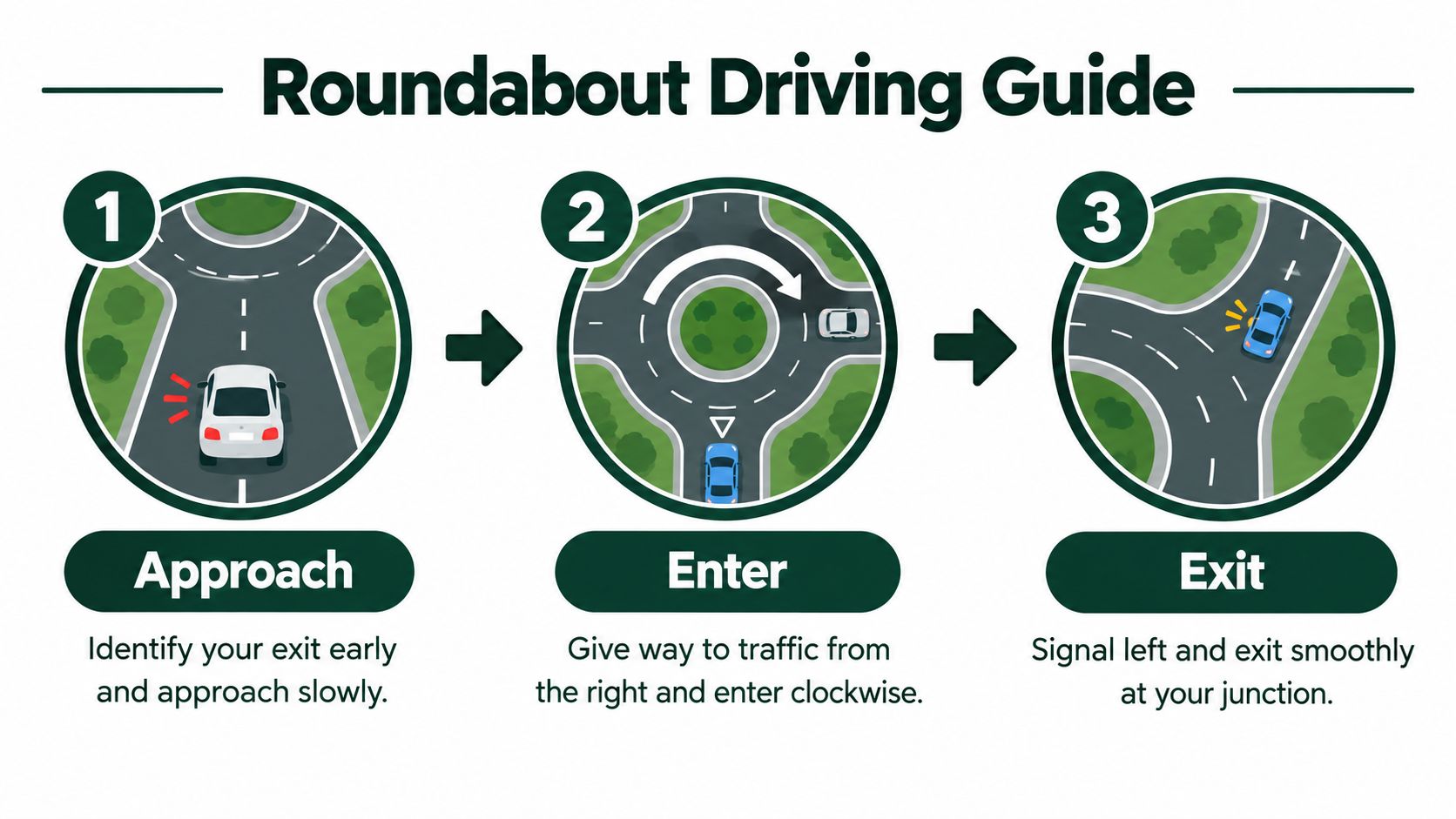
A roundabout is a circular junction where traffic travels clockwise around a central island. In normal circumstances, you give way to traffic approaching from your right and to vehicles already circulating, unless signs, signals or road markings tell you otherwise. You'll find roundabouts ranging from quiet single-lane layouts to complex multi-lane systems with several exits.
The safest approach begins before the give-way line. Check your mirrors, identify your exit, read the lane arrows and reduce speed so you can assess traffic without making a rushed decision. Signal left as you pass the exit before yours, then keep checking mirrors as you leave.
Lane choice matters more on larger layouts
On a single-lane roundabout, your main tasks are speed control, observation, gap selection and timely signalling. On a multi-lane roundabout, you'll also need to follow lane markings, maintain your position and check blind spots before changing lanes or leaving. Don't assume that the lane you used to enter will always lead naturally to your exit.
The Magic Roundabout in Swindon, the roundabout at the Heathrow Airport entrance and County Gate roundabout in Bristol all demonstrate how different a circular layout can feel in practice. The same principles still apply, but local signs and lane arrows determine how you should proceed.
For a detailed refresher, use this guide to types of roundabouts. During lessons, practise on familiar local roundabouts first, then build towards busier or multi-lane routes.
Practical rule: Know your exit before you enter, but keep observing after you've chosen your lane.
Here's a short visual explanation of the approach, entry and exit process:
2. T-Junction
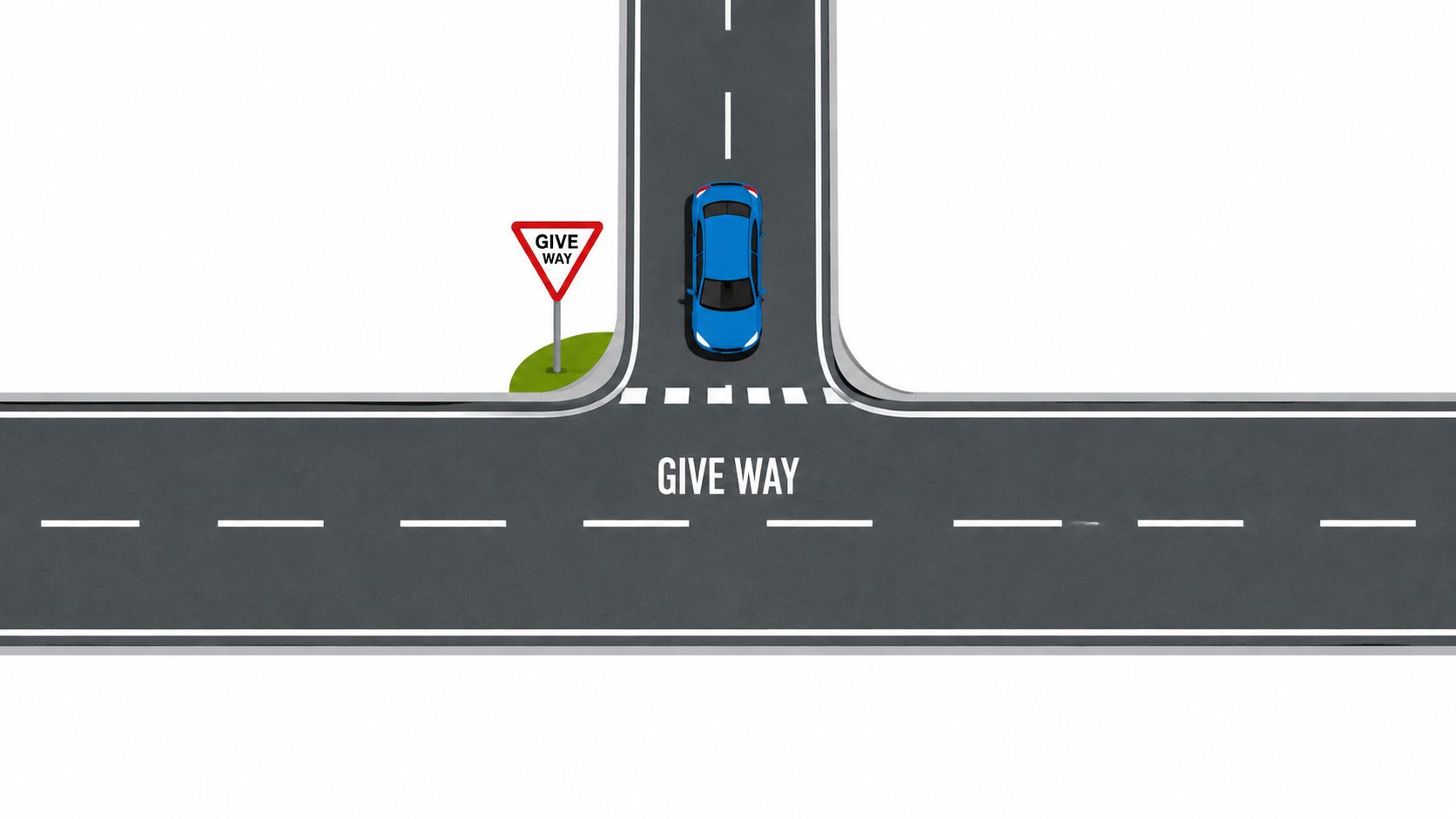
A T-junction has three arms. One road ends at another, so the vehicle approaching along the stem usually has to give way to traffic on the road running across the top of the T. That expectation is useful, but it isn't a substitute for reading the actual signs, markings and visibility.
At a marked give-way line, you must give way before emerging. The approach may also have a Give Way sign or triangular road marking, and the Highway Code guidance on using the road applies to T-junctions, Y-junctions, staggered junctions and crossroads.
Build a view before you turn
Slow down well before the line and use your mirrors before positioning. If you're turning left, look for traffic approaching from the right, cyclists near the kerb and pedestrians crossing the road you're joining. If you're turning right, you'll need to assess traffic from both directions and cross the path of oncoming vehicles only when there's a safe gap.
Buildings, hedges, parked vehicles and angled walls can restrict your view. If you can't see clearly, stop at the line and edge forward carefully only when it's safe to improve your view. Don't roll into the major road while looking in just one direction.
Residential T-junctions on UK high streets, village junctions in rural England and A-road approaches into cities such as Edinburgh can all demand different speeds and levels of observation. A familiar shape doesn't guarantee a familiar risk. On a driving test, clear observation and a controlled, decisive decision matter more than entering quickly.
3. Four-Way Junction Crossroads
A crossroads is formed where two roads cross, creating four possible traffic movements. The roads may be similar in width and importance, or one may clearly carry the main flow. The junction might be controlled by traffic lights, marked give-way lines or signs, or it might have little visible control in a quiet village.
The first task is to identify how priority is being managed. Look for signs, stop or give-way lines, traffic signals, lane arrows and the position of other vehicles. At an uncontrolled crossroads, slow down early and be ready to stop. If you're unsure who should proceed, waiting is safer than assuming another driver will yield.
Avoid the simultaneous-arrival trap
Several vehicles can approach at once, especially where roads are narrow or visibility is limited. Don't rely solely on eye contact, because another driver may not have seen a cyclist, pedestrian or vehicle approaching from a different arm. Scan across the whole junction, not just along the road you intend to join.
A rural crossroads in Norfolk may use give-way signs, while a city-centre crossroads in Manchester may be controlled by signals. An unmarked junction in a Scottish village may require especially cautious observation because road users can have less formal guidance.
For a right turn, check that you won't block the junction or cut across oncoming traffic. Keep your speed low enough to respond to late information, and make your final decision only after you've identified a safe path through.
At an uncontrolled crossroads, uncertainty is a reason to slow or stop, not a reason to press on.
4. Traffic Light-Controlled Junction
Traffic lights control the movement of vehicles and pedestrians through red, amber and green signals. They can manage a straightforward crossroads, a large multi-lane intersection, a roundabout or a crossing within a busy town centre. The lights provide a control system, but you still need to choose the correct lane, monitor surrounding traffic and respond to changes smoothly.
Read the approach lane arrows early. Check mirrors before slowing, maintain a safe following distance and avoid changing lanes at the last moment. A green light means you may proceed if the junction is clear, not that you should enter a blocked exit and stop across the crossing.
Treat amber as a decision point
When amber appears, decide whether you can stop safely based on your speed, distance and the traffic behind you. Don't accelerate to beat the light. If stopping would create a sudden danger, continue with proper care, but don't treat amber as an invitation to rush.
The Highway Code traffic light sequence guidance can help you revise the order and meaning of the signals. Piccadilly Circus in London, traffic controls near Edinburgh's Waverley Bridge and major High Street junctions all show why a learner must look beyond the nearest signal. There may be separate lanes, filter arrows, pedestrian phases or signals positioned above the road.
Remain alert while waiting at red. Check mirrors, watch for cyclists and be ready to move smoothly when the signal changes, while still confirming that the route ahead is open.
5. Staggered Junction
A staggered junction has two side roads joining a main road at offset positions rather than directly opposite one another. From a distance, it may look like a crossroads, but the two side roads are usually treated as separate junctions. That difference can change your priority decision and the path you need to take.
Approach slowly enough to understand the layout before you reach the first arm. Check the signs and markings, then look for traffic emerging from both side roads. If you're turning right, you may need to give way at one point and then reassess the second arm before completing the manoeuvre.
Treat each arm as its own decision
A common mistake is to see a gap in the main-road traffic and focus only on the first turn. A vehicle from the offset road may then become a hazard, or your chosen position may leave you blocking part of the junction. Keep scanning and don't let an apparently simple opening make you rush.
Staggered side roads are found throughout residential areas in London, on suburban approaches in Birmingham and beside rural roads in Yorkshire. The surroundings can make the layout harder to read, particularly where parked vehicles, hedges or farm entrances obscure the second arm.
Use your mirrors before slowing and throughout the turn. If priority isn't clear, stop where you can do so safely and wait for a complete view. The 2024 pedestrian factsheet from the Department for Transport recorded T or staggered junctions as accounting for 29.9% of all reported pedestrian casualties, compared with 7.7% at crossroads. Those figures describe reported casualties, not exposure-adjusted risk, but they support giving these layouts serious attention during training.
6. Slip Road Motorway Junction
A slip road connects a motorway with another road, allowing vehicles to join or leave high-speed traffic without crossing the main carriageway at level. An entry slip road usually gives you space to build speed, while an exit slip road allows you to reduce speed after leaving the motorway. The layout still varies, so follow signs and road markings rather than relying on a memorised pattern.
Learner drivers can study slip-road principles before they're permitted to drive on motorways. Use the available length to adjust speed progressively, check mirrors and blind spots and identify where the joining lane ends. Don't wait until the final moment to merge, but don't force your way into a gap that isn't safe either.
Match traffic without losing control
Joining traffic needs a controlled acceleration that brings you close to the speed of vehicles in the target lane. Check the centre and right mirrors, look over your shoulder where appropriate and keep monitoring the traffic ahead. Once you've merged, settle into the lane and create space before considering another move.
When leaving, signal in good time, move into the exit lane when safe and continue checking mirrors for vehicles that may also be changing lanes. Use the deceleration lane to reduce speed, rather than braking sharply on the motorway itself.
Junctions 1 to 4 of the M25, M6 slip roads around Birmingham and Manchester, and M1 slip roads around London and the Midlands show how busy these connections can become. A post-test driver should plan the route before setting off and consider asking an experienced driver to accompany their first motorway journeys. This motorway driving guide provides further preparation for the transition.
7. Mini-Roundabout
A mini-roundabout is a small circular junction, often marked by a painted circle rather than a raised central island. It uses the same basic priority principle as a larger roundabout. Traffic travels clockwise, and you give way to traffic approaching from the right unless signs, signals or markings provide different instructions.
The lower speed can make a mini-roundabout appear easy, but that doesn't mean you can treat it like a T-junction. Approach with enough control to check every arm, choose the correct route and avoid stopping unnecessarily when the way is clear. If you're turning left or travelling ahead, keep a suitable position and signal left when leaving.
Don't let the small size reduce observation
Mini-roundabouts are common on residential streets in London and Manchester, in village centres and in traffic-calmed areas of Scottish towns. Parked cars and buildings can hide approaching vehicles, while the small circle may leave less room to correct a poor entry position.
Look well ahead for lane markings and signs. Some layouts have more than one approach lane or unusual geometry, so the painted circle alone may not tell you everything. Check mirrors before slowing and as you leave, particularly if a cyclist or motorcyclist is travelling alongside you.
A smooth, flowing approach is usually preferable to an unnecessary stop, but only when you've established that the route is safe. If traffic is already circulating or approaching from the right, give way and wait for a suitable gap.
A mini-roundabout is small in size, not small in responsibility. Apply the circular priority rule and keep your speed under control.
8. Pedestrian Crossing-Controlled Junction
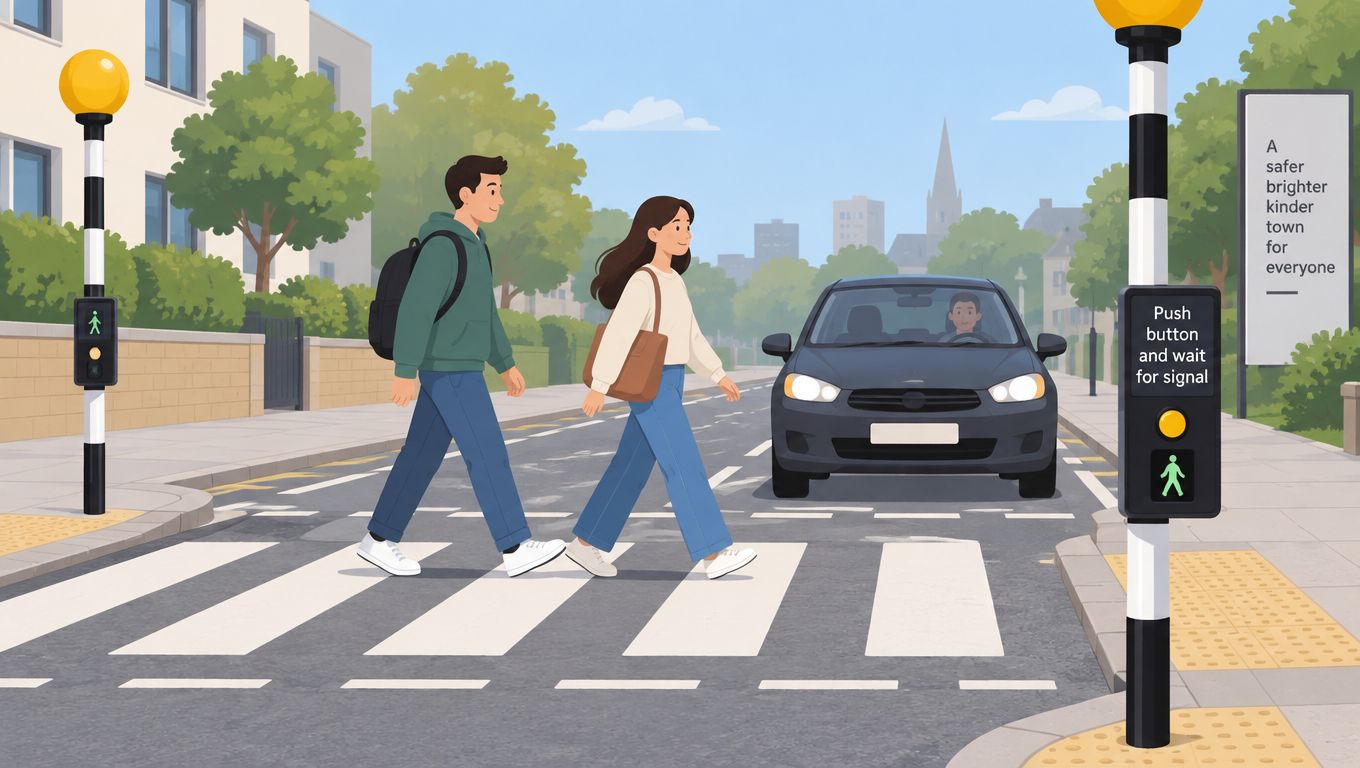
A pedestrian crossing-controlled junction manages vehicle movement around people crossing the road. You may encounter a zebra crossing, pelican crossing, puffin crossing or toucan crossing near a junction, often in a town centre, on a busy A-road or beside a school route. The crossing may be integrated into the junction or positioned just before or after it, so look beyond the immediate give-way line.
Scan pavements and crossing areas before you reach the control point. People may be waiting, moving towards the kerb or hidden by a parked vehicle. Reduce speed early and brake smoothly so pedestrians and following drivers can understand what you're doing.
Turning traffic must protect crossing pedestrians
When turning into or out of a junction, you must give way to pedestrians who are crossing or waiting to cross the road you're entering. Highway Code Rule H2 also requires you to avoid cutting across cyclists, horse riders or horse-drawn vehicles travelling straight ahead, and you must not make them stop or swerve.
Don't wave pedestrians across. Stop where they can see you, let them cross safely and remain alert for someone following behind them. Check mirrors before braking, but don't allow concern about traffic behind to override a person's right to cross safely.
High Street zebra crossings, pelican crossings on busy routes near city centres and puffin crossings in pedestrian-heavy areas such as Oxford Street require anticipation rather than late reactions. School crossing patrols also deserve particular care, because children may change direction or move into the road unexpectedly.
9. Grade-Separated Junction Motorway Interchange
A grade-separated junction allows roads to pass over or under one another using bridges, tunnels or underpasses. Unlike a normal level junction, traffic doesn't usually stop to cross directly through the opposing flow. Slip roads, merge lanes and diverge lanes connect the different routes.
These interchanges are found on motorways and major A-roads. They're designed to preserve traffic flow, but their complex lane arrangements can make route planning difficult. Read direction signs early, choose your lane in good time and avoid unnecessary changes once you're committed to a route.
Plan before the lanes divide
Spaghetti Junction in Birmingham, the M25 interchange at junction 10 with the M1 and Manchester's A57(M) interchange system illustrate how different a grade-separated layout can look. The name or appearance of the interchange doesn't tell you which lane to use. Your destination, signs, lane arrows and sat-nav instructions must work together.
Keep a steady speed and check mirrors frequently, particularly where joining and leaving traffic creates a weaving area. Use acceleration lanes fully when merging, but don't continue in a lane that's ending while hoping another driver will make room. If you miss your exit, continue safely and follow signs for a suitable alternative. Never reverse or stop on a high-speed connection.
Learners won't practise every motorway interchange during ordinary on-road training, but understanding the principles helps after passing the test. On a first motorway journey, an experienced driver can provide useful support while you develop confidence with lane discipline, signs and high-speed gap assessment.
Comparison of 9 Junction Types
| Junction Type | Implementation complexity | Resource requirements | Expected outcomes | Ideal use cases | Key advantages |
|---|---|---|---|---|---|
| Roundabout | Medium, design island & entry geometry | Moderate, land, signage; higher for multi-lane | Smoother flow; lower collision severity | Busy intersections without signals | Continuous movement; traffic calming; reduced impact speeds |
| T-Junction | Low, simple right-angle layout | Low, markings, signs, possible stop/give-way | Clear priority; possible delays for turning traffic | Residential streets and minor-to-major joins | Simple rules; easy to implement and understand |
| Four-Way Junction (Crossroads) | Medium, may need control measures | Variable, signage or signals; moderate space | Efficient cross-traffic if controlled; complex if uncontrolled | Urban and rural crossroads where roads meet | Accommodates four directions; controllable by lights or signs |
| Traffic Light-Controlled Junction | High, signal phasing and detectors | High, equipment, power, maintenance | Unambiguous priority; manages heavy flows safely | Busy urban intersections and pedestrian zones | Removes ambiguity; predictable timing; safer for high volumes |
| Staggered Junction | Low–Medium, offset alignment design | Low, signs and markings; modest land use | Two sequential decision points; potential confusion | Residential and rural roads with offset side roads | Space-efficient; forces attentive driving; slows traffic |
| Slip Road (Motorway Junction) | Medium–High, speed transition design | High, long acceleration/deceleration lanes, signage | Safe merging/diverging at high speed when used correctly | Motorway entry/exit points | Smooth transitions to/from high-speed traffic; reduced conflict |
| Mini-Roundabout | Low, painted centre instead of island | Low, road markings and signs | Calmed traffic; lower approach speeds | Residential streets and quiet town centres | Low cost; effective traffic calming; simpler for learners |
| Pedestrian Crossing-Controlled Junction | Medium, varied crossing types & sensors | Moderate, signals, tactile paving, markings | Increased pedestrian safety; intermittent vehicle delay | Town centres, schools, high-footfall locations | Prioritises pedestrians; clear visual and signal cues |
| Grade-Separated Junction (Motorway Interchange) | Very high, multi-level geometry, ramps | Very high, bridges, land, construction and signage | Uninterrupted high-speed flow; separated conflicts | Major motorways and high-capacity interchanges | Eliminates level crossings; high throughput and safety at speed |
Make Priority Decisions Earlier
The most useful lesson across these types of junctions is that priority begins with reading, not moving. Look for signs, road markings and signals first. Reduce speed early enough to give yourself time to interpret them, then identify who has priority and whether the exit or road ahead is clear.
Your observation must include more than other cars. Check pavements for pedestrians, cycle lanes for cyclists, mirrors for following traffic and blind areas created by parked vehicles, hedges, walls or large vehicles. At a T-junction, that may mean edging forward for a better view. At a roundabout, it may mean holding your lane while checking a blind spot. At a pedestrian-controlled junction, it means preparing to stop before someone steps into the crossing.
Official UK data supports giving particular attention to T and staggered layouts. The Department for Transport's 2023 pedestrian factsheet recorded T, Y or staggered junctions as representing 30.1% of all reported pedestrian casualties, while crossroads represented 7.8% and roundabouts 2.8%. The figures concern reported casualties at or within 20 metres of a junction, not every collision or exposure-adjusted risk, so they shouldn't be treated as proof that one design is automatically more dangerous than another. They do show why observation, approach speed and gap selection deserve structured practice at these layouts.
Junction data also needs careful interpretation. From 2024, Great Britain changed its STATS19 collision classification, with roundabouts and slip roads removed from the junction-detail field because they're recorded elsewhere. The initial impact note on the 2024 STATS19 specification explains why apparent changes in category percentages can't automatically be read as changes in safety. A raw count may reflect how often a layout is used, how collisions are classified or how the road environment changes.
Practise locally, but don't limit yourself to one familiar route. Use routes containing T-junctions, staggered junctions, crossroads, signal-controlled junctions, mini-roundabouts and larger roundabouts. Mock tests near your chosen test centre can reveal whether you're reacting to each situation or just repeating a script.
Structured feedback is especially valuable when a manoeuvre feels almost right. An instructor can identify whether the problem is late mirror checking, excess speed, weak gap judgement, poor lane choice or hesitation after the correct decision has already been made. Fast Track Driving Lessons offers intensive and semi-intensive tuition, route-based mock tests, a Learner Hub and manual or automatic instruction through matched instructors. Those tools can support preparation, but the goal remains your own judgement at unfamiliar junctions.
Keep the final routine short enough to use under pressure:
Look, slow, decide, act, and keep checking.
Fast Track Driving Lessons connects learners with DVSA-approved instructors for intensive and semi-intensive manual or automatic tuition, including practice on different junction layouts and mock tests near the chosen centre. Visit Fast Track Driving Lessons to find structured support for junction observation, positioning, speed control and safe gap judgement.
Written by Fast Track editorial team.