
Fewer than half of car theory-test attempts in Great Britain currently end in a pass. DVSA data shows the pass rate fell from 65.4% in 2007/08 to 44.8% in 2025/26, a decline of 20.6 percentage points (official DVSA theory-test statistics). If you're learning how to pass theory test first time, casual reading and a few familiar-looking practice questions aren't enough. You need a plan that trains knowledge, judgement and test technique together.
The target isn't just to feel prepared. You must clear 43 out of 50 in multiple choice and 44 out of 75 in hazard perception during the same appointment. The approach below treats those marks as one combined hurdle, then turns them into a practical revision routine you can follow around work, college or driving lessons.
Table of Contents
- Why Passing First Time Is Harder Than It Looks
- How the UK Theory Test Really Works
- Your Two Week Revision Timetable That Actually Works
- Hazard Perception Strategies That Boost Your Score
- Common Pitfalls That Cause First Time Fails
- Final Checks and What to Do After You Pass
Why Passing First Time Is Harder Than It Looks
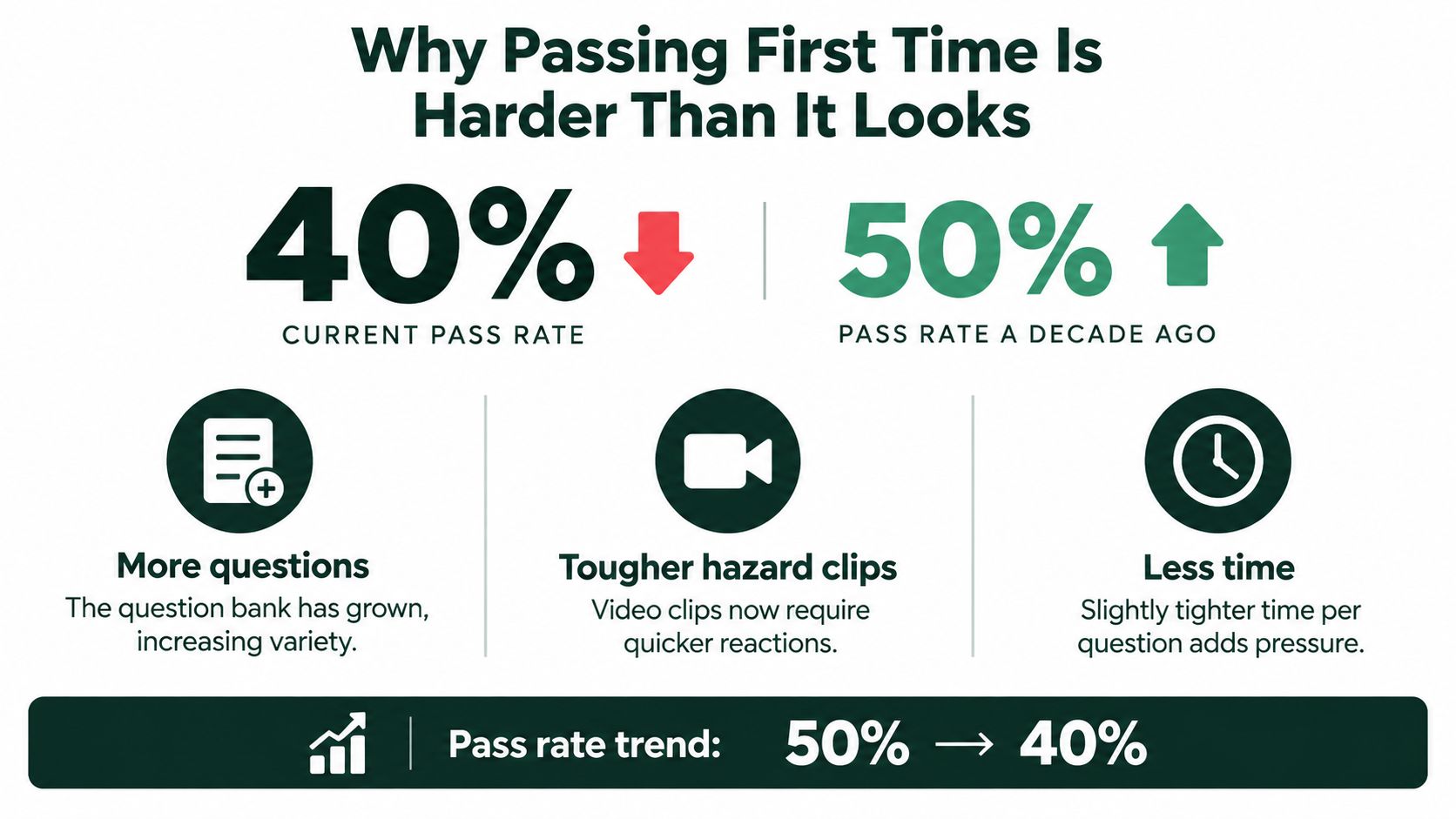
The current national result should change how you prepare. A 44.8% pass rate in 2025/26 means fewer than half of attempts ended successfully, compared with 65.4% in 2007/08 (DVSA national data). That doesn't mean the test is impossible. It means the old approach of reading the Highway Code once, answering a handful of questions and hoping for the best is unreliable.
The test examines more than recognition of road signs. It checks whether you understand rules, apply safe decisions and identify developing danger in moving scenes. A learner can perform well on multiple choice and still fail because hazard perception falls short. Equally, confident clicking won't rescue weak knowledge of signs, markings, priorities or vehicle safety.
Replace hope with a measurable standard
Your working objective should be to repeatedly outperform the national pass rate, not to scrape a single practice score. The official benchmark is clear, but one lucky mock test doesn't prove readiness. You need stable performance across unfamiliar questions and hazard clips, with enough margin to cope with nerves.
Practical rule: Don't book because you've passed once. Book when your scores show that both sections are dependable.
The statistics are also published by financial year, gender, age and test centre through DVSA's national framework, covering England, Scotland and Wales (DVSA tables index). Centre-level information can help you understand the wider context, but it shouldn't encourage you to hunt for an “easy” venue. The pass mark is standardised, and there's no evidence that a particular centre gives an easier test.
What a first-time plan must include
A credible plan has four parts:
- Official knowledge: Work from the Highway Code and DVSA-aligned materials rather than thin summaries.
- Timed recall: Use full mock tests so you practise retrieving information under pressure.
- Error correction: Study every wrong answer, including answers you guessed correctly.
- Visual judgement: Practise hazard clips regularly, not only when multiple-choice scores look comfortable.
That combination is more demanding than passive revision, but it removes the most common source of false confidence. You're not trying to remember a list of answers. You're building the ability to recognise the rule behind a question and the danger developing in front of you.
How the UK Theory Test Really Works
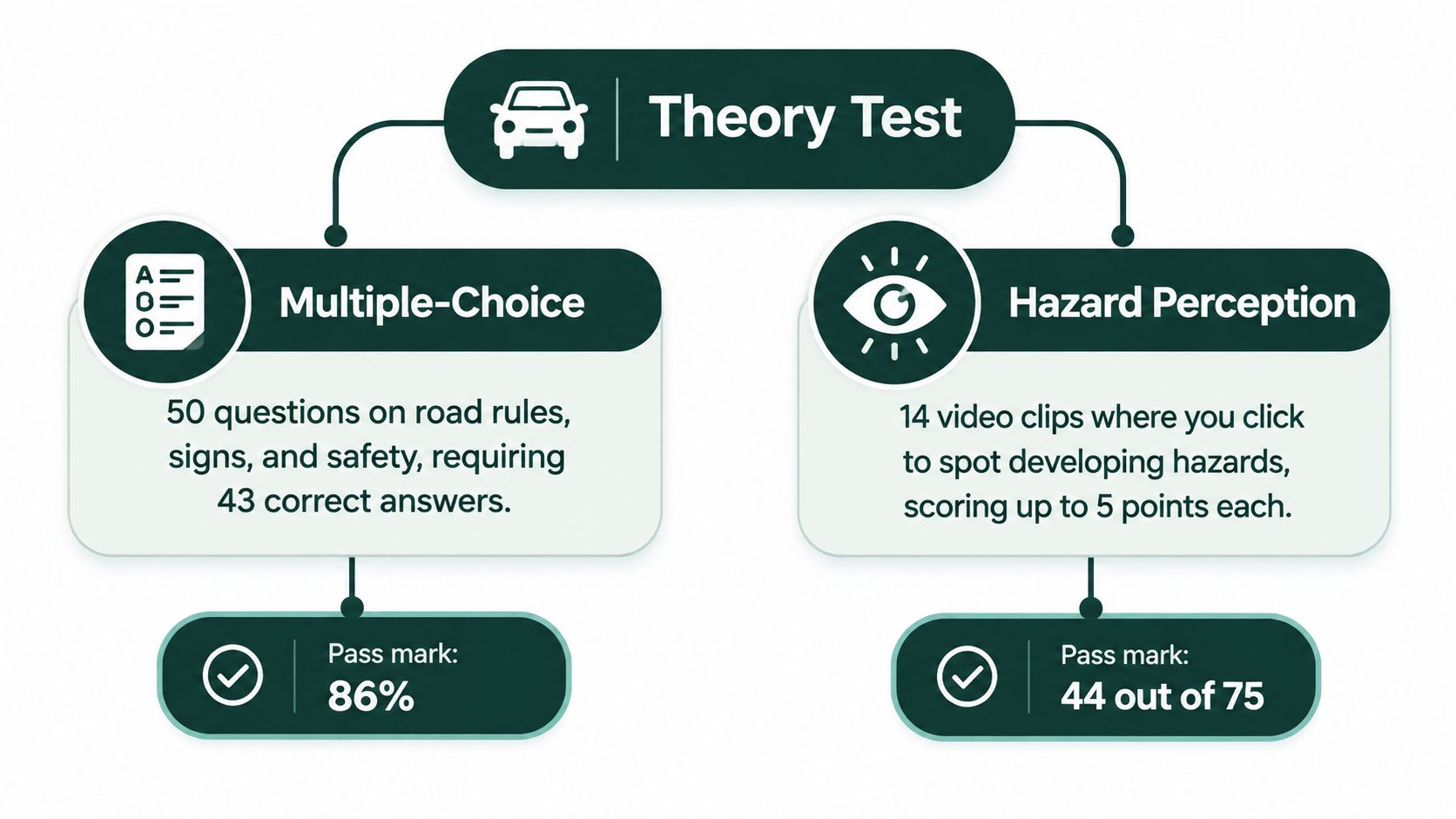
The car theory test has two sections taken during one appointment. The DVSA requires you to score at least 43 out of 50 in multiple choice and at least 44 out of 75 in hazard perception, and both sections must be passed in the same sitting (DVSA pass marks and results).
Multiple choice tests applied knowledge
The multiple-choice section covers subjects including road rules, signs, markings, vehicle handling, safety and responsible road use. Questions may include a case-study style scenario, so memorising isolated answers can fail when the wording or context changes.
Read each question fully before looking at the options. Identify what the question is testing, then eliminate answers that conflict with the Highway Code or safe driving principles. If two options seem plausible, return to the precise wording. Small details such as road position, weather, visibility or the presence of vulnerable road users can change the correct response.
The official DVSA revision and practice guidance recommends using books and software, taking practice tests and working with the Official DVSA Theory Test Kit, the car-driver book and traffic-sign flashcards. Those materials are useful because they keep revision aligned with the rules and format you're expected to know.
Hazard perception measures timing
Hazard perception uses video clips of everyday road situations. You click when you see a developing hazard, meaning something that would cause you to take action, such as changing speed or direction. Clicking too early, before a hazard develops, may not score, while uncontrolled repeated clicking can be treated as inappropriate.
Watch the road environment rather than staring at one object. Scan parked vehicles, side roads, crossings, cyclists, pedestrians, bends and changes in traffic flow. The skill is recognising what could require a response, then clicking as the situation becomes actionable.
For a concise explanation of the sections, scoring and result process, use this guide to how the theory test works. Treat your result as a diagnosis. If one part is below standard, revise that skill instead of assuming the other section will compensate.
Your Two Week Revision Timetable That Actually Works
A two-week schedule works best when every day has a defined purpose. Start with the rules, move into timed retrieval, then spend the final days testing consistency rather than cramming new material. The official DVSA approach supports studying official materials, taking practice tests and practising with the Official DVSA Theory Test Kit (DVSA revision guidance).
Use the table as a framework. If you work long shifts, split the day's study into shorter sessions, but keep the order of activities.
| Day | Focus Area | Key Task | Target Outcome |
|---|---|---|---|
| 1 | Highway Code foundation | Read the Highway Code from start to finish and note unfamiliar rules | Understand the full subject range |
| 2 | Signs and markings | Study road signs, signals, lines and lane markings with flashcards | Recognise signs by meaning and action |
| 3 | Junctions and priorities | Review junction rules, roundabouts, crossings and vulnerable road users | Explain who should wait and why |
| 4 | Vehicle safety | Revise vehicle condition, loading, lights, stopping distances and handling | Link safety rules to driving decisions |
| 5 | First timed mock | Take a full multiple-choice mock without pausing | Establish a genuine baseline |
| 6 | Error drilling | Review every wrong or guessed answer and return to the relevant rule | Turn mistakes into notes |
| 7 | Hazard perception | Complete a full set of hazard clips and review low-scoring scenes | Identify developing hazards earlier |
| 8 | Mixed recall | Take another timed mock, then practise signs and weak topics | Improve recall under time pressure |
| 9 | Hazard timing | Complete another full hazard set, focusing on calm, purposeful clicks | Avoid late clicks and over-clicking |
| 10 | Rules in context | Revisit case studies, weather, road users and changing road conditions | Apply rules to unfamiliar wording |
| 11 | Mock and correction | Take a full mock and immediately correct errors | Move towards dependable performance |
| 12 | Targeted repair | Spend most revision time on your two weakest categories | Close specific knowledge gaps |
| 13 | Full rehearsal | Complete a realistic combined practice session | Check both sections in one sitting |
| 14 | Light review | Read short notes, refresh signs and hazards, then rest | Arrive alert rather than overloaded |
How to use each study session
Begin with active recall. Close the book and explain a rule aloud, sketch a sign from memory or answer questions without checking the explanation first. Then use the explanation to correct your reasoning.
For multiple choice, don't record only the final score. Keep an error log with three columns: the question topic, why your answer was wrong and the rule that would have led you to the right answer. Include questions you guessed, because a lucky answer can hide a knowledge gap.
For hazard perception, practise full test-length sets rather than isolated clips only. Single clips can make your timing feel better than it is. After each session, ask what changed in the scene, when the risk became actionable and whether your click reflected that moment.
A useful comparison is A-Level Past papers. They aren't theory-test materials, but the principle of timed papers, marking errors and revisiting weak topics transfers well to driving revision. The resource is particularly useful if you need a structured way to turn practice into correction rather than just collecting scores.
The booking decision
Don't treat the timetable as a promise that you'll be ready after fourteen calendar days. Treat it as a test of evidence. If your multiple-choice results remain below the required level, or hazard perception is inconsistent, repeat the weak days before sitting the test.
This guide on how to revise for the theory test can support a longer schedule when two weeks isn't realistic. The key is the sequence, official material, timed practice, immediate correction and repeated hazard work.
Hazard Perception Strategies That Boost Your Score
Hazard perception rewards observation and timing, not frantic clicking. A developing hazard starts as a situation that may require action, then becomes more immediate as the road scene changes. Your task is to notice that progression and respond at the right point.
Consider a pedestrian walking beside a road. At first, the person may be safely contained on the pavement. If they turn towards the kerb, move around an obstruction or approach a crossing, the situation deserves closer attention. If they step into your path or create a need to slow or alter position, the hazard is developing. Click when that change becomes clear, not merely because a pedestrian exists.
A similar pattern appears at a junction with restricted visibility. A parked vehicle may hide a cyclist or car. The obstruction itself is an observation cue, but the developing hazard is the road user emerging into a path that affects your progress. Scan beyond the obstruction and click as the risk becomes real.
Build a reliable scanning rhythm
Use a left-to-right and near-to-far scan. Keep checking:
- Road edges: Look for pedestrians, cyclists, parked vehicles and doors that may open.
- Side roads: Watch for vehicles approaching a junction, especially where visibility is limited.
- Traffic flow: Notice brake lights, queues, merging vehicles and sudden changes in speed.
- Conditions: Rain, glare, darkness or standing water can change how quickly a situation develops.
Weather matters because it changes stopping distance, visibility and the time available to respond. Don't wait for a hazard to become obvious if the surrounding conditions already demand more caution.
Click with control
A single click can be mistimed. A short, deliberate sequence can help you register the developing phase without resorting to rapid, random clicking. The sequence should reflect a changing situation, not a fixed clicking pattern.
Avoid clicking continuously throughout a clip. That approach doesn't demonstrate observation and may produce an inappropriate-click result. Equally, waiting until a pedestrian, cyclist or vehicle is directly in conflict with you is often too late.
After every practice set, review the clips where your score was weak. Ask three questions:
- What first drew my attention?
- What visual change made the hazard develop?
- Did I click before, during or after that change?
Keep a short hazard log. “Missed cyclist behind parked car” is more useful than “bad score”. The next session can then target concealed road users, junctions or changing traffic rather than repeating clips without learning from them.
Use this hazard perception explanation alongside official practice. The aim isn't to predict a clip. It's to develop the same observation habit you'll need on the road.
Common Pitfalls That Cause First Time Fails
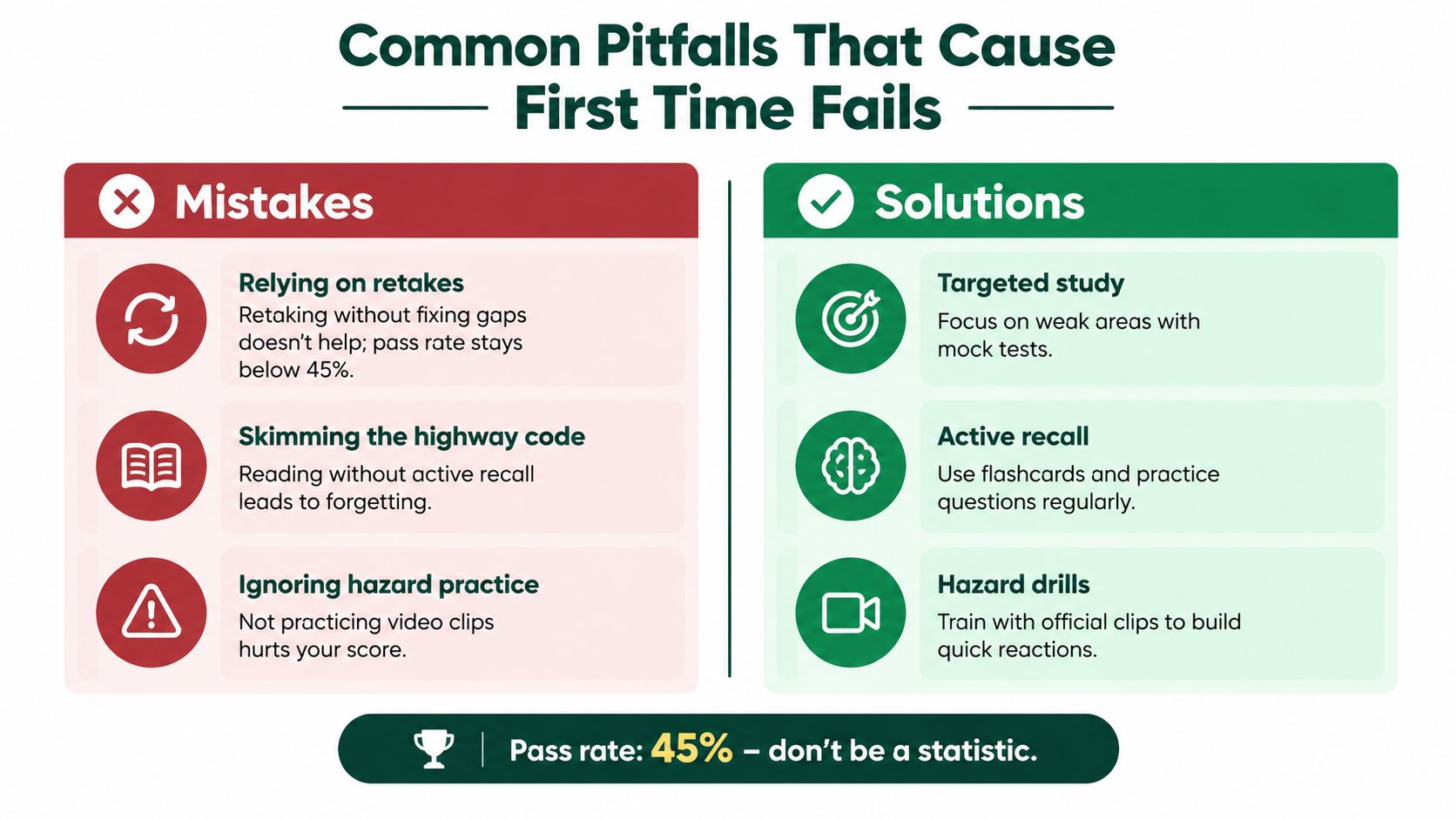
Retaking the test isn't a preparation strategy. The national car theory-test pass rate remained below 45% in 2025/26, at 44.8%, so repeating the appointment without repairing the underlying gap won't turn weak preparation into reliable knowledge (DVSA statistics).
Mistake one, relying on unofficial question banks
A learner practises questions that look convincing but use outdated wording or simplify a rule. They become familiar with the app's answers, then struggle when a question tests the same rule in a different situation.
Fix: Make official DVSA materials your reference point. Use third-party practice only as extra retrieval, and check confusing explanations against the Highway Code or official guidance. Understanding why an answer is correct protects you when the wording changes.
Mistake two, reading without recalling
Highlighting pages can feel productive while leaving you unable to explain the rule later. A learner may recognise a sign on the page but confuse its instruction when several similar signs appear together.
Fix: Close the book and retrieve. Draw the sign, explain the rule aloud, answer a question without looking at the options, then check the explanation. Active recall exposes gaps earlier than rereading.
Mistake three, postponing hazard perception
Some candidates spend all their time on multiple choice and open hazard clips shortly before the appointment. They know the rules but haven't trained their eyes to detect movement, concealment and changing risk.
Fix: Add hazard practice from the start. Complete full sets, review low-scoring clips and describe the moment when each situation became actionable. Visual judgement improves through repeated feedback, not last-minute exposure.
Mistake four, chasing a convenient centre
Published figures show variation between high-volume test centres, with reported pass rates ranging from 36.8% to 53.6% in 2024/25 (centre-level theory-test analysis). Separate estimates put Scotland at around 48.9%, England at around 46.0% and Wales at around 42.3%, but those figures don't establish that one centre gives an easier test.
Fix: Use local information to plan travel and reduce unfamiliarity, not to replace revision. A convenient appointment at a centre you can reach calmly is sensible. Choosing a location solely because its reported pass rate looks higher is not a sound first-time strategy.
Mistake five, forgetting the appointment rules
A learner realises they can't attend and tries to change the booking at short notice. DVSA says a theory-test appointment can be changed only with at least 3 full working days' notice. Without that notice, the candidate has to pay again (DVSA booking-change rules).
Fix: Check the date, travel arrangements and personal details when you book. If circumstances change, act early and keep the booking information available.
Final Checks and What to Do After You Pass
The final preparation should reduce uncertainty, not create a new revision marathon. Use the official booking details, confirm your route to the test centre and check that you have the required identification before leaving home. Keep the last review short, focused on signs, error-log rules and hazard timing rather than attempting to learn an entire topic from scratch.
A simple test-day checklist
- Documents: Take your valid UK provisional photocard driving licence and check the booking details.
- Travel: Plan the journey so you can arrive composed, with time to deal with delays.
- Revision: Stop heavy study before the appointment. Read concise notes and avoid filling your head with unfamiliar material.
- Mindset: Read multiple-choice questions carefully and treat hazard clips as observation exercises, not guessing games.
- Results: Expect the centre to provide your result after you complete the test, then note which areas need carrying into practical training.
Passing theory is permission to progress, not proof that every road situation is already familiar. Use lessons to connect signs, priorities, observation and hazard awareness with real decisions. Ask your instructor to explain why a hazard matters, when you should act and how the rule applies in different traffic and weather conditions.
Once your knowledge is secure, structured practical tuition can turn it into consistent driving. Intensive and semi-intensive lessons may suit learners who want concentrated progress, while regular lessons give others more time between sessions to practise and reflect. Mock tests on routes near your chosen practical test centre can also expose weak planning, positioning and examiner-marked faults before the actual appointment.
Your next action is straightforward. Review your weakest multiple-choice topics, complete a full hazard set, and book only when both sections are repeatedly within reach of their official standards. A calm, evidence-led preparation plan gives you a far stronger foundation than another rushed retake.
Fast Track Driving Lessons matches learners with DVSA-approved instructors for manual or automatic tuition, including intensive and semi-intensive courses, theory practice and mock tests near local test centres. Visit Fast Track Driving Lessons to explore instructor matching and choose a practical training route that builds on your theory preparation.
Written by Fast Track editorial team.