
The short version
- Revise little and often: 30 to 40 minutes a day beats one long cram session.
- Use DVSA-style questions and the Highway Code, not random social media quizzes.
- Practise hazard perception by clicking developing hazards early, then again if the risk continues to build.
- Do timed mock tests until you can pass both parts consistently, not just once.
- Ask your instructor to link theory topics to real junctions, signs and meeting situations in lessons.
Know exactly what the theory test includes
The car theory test has two parts: multiple-choice questions and hazard perception. For the multiple-choice section, you get 50 questions and need 43 correct to pass. You have 57 minutes, which is more than enough if you have revised properly and do not rush. The hazard perception part has 14 video clips, with 15 scoreable hazards because one clip contains two developing hazards. You need 44 out of 75 to pass.
You must pass both parts at the same sitting. If you pass the questions but fail hazard perception, you fail the theory test overall and must retake both parts. The car theory test fee was £23 on GOV.UK at the time of writing, but fees can change, so always check the official booking page before paying.
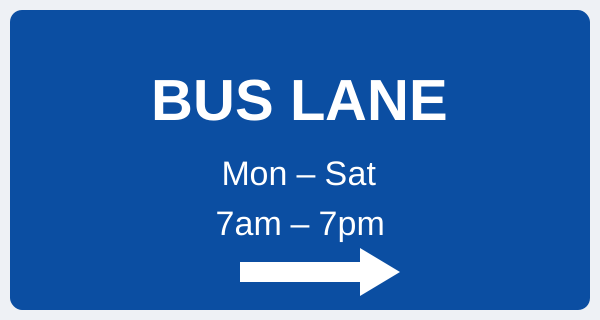
What I see most often as an instructor is learners treating the theory test like a memory quiz, then struggling on the road because they do not understand why the answer is right. The best revision links the rule to a real driving situation: a zebra crossing, a bus lane sign, a wet dual carriageway or a tight meeting situation with parked cars.

Start with the Highway Code, but do not read it like a novel
The Highway Code is the base of the theory test, but reading it cover to cover once is not enough for most learners. It is better to break it into short sections and test yourself straight away. The parts that matter most for new drivers are road signs, speed limits, stopping distances, vulnerable road users, junction priority, motorways, road markings, and safety margins.
Some things are worth memorising exactly, such as national speed limits, legal tyre tread depth, and the meaning of common signs and lines. Other things need understanding rather than word-for-word recall. For example, you may not be asked the exact same wording you saw in practice, but you may be asked what you should do when a cyclist is ahead near parked cars. The safe answer usually comes from planning, patience and leaving space.
In lessons, I drill this by asking short questions while the situation is happening. If we approach a 30 mph road with street lights, I may ask, “What tells you this is 30 if there is no repeater sign?” If we see a triangular warning sign, I may ask what hazard it is preparing you for and what you will do with speed, position and mirrors.
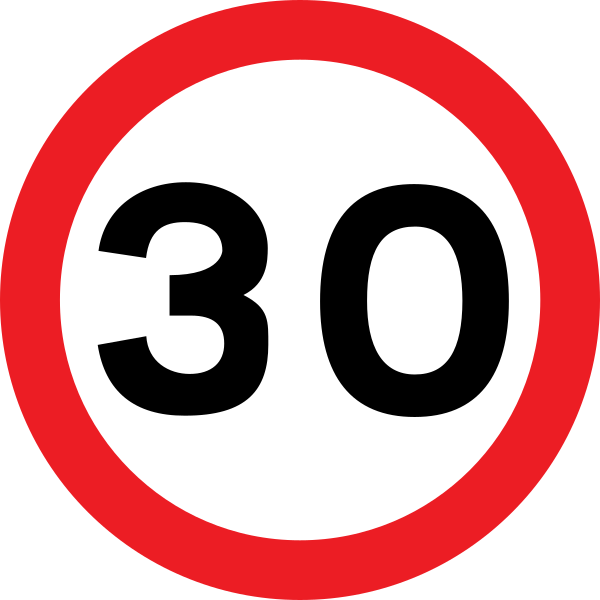
- Revise road signs daily until recognition is instant.
- Learn speed limits by vehicle type and road type, not by guessing from the road width.
- Use stopping distances as a safety concept as well as a test topic.
- Pay attention to rules involving pedestrians, cyclists, horse riders and motorcyclists.
Use a simple weekly revision plan
Most learners do best with a steady plan over two to four weeks. If your test is sooner, you can compress the plan, but avoid only doing mock tests. Mock tests show your score; they do not teach weak topics unless you review every mistake properly.
For Fast Track Driving Lessons pupils on an intensive course, I normally suggest starting theory revision before the driving hours begin if possible. Our courses are 10 to 40 hours, and at £61.23 per hour your lesson time is best spent driving, not sitting at the side of the road explaining things you could have revised at home. You can use our free theory test practice at /theory alongside official DVSA materials.
- 1Days 1 to 3: cover road signs, speed limits, road markings and alertness, then do short quizzes on each topic.
- 2Days 4 to 7: revise junctions, vulnerable road users, safety margins, weather, motorway rules and vehicle handling.
- 3Week 2: do one full multiple-choice mock test every day and review every wrong answer before taking another.
- 4Week 3 if needed: focus only on weak subjects and complete hazard perception practice daily.
- 5Final 48 hours: do timed mocks, check your documents and sleep properly rather than cramming late at night.
How to revise the multiple-choice questions properly
Good multiple-choice revision is not just repeating questions until you recognise the wording. The DVSA can phrase topics in different ways, so aim to understand the rule behind the answer. When you get one wrong, write down the topic, the correct rule and why your answer was unsafe or incomplete.
Use the flag function in practice apps if available, and keep a short list of weak areas. The common weak areas I see are stopping distances, motorway rules, safety equipment, road signs that look similar, and questions about vulnerable road users. Many learners also lose marks by choosing the answer that sounds assertive rather than the one that is safest and most considerate.
Do not spend time trying to learn “trick question” methods. The real test is not designed to trick you, but it does expect careful reading. Words such as “must”, “should”, “except”, “first” and “most likely” matter. In the test, read the question twice before looking at the options if you are nervous.
- If two answers look possible, choose the one that reduces risk most clearly.
- Never ignore words such as “at night”, “in wet weather” or “on a motorway”.
- Review wrong answers on the same day, while the mistake is still fresh.
- Keep practising until you pass several mocks comfortably, not by one mark.
How to pass hazard perception
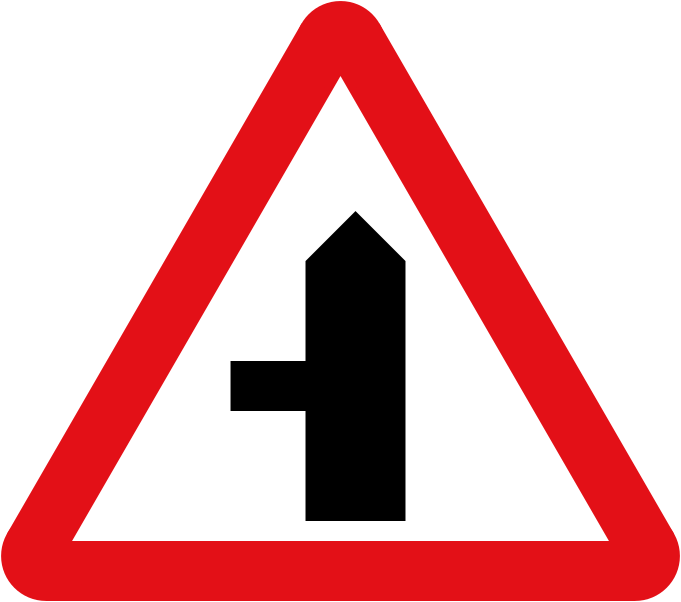
Hazard perception is where many capable learners fail because they click too late. A developing hazard is something that would cause you to change speed or direction, such as a pedestrian moving towards a crossing, a car edging out of a side road, or a cyclist moving out around a parked vehicle. A parked car on its own is a potential hazard, but it becomes developing when something starts to happen.
The scoring window opens as the hazard develops. Click too early, before it develops, and you may not score. Click too late, and the score drops. My practical advice is to click when you first see the hazard starting to develop, then click again if it continues to worsen. Do not click in a constant pattern or repeatedly all over the clip, because the system can give zero for that clip if it detects unacceptable clicking.
In lessons, I teach hazard perception through commentary driving. For example: “van parked on the left, feet under the bumper, child may step out, mirror, ease off.” That is the same thinking the test wants, but in real time. The test does not care whether you can name every hazard; it cares whether you spot the one that would make a driver react.
- 1Scan far ahead, not just the vehicle in front.
- 2Look for clues: side roads, pedestrians, brake lights, parked vehicles, bends and roadworks.
- 3Click when a hazard starts to develop and would make you adjust speed or position.
- 4Click again if the hazard clearly continues to develop.
- 5Stay calm after one missed hazard; one poor clip does not automatically mean failure.
What matters less than learners think
You do not need to know the exact wording of every Highway Code rule to pass, and you do not need to buy every app available. One good DVSA-style resource, used properly, is better than five apps used casually. You also do not need to wait until you are test-ready in the car before taking your theory. In fact, passing it early can remove pressure and allow your instructor to plan towards the practical test.
You should not rely on unofficial answer sheets, social media clips or old screenshots. Rules and question banks can change, and some online content is oversimplified or just wrong. Use GOV.UK for booking and official information, and use revision material that is current for the UK car theory test.
What does not matter in the exam room is how fast you finish. You do not get extra credit for leaving early. Use the time, check flagged questions, and make sure you have not missed a negative word in the question.
Test day: avoid easy mistakes
Take your photocard provisional licence to the test centre. If you do not bring the correct licence, you may not be allowed to take the test and you may lose the fee. Arrive early enough to deal with parking, buses, train delays or finding the entrance without rushing.
During the multiple-choice section, use the practice question if offered so the system feels familiar. Flag any question you are unsure about and move on; another question later may jog your memory. For hazard perception, settle into each clip quickly and keep scanning. Treat it like looking through the windscreen, not like playing a game.
If you fail, ask for the topic feedback and revise those areas before rebooking. Do not just book the next available date and hope. A fail normally means there is a pattern: weak hazard timing, poor sign knowledge, rushing questions or not understanding safety rules deeply enough.
- Bring your photocard provisional licence.
- Check the test centre address and time the day before.
- Do not take revision notes into the test room.
- Use the full time and check flagged answers.
- Book only through GOV.UK or a trusted route to avoid paying unnecessary extra charges.
Common questions
When should I take my theory test?
Take it once you can pass both parts of practice tests consistently, not just once. Many learners do it before or during early driving lessons, because the theory pass is needed before you can book a practical driving test.
How long is a theory test pass valid for?
A car theory test pass is valid for two years. You must pass your practical driving test within that time, otherwise you need to take and pass the theory test again.
Is the hazard perception test the same as real driving?
It tests the same early-warning skill, but through video clips. Real driving adds mirrors, speed control, steering and other road users reacting to you, so lessons are still essential for building the habit properly.
Can I pass by only doing mock tests?
Some learners can, but it is risky. Mock tests are useful for checking progress, but you still need to review mistakes and understand the Highway Code rules behind the answers.
What score do I need to pass the car theory test?
For the multiple-choice part you need 43 out of 50. For hazard perception you need 44 out of 75, and you must pass both parts in the same test.
Do I need my instructor to teach me theory?
You can revise most of it yourself, but a good instructor will connect it to real driving. In lessons, ask about signs, priority, speed limits and hazards as they appear, because that makes the rules easier to remember.
Practise theory free
Reading about it only gets you so far. Our instructors drill this with you in the car, on the roads around your test centre.