
The short version
- Defensive driving is about planning early, not driving timidly.
- Space, speed and observation are the three habits that prevent most near misses.
- Examiners mark late reactions, poor judgement and forcing others to change speed or direction.
- The Highway Code gives clear guidance on following distances, vulnerable road users and safe overtaking.
- A calm driver who anticipates hazards usually has fewer faults and smoother lessons.
Defensive driving explained in plain English
Defensive driving is a way of driving where you expect hazards to develop and plan for them before they become a problem. It does not mean being nervous, crawling everywhere or giving up your priority at every junction. It means using observation, anticipation, space and speed control so that you have time to deal with other people's mistakes, poor road conditions and the unexpected.
When I teach learners, the difference is easy to see. A reactive learner sees the brake lights ahead, brakes late, then checks the mirror afterwards. A defensive learner has already noticed the pedestrian near the crossing, the parked van blocking the view, the child on the scooter and the car behind following too closely. They ease off early, check mirrors before changing speed, and keep the car balanced. The drive feels calmer because the decisions are made earlier.
On the practical driving test, the examiner is not looking for a perfect robot. They are assessing whether you drive safely and independently, without creating danger or making other road users take avoiding action. Defensive driving helps with that because it reduces the common test faults: late mirror checks, harsh braking, poor judgement at junctions, meeting traffic too fast, and not responding to developing hazards.
The four core habits: look, think, space and speed
The first habit is looking far enough ahead. Many learners stare at the car directly in front or at the kerb they are worried about. I want your eyes moving: far distance, middle distance, near distance, mirrors, then back ahead. On a busy high street, that means reading shop doorways, bus stops, side roads, cyclists, parked vehicles and crossings, not just following the bumper in front.
The second habit is thinking ahead. Ask yourself, 'What could change in the next five seconds?' A parked car might open a door. A bus might pull out. A driver waiting at a side road might not have seen you. A ball in the road may be followed by a child. This is not pessimism, it is planning. If nothing happens, you have simply driven smoothly. If something does happen, you are ready.
The third and fourth habits are space and speed. Space gives you options, and speed decides how much time you have. If you are too close or too fast, even good observations cannot save a poor plan. In lessons, I often say: 'If you need a perfect reaction to make it safe, you have left it too late.' Defensive drivers set the situation up so that an ordinary reaction is enough.
- Look well ahead, not just at the vehicle directly in front.
- Check mirrors before you signal, change speed, change direction or change position.
- Leave a safe following gap so you can stop without swerving.
- Adjust speed before the hazard, not while you are already in it.
- Keep an escape space where possible, especially around parked vehicles and cyclists.
Following distances and stopping time
Highway Code Rule 126 says to leave at least a two-second gap between you and the vehicle in front on roads carrying faster-moving traffic and in tunnels where visibility is reduced. It also says the gap should be at least doubled on wet roads and increased still further on icy roads. The published Highway Code stopping distances include, for example, 96 metres at 70 mph in good conditions. These figures are from the Highway Code and can be updated, so always check the latest version on GOV.UK.
In the car, I use a simple marker method. When the vehicle ahead passes a sign, lamp post or bridge shadow, say 'Only a fool breaks the two-second rule' at a normal speed. If you reach the marker before you finish, you are too close. In wet weather, use a longer phrase or simply count four seconds. If someone cuts into your gap, do not take it personally. Ease off and rebuild the space.
Examiners notice following distance because it affects everything else. If you sit too close, your view is blocked, your braking becomes sharp and your decisions become rushed. It can be marked as a driving fault, and if you are so close that there is a real risk of collision, it can become serious. I see this most on dual carriageways, where a learner wants to 'keep up' and forgets that speed reduces thinking time.
- 1Pick a fixed marker that the vehicle ahead has just passed.
- 2Count at least two seconds in dry conditions.
- 3Double the gap in wet weather, and allow much more on ice or snow.
- 4If another driver moves into your gap, ease off rather than closing up.
- 5Check your centre mirror before you reduce speed to rebuild the gap.
Mirrors, blind spots and what examiners actually mark
Defensive driving relies on knowing what is around you, not just what is in front. The mirror routine is not a box-ticking exercise for the test. You check mirrors so you know whether braking, signalling, moving out or turning will affect someone behind or beside you. If you slow sharply without a centre mirror check and a vehicle behind has to brake hard, that is exactly the kind of risk examiners are trained to notice.
The usual learner fault is checking mirrors too late. For example, they signal first, then look. The correct thinking is: what is behind me, what am I about to do, and who needs to know? Before changing lane or moving out around a parked car, you also need the relevant door mirror and blind spot check. On motorways and dual carriageways, that blind spot check is often the difference between a safe lane change and a serious fault.
A useful instructor tip is to connect each mirror check to a decision. Centre mirror before you brake. Door mirror before you move sideways. Centre and appropriate door mirror before you signal. Mirrors before speed changes on approach to hazards, speed limit changes, roundabouts and crossings. If your head is moving randomly but your driving decision does not change, you are not really using the information.
- Centre mirror before slowing, braking or changing speed.
- Door mirror before moving left or right.
- Blind spot check before moving off, changing lanes or leaving a parked position.
- Mirrors before signals, so the signal is based on what is around you.
- Extra mirror checks where cyclists or motorcyclists may filter alongside.
Defensive driving at junctions, roundabouts and crossings
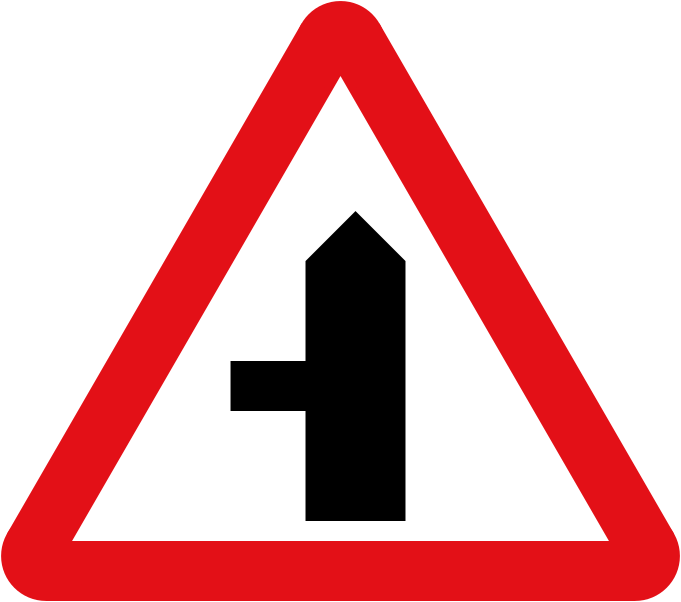
Junctions are where I see the most serious defensive driving errors. The common one is looking but not judging. A learner glances right, sees a car, but pulls out because they feel pressure from the vehicle behind. If the approaching driver has to brake or steer because of you, that can be a serious fault on test. Your priority is not what the driver behind wants, it is whether the gap is safe.
At roundabouts, defensive driving means reading lanes, signals, road position and speed. Do not rely on another driver's indicator alone. I teach learners to ask, 'What are they actually doing with the car?' A vehicle signalling left may continue around, and a vehicle not signalling may leave. Wait until their speed, position and direction confirm the opportunity. That patience is not hesitation if the risk is real.
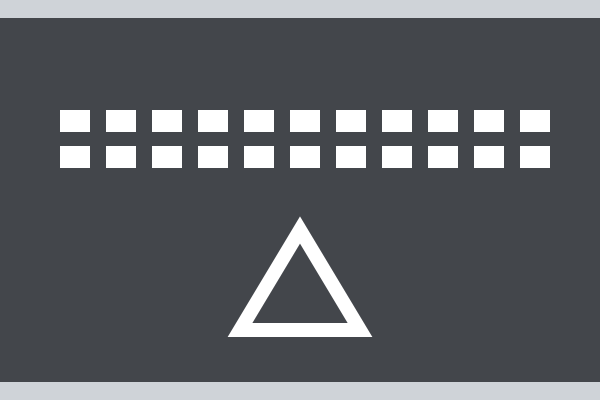
At crossings, the key is early recognition. Highway Code Rule 19 covers zebra crossings and says drivers should give way to pedestrians waiting to cross. Rules 195 and 196 also set out duties at zebra, parallel, pelican, puffin and toucan crossings. In test terms, the fault is usually late braking or failing to respond to someone clearly waiting. A defensive driver spots the crossing early, checks the mirror, eases off and is ready to stop smoothly.
Sharing the road with vulnerable road users
The Highway Code introduced the hierarchy of road users in Rule H1, which makes clear that those who can cause the greatest harm have the greatest responsibility to reduce danger to others. For learners, that means taking extra care around pedestrians, cyclists, horse riders, motorcyclists and mobility scooter users. This is general guidance, not legal advice, and you should check the current Highway Code and legislation on GOV.UK.
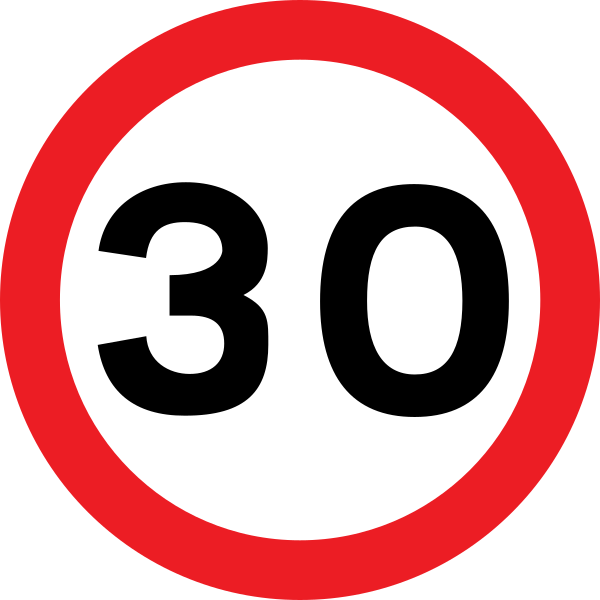
Rule 163 gives practical overtaking guidance. It says you should leave at least 1.5 metres when overtaking cyclists at speeds up to 30 mph, give more space at higher speeds, and pass horse riders and horse-drawn vehicles at under 10 mph with at least 2 metres of space. These figures are published in the Highway Code and can change, but the principle stays the same: if you cannot pass safely, wait.
In lessons, the costly fault is squeezing through because the learner is worried about holding up traffic. If a cyclist wobbles around a pothole, a pedestrian steps from between cars, or a horse reacts to noise, the extra space is what protects them and you. Examiners would much rather see a short, well-planned hold back than a close pass that forces a vulnerable road user to feel threatened or alter course.
- Do not overtake a cyclist just before turning left.
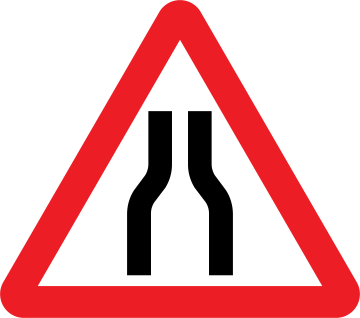
- Hold back if the road narrows and you cannot leave enough space.
- Expect cyclists to move out for drains, potholes and parked car doors.
- Pass horses slowly, quietly and wide.
- Check mirrors for motorcyclists filtering in slow traffic.
Weather, darkness and road surface changes
Defensive driving changes with the conditions. In rain, your tyres have less grip, spray reduces visibility and drivers make more mistakes. In darkness, you may see headlights before you see the shape of the vehicle, pedestrian or cyclist. In low sun, road markings, brake lights and traffic signals can be harder to read. The safe response is not panic, it is earlier observation, smoother controls and bigger gaps.
The Highway Code advises that stopping distances are at least doubled on wet roads and can be ten times greater on icy roads. Those are Highway Code figures and should be treated as safety guidance, not a challenge to see how close you can get. I see learners make the mistake of driving at the posted speed limit simply because it is legal. The limit is a maximum, not a target, and you must drive at a speed that is safe for the conditions.
Surface changes matter too. Painted road markings, metal drain covers, mud, leaves, diesel spills and loose gravel can all reduce grip. On lessons after rain, I often point out shiny patches near roundabouts and bus stops, because that is where heavy vehicles may have polished the surface or left residue. Smooth steering, progressive braking and planning early keep the car settled.
A practical defensive driving checklist
Use this checklist during private practice and lessons. Do not try to do it as a separate routine that overloads you. The aim is to build habits until they become normal. A good drive should feel observant and prepared, not tense.
If you are a new driver, this checklist is just as useful after you pass. The first months can be challenging because you no longer have an instructor prompting you. Defensive driving gives you a structure for dealing with unfamiliar roads, passengers, bad weather and drivers who make poor choices around you.
- 1Scan far ahead and name the next possible hazard before you reach it.
- 2Check the centre mirror before every planned speed reduction.
- 3Keep at least a two-second gap in dry conditions and more when needed.
- 4Ask whether your speed gives you time to stop for what you cannot yet see.
- 5Hold back from vulnerable road users until you can pass wide and slow.
- 6At junctions and roundabouts, move only when the gap is safe, not because someone behind is impatient.
- 7After any near miss, ask what you could have spotted earlier next time.
Common questions
Is defensive driving the same as driving slowly?
No. Defensive driving means choosing the right speed for the risk, road layout and conditions. Sometimes that will be close to the speed limit, and sometimes it will be much slower, such as near schools, parked cars, bends or poor visibility.
Can defensive driving help me pass my practical test?
Yes, because it supports the skills examiners are assessing: observation, judgement, control and consideration for other road users. It will not hide weak control or poor knowledge, but it reduces common faults such as late braking, unsafe gaps and missed mirror checks.
What is the biggest defensive driving mistake learners make?
The biggest mistake is reacting late instead of planning early. I often see learners identify a hazard only when they are almost on top of it, then brake harshly or steer suddenly. Looking further ahead usually fixes several faults at once.
How much space should I leave behind cyclists?
If you are following a cyclist, leave enough room to stop if they slow, wobble or move out for a hazard. When overtaking, Highway Code Rule 163 says to leave at least 1.5 metres at speeds up to 30 mph and give more space at higher speeds.
Should I give up my priority to be defensive?
Not automatically. Giving way when you have priority can confuse other road users and may create risk behind you. Defensive driving means being prepared to give up priority if someone else makes a mistake, but not waving people through or stopping unpredictably.
How do I practise defensive driving between lessons?
Use commentary driving with your supervising driver: say what you can see, what might happen and what you will do about it. Keep it short and useful, such as 'parked cars, checking mirror, easing off, cyclist ahead, holding back'. This builds anticipation without waiting for your instructor to prompt you.
Find a course near you
Reading about it only gets you so far. Our instructors drill this with you in the car, on the roads around your test centre.