
The short version
- Aquaplaning is caused by speed, standing water and insufficient tyre contact with the road.
- If it happens, ease off the accelerator and avoid harsh braking or steering.
- Wet stopping distances are at least double those on dry roads, according to Highway Code rule 227.
- Good tyres, correct pressures and sensible speed reduce the risk significantly.
- Examiners mark poor planning for puddles, late speed changes and loss of control.
What aquaplaning is and what you should do
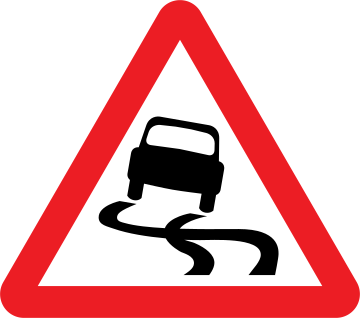
Aquaplaning is when a layer of water builds up between your tyres and the road surface, so the tyres can no longer grip properly. The car may suddenly feel light, the steering may stop responding as normal, and you may feel as if the vehicle is floating or sliding. It usually happens at higher speeds on wet roads, but it can also happen at lower speeds if the water is deep enough or your tyres are in poor condition.
If your car aquaplanes, do not stamp on the brake or yank the steering wheel. Ease off the accelerator, keep the steering wheel steady and allow the car to slow naturally until the tyres regain grip. If you drive a manual car, avoid making sudden clutch or gear changes while the car is unsettled. Once you feel grip return, gently steer and brake as needed.
This is general road-safety guidance, not legal advice. The key point for learners is that aquaplaning is usually a planning problem before it becomes a control problem: you reduce the risk by spotting standing water early, slowing before you reach it, increasing your following distance and keeping your tyres legal and healthy.
What causes aquaplaning on UK roads
In lessons, I see the same pattern after heavy rain: learners continue at their normal dry-road speed, then only react when they are almost on top of the water. That is too late. Aquaplaning is most likely when the tyre cannot clear water from the road quickly enough. Instead of the tread cutting through the water to the tarmac, the tyre rides up onto the water film.
Three things usually come together: vehicle speed, water depth and tyre condition. Speed matters because the faster the tyre turns, the less time it has to push water away. Water depth matters because shallow wetness is very different from a long puddle across the lane. Tyre condition matters because tread grooves are there to disperse water; worn, damaged or underinflated tyres are less effective.
Road layout can make it worse. Watch for dips, blocked drains, motorway wheel tracks, nearside puddles beside the kerb, water running across bends, and shaded rural roads where rainwater sits for longer. On dual carriageways and motorways, standing water in lane one or in lorry ruts can catch new drivers out because everything looks normal until the steering goes vague.
- Higher speed gives the tyres less time to clear water.
- Deeper standing water can lift the tyre away from the road surface.
- Low tread depth reduces the tyre's ability to channel water away.
- Incorrect tyre pressure can reduce the tyre's contact patch and stability.
- Sudden braking, steering or acceleration makes any loss of grip harder to recover.
How to recognise aquaplaning from the driver's seat
The first sign is often a change in feel rather than a dramatic skid. The steering may suddenly feel very light, as though the front wheels are no longer connected to the road. You might notice the engine note rise slightly if the driven wheels spin more freely. The car may drift despite you holding the wheel still.
Learners sometimes mistake aquaplaning for being blown by wind or being pulled by the road camber. The difference is that aquaplaning usually happens as you hit a patch of standing water, and the steering response becomes unusually weak. If you add more steering and nothing happens, your tyres probably do not have the grip to respond at that moment.
Do not test for grip by making a sharp movement. That is one of the common faults I see in wet weather practice: the driver feels the car go light, panics, and turns the wheel more. When the tyres grip again, the car can then dart in the direction the wheels are pointing. Calm hands are vital.
The safest recovery: what to do step by step
Recovery is about giving the tyres the best chance to reconnect with the road. You are not trying to force the car back into grip; you are removing the demands you are placing on it. Sudden braking asks the tyres to slow the car. Sudden steering asks them to change direction. Sudden acceleration asks them to drive the car forward. During aquaplaning, the tyres may not be able to do any of those jobs properly.
In an automatic, ease off the accelerator and keep your steering steady. In a manual, ease off the accelerator and avoid dipping the clutch unless you need to prevent stalling at very low speed after grip has returned. If you are already braking when aquaplaning starts, reduce pressure smoothly rather than snapping your foot off in panic, especially if traffic is close behind.
- 1Hold the steering wheel firmly but do not grip it rigidly.
- 2Ease off the accelerator smoothly.
- 3Keep the front wheels pointing in the direction you want to travel.
- 4Avoid harsh braking, sharp steering and sudden gear changes.
- 5Wait for the tyres to regain grip; this may only take a moment.
- 6Once grip returns, gently reduce speed and reassess the road ahead.
- 7If safe, increase your following distance and move away from deeper water.
How to avoid aquaplaning before it starts
The best drivers in heavy rain look further ahead than usual. I want learners to search for changes in surface colour, spray from other vehicles, ripples across the road, and water collecting near the kerb. By the time you reach the puddle, your speed decision should already be made. Braking hard in the water is the wrong order; slow before it.
Highway Code rule 227 says that in wet weather stopping distances will be at least double those required for stopping on dry roads. That is a published Highway Code figure and it is a minimum reminder, not a promise that you will always stop in double the distance. Heavy rain, poor tyres, standing water, downhill gradients and poor visibility can all require more space.
A useful phrase I use in the car is: "see it, ease it, leave it". See the water early, ease off speed before you reach it, and leave more space around you. That space gives you time to respond if the car in front brakes, if a pedestrian is near a puddle, or if the vehicle begins to lose grip.
- Look well ahead for standing water, spray and darker patches of road.
- Reduce speed before the puddle, not while you are in it.
- Leave a larger gap to the vehicle in front, especially on faster roads.
- Avoid cruise control in very wet conditions if it encourages you to maintain speed into water.
- Use smooth steering, braking and acceleration inputs.
- Consider delaying non-essential journeys in severe rain or flooding.
Tyres, tread depth and legal responsibilities
Tyres are your only contact with the road, and in aquaplaning they matter enormously. The legal minimum tread depth for cars in the UK is 1.6mm across the central three-quarters of the breadth of the tyre and around the entire circumference. This is published by GOV.UK and reflected in the Highway Code, but legal limits and penalties can change, so always check current official guidance.
As an instructor, I do not want learners thinking "legal" automatically means "good in heavy rain". A tyre close to the legal minimum has less tread available to clear water than a newer tyre. Correct tyre pressures matter too; the right pressures are listed in your vehicle handbook, on a door pillar, inside the fuel flap or through the manufacturer information for the car.
Driving with illegal tyres can lead to enforcement action. GOV.UK states that you can receive penalty points and a fine for using a vehicle with defective tyres; the commonly published maximum is up to £2,500 and 3 penalty points per illegal tyre, but you should check the current official position because penalties can change. From a safety point of view, tyre checks are not just a test question; they are part of avoiding a real loss of control.
- Check tread depth regularly, not just before an MOT.
- Look for cuts, bulges, nails or uneven wear.
- Set tyre pressures when the tyres are cold where possible.
- Do not ignore the spare or tyre repair kit if your car has one.
- Replace tyres before they become a wet-weather risk, not merely when they are illegal.
What the driving examiner is looking for in heavy rain
Examiners do not have a special box labelled "aquaplaning", but they do assess your judgement, planning, control and response to road and weather conditions. If you drive into standing water too fast, brake late, spray a pedestrian, or continue too close to the car in front, those can all be marked under the relevant control, planning, awareness or safety areas depending on what happens.
The fault that costs people is often not the puddle itself; it is the late decision. I have seen learners spot water, say "that looks deep", and still keep the same speed until the last second. By then any braking is rushed and the car is unsettled. On test, a safe driver shows early observation, a smooth speed reduction and a clear plan.
You also need to think about other people. The Highway Code tells drivers to be considerate and not splash pedestrians. If there is a large puddle near the kerb and someone is walking beside it, slow down and give space if safe. Deliberately or carelessly soaking someone is not just poor manners; it can be treated as inconsiderate driving.
- Possible driving fault: slight late speed reduction for surface water, but control remains safe.
- Possible serious fault: entering deep standing water at an unsafe speed and losing control.
- Possible serious fault: following too closely in heavy spray with reduced stopping distance.
- Possible serious fault: harsh steering or braking that causes the car to skid or drift.
- Possible fault: failing to show consideration by driving through kerbside water near pedestrians.
Flooded roads, puddles and when not to drive through
Aquaplaning is not the only wet-weather danger. Deep floodwater can damage your engine, hide kerbs or potholes, move drain covers, and make it impossible to judge the road edge. If you cannot see the surface or you do not know how deep the water is, the safest decision is often to turn around and find another route.
Do not assume that because another vehicle went through, you can too. A high 4x4, van or lorry may cope with water that would be risky for a small car. Bow waves from larger vehicles can also push water towards you. If you must pass through shallow water, go slowly, keep the engine revs steady, avoid stopping if possible, and test your brakes gently afterwards when safe, as the Highway Code advises after driving through water.
On country roads, be especially cautious after storms. Mud, leaves and water together can create a slippery surface even where there is no obvious flood. In urban areas, poor drainage near bus stops, parked cars and kerbs can create hidden pools. The right decision is not always to continue; sometimes the professional decision is to wait, divert or cancel the journey.
- 1Ask: can I see the road surface through the water?
- 2Ask: is there a safe alternative route?
- 3Ask: will my car create spray or a bow wave affecting others?
- 4Enter only if the water appears shallow and it is safe to continue.
- 5Drive slowly and steadily, without sudden acceleration.
- 6Afterwards, gently test the brakes when it is safe and clear behind.
- 7If the engine cuts out in floodwater, do not keep trying to restart it.
Common questions
At what speed does aquaplaning happen?
There is no single fixed speed because it depends on water depth, tyre tread, tyre pressure, road surface and vehicle load. The practical lesson is that the faster you travel into standing water, the higher the risk. Slow down before you reach the water and leave more space than usual.
Should I brake if my car starts aquaplaning?
Avoid harsh braking because the tyres may not have enough grip to respond. Ease off the accelerator, keep the steering steady and allow the car to slow until grip returns. Once you feel the tyres reconnect with the road, brake gently if you need to reduce speed further.
Does ABS stop aquaplaning?
ABS can help prevent wheel lock during braking, but it cannot create grip where the tyre is riding on water. Do not rely on ABS to make it safe to drive quickly through standing water. Your best protection is early observation, lower speed and good tyres.
Can aquaplaning happen during a driving test?
Yes, a test can take place in wet weather unless conditions are considered unsafe. The examiner will expect you to adapt your speed, increase following distance and deal with surface water safely. If conditions become dangerous, the test centre or examiner can decide not to continue.
What should I do if I hit a deep puddle on a bend?
Keep your eyes looking where you want the car to go and avoid adding sudden steering or braking. Ease off the accelerator smoothly and let the car regain grip. After the bend, reduce speed further and reassess the conditions.
How can a learner practise driving safely in heavy rain?
Practise with an instructor or experienced supervising driver on familiar roads first, avoiding severe weather or flooding. Focus on earlier observations, smoother controls and bigger gaps rather than trying to drive at normal dry-road pace. If visibility is poor or roads are flooded, postponing the drive is the safer learning decision.
Find a course near you
Reading about it only gets you so far. Our instructors drill this with you in the car, on the roads around your test centre.