
The short version
- The car driving test usually lasts about 40 minutes.
- You start with an identity check, eyesight test and one tell me question.
- Most tests include around 20 minutes of independent driving.
- You will do one reversing manoeuvre and may do an emergency stop.
- You pass if you avoid serious and dangerous faults and make no more than 15 driving faults.
What happens in a driving test, step by step
A standard UK practical car driving test is run by a DVSA driving examiner and usually lasts about 40 minutes. The route is designed to include everyday driving: junctions, roundabouts, pedestrian crossings, speed changes, meeting traffic, and some independent driving. It is not about perfect driving. It is about proving you can drive safely, legally and independently without help.
In simple order, you arrive at the test centre, meet the examiner, complete an eyesight check, answer a vehicle safety question, drive on a mixed route, follow directions independently for part of the test, complete one reversing manoeuvre, possibly do an emergency stop, then return for the result. The examiner records faults on a digital marking sheet. According to DVSA guidance, you can pass with up to 15 driving faults, but one serious or dangerous fault means a fail.
From the passenger seat as an instructor, I see the same pattern: learners rarely fail because they cannot drive at all. They fail because test pressure makes them rush observations, hesitate when it is safe to go, drift out of lane at roundabouts, or forget mirrors before changing speed or direction. The test is step by step, but your driving must still flow like a normal safe journey.
- 1Arrive in good time and bring your UK photocard provisional licence.
- 2Meet the examiner in the waiting room and confirm your details.
- 3Read a number plate for the eyesight check.
- 4Answer one tell me vehicle safety question before you drive.
- 5Drive the test route, including general and independent driving.
- 6Complete one reversing manoeuvre and possibly an emergency stop.
- 7Return to the test centre and receive your result and feedback.
Before the test starts: documents, car and nerves
You must take your photocard provisional driving licence. If you do not have it, the examiner will not normally conduct the test and you may lose your fee. If you are using your instructor's car, they will usually handle the car requirements, such as insurance, L plates and roadworthiness. If you use your own car, it must meet DVSA rules, be taxed, have a valid MOT if needed, be insured for a driving test, have no warning lights showing, and have an extra interior rear-view mirror for the examiner.
DVSA publishes the official practical car test fee on GOV.UK. At the time of writing, the standard weekday car test fee is £62 and the evening, weekend and bank holiday fee is £75, but fees can change, so always check GOV.UK when booking. Only book through the official GOV.UK service unless you fully understand any extra charges from another booking service.
This is general guidance, not legal advice. In practical terms, I tell learners to arrive about 10 to 15 minutes early, use the toilet before the test, and avoid last-minute cramming in the waiting room. A short warm-up drive before the test is helpful, but it should be calm. The worst warm-ups are the ones where the learner tries to fix every weakness in 45 minutes and arrives mentally overloaded.
- Bring your photocard provisional licence.
- Make sure the test car is legal, insured and suitable for a DVSA test.
- Check the test time, test centre and booking reference before you travel.
- Wear comfortable shoes you have driven in before.
- Do not arrive so early that you sit worrying for half an hour.
Meeting the examiner and the eyesight test
When the examiner comes into the waiting room, they will call your name and ask to see your licence. They may ask you to confirm your address and whether you want your instructor or accompanying driver to sit in the back. You are allowed to have them present, but they must not help, speak or interfere. Most of my learners choose for me either to sit in or to stay at the test centre; both choices are fine.
Next comes the eyesight check. You must read a number plate from 20 metres for a new-style number plate, or 20.5 metres for an old-style plate. This is a DVSA requirement. If you need glasses or contact lenses to meet the standard, you must wear them whenever you drive. If you cannot read the plate, the test will not continue and it is recorded as a fail.
Do not treat the eyesight test as a formality if your vision is borderline. I have seen learners practise for months and then struggle because they forgot their glasses or had not checked their prescription. If you wear glasses for driving, have them on before you leave the waiting room. It is one less thing for your brain to deal with.
Vehicle safety questions: tell me and show me
You will be asked one tell me question before you start driving. This might be about checking tyres, brakes, lights, oil, coolant, brake fluid, head restraints or demisters. You do not need to deliver a mechanic's lecture. You need a sensible safety answer in plain English. For example, for tyres you would mention correct pressure, tread depth, condition and no cuts or bulges.
During the drive you will be asked one show me question, such as showing how you would wash and clean the windscreen, switch on dipped headlights, open and close the side window, or operate the horn when safe and legal. The key is to keep control of the car while doing it. If you swerve, look down for too long or affect another road user, the fault is not really the question; it is loss of control or poor observation.
Learners often worry too much about getting the wording perfect. A wrong safety answer is usually a driving fault, not an automatic fail, unless it leads to unsafe driving. The bigger risk is fiddling with controls on the move. Practise the show me controls until you can find them by touch, because on test you will already be using spare mental capacity for the road.
- Tell me questions are answered before moving off.
- Show me questions are done while driving, when the examiner asks.
- Use simple safety language rather than memorised speeches.
- Know where the controls are in the car you use for test.
- If unsure on the move, keep driving safely first.
Moving off and general driving on the route
Once in the car, the examiner will explain that they want you to follow the road ahead unless signs, road markings or their directions say otherwise. They are not trying to trick you. If you are unsure, ask for the direction again. If you take a wrong turn safely, it is not automatically a fault. If you cut across lanes late, signal without checking, or panic brake to correct it, that is where the mark appears.
At the start, the examiner is already assessing your routine: cockpit checks, seat belt, mirrors, signalling if needed, blind spot, control, and whether you move off safely. Highway Code rule 159 reminds drivers to check mirrors and blind spots before moving off. On test, a missed blind spot when moving away from the kerb is one of the most common early faults I see, especially when the road feels quiet.
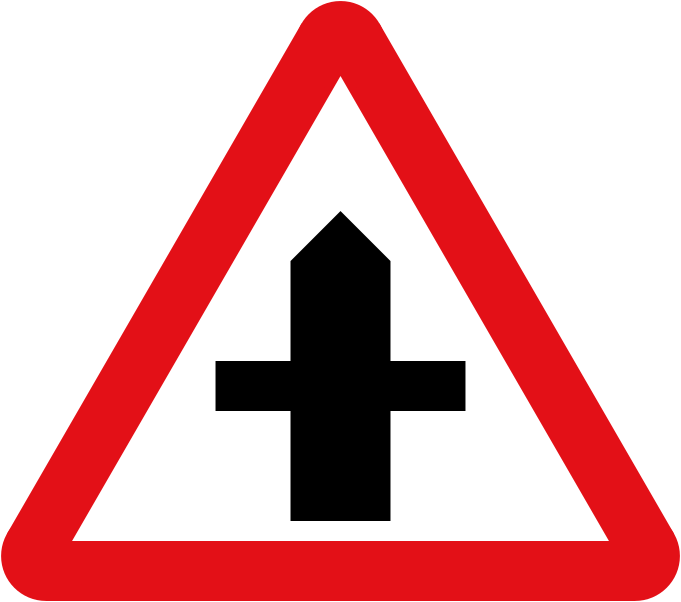
The general drive includes normal roads, not a special exam course. Expect crossroads, T-junctions, parked cars, meeting situations, bends, traffic lights, crossings and roundabouts. The examiner is looking for safe judgement: correct speed for the conditions, good lane discipline, effective observations, and progress where appropriate. Driving too slowly for no reason can be marked if it holds up others or shows lack of confidence, but forcing gaps is far worse.
- Check mirrors before signalling, changing speed or changing direction.
- Use blind spot checks before moving off and when position changes need them.
- Approach junctions at a speed that allows you to observe properly.
- Follow road markings and signs rather than relying on memory.
- If you go the wrong way, stay safe and let the examiner redirect you.
Independent driving: sat nav, signs and staying calm
For about 20 minutes, most car tests include independent driving. DVSA says this may involve following directions from a sat nav or following traffic signs. The examiner normally sets up the sat nav if one is used. You are not being tested on map reading; you are being tested on driving safely while making your own decisions.
The sat nav voice can make learners rush. If it says 'turn right' and the lane has already passed, do not dive across. Continue safely and the examiner will help you get back on route. Missing a direction is usually less serious than unsafe lane changes, late braking or signalling after you have already started turning.
When following signs, scan early and plan. At large roundabouts, the examiner may say something like 'follow the signs for the town centre'. You then need to use signs and markings to choose the correct lane. Highway Code rules 184 to 190 cover roundabouts, including giving priority to traffic from the right unless signs or markings indicate otherwise, signalling correctly, and watching for cyclists, motorcyclists and pedestrians. On test, lane discipline at roundabouts is a frequent deciding factor.
- 1Listen to the instruction, but keep your eyes moving between road, mirrors and signs.
- 2Choose your lane early using road markings and direction signs.
- 3If you are unsure, ask the examiner to repeat the instruction.
- 4If you miss a turn, continue safely rather than correcting suddenly.
- 5After any lane change or turn, check your mirrors and rebuild your plan.
Manoeuvres and the possible emergency stop
You will be asked to do one reversing manoeuvre. The current DVSA car test manoeuvres are parallel parking at the roadside, parking in a bay either by driving in and reversing out or reversing in and driving out, or pulling up on the right, reversing for about two car lengths and rejoining traffic. The examiner will choose one. You are allowed to correct the manoeuvre if you do it safely, so do not give up because the first angle is not perfect.
What examiners mark is safety, control and observation. A slow, slightly adjusted manoeuvre with excellent all-round checks is usually much better than a neat-looking park done while staring through one window. The classic fault is not steering accuracy; it is failing to look properly before the car moves or while the front of the car swings out. Pedestrians, cyclists and vehicles can appear quickly, especially in test centre areas and supermarket-style car parks.
Around one in three tests includes an emergency stop, according to DVSA wording used in test guidance, but the exact chance on your day is not something you can know. If asked, the examiner will brief you and then give a clear signal to stop. You should stop promptly and under control, secure the car, then make effective all-round observations before moving off again. Learners often remember the braking but forget the blind spots afterwards.
- Parallel park: avoid mounting the kerb and keep checking all around.
- Bay park: control the car slowly and watch for pedestrians and vehicles.
- Pull up on the right: observe carefully before crossing the road and before rejoining.
- Emergency stop: brake firmly, keep control, then check all around before moving off.
- Correction is allowed if it is safe and controlled.
How the examiner marks faults
The examiner records three broad levels of fault: driving faults, serious faults and dangerous faults. DVSA explains that a driving fault is not potentially dangerous, but if you keep making the same type of driving fault it may become serious. A serious fault is something potentially dangerous. A dangerous fault involves actual danger to you, the examiner, another person or property. You can pass with no more than 15 driving faults, but you cannot pass with a serious or dangerous fault.
This is where learners misunderstand the test. It is not one mark for every tiny imperfection. The examiner is judging risk. For example, if you check mirrors slightly late but no one is affected, it may be a driving fault. If you change lane without knowing what is beside you, that can be serious. If another vehicle has to brake or swerve because of you, the risk level rises quickly.
The specific faults I see costing people are often basic routines under pressure: no right blind spot before moving off, entering a roundabout when the gap is too small, stopping after the stop line at traffic lights, driving too close to parked cars, or not responding properly to a change of speed limit. Highway Code rule 126 gives the two-second rule in good conditions and at least double on wet roads; following too closely is not just bad style, it is a safety risk.

- Driving fault: a less serious error, but repeated errors can add up.
- Serious fault: something potentially dangerous, such as poor observation at a junction.
- Dangerous fault: actual danger, such as causing another road user to take avoiding action.
- Common test-losing fault: moving off without an effective blind spot check.
- Common test-losing fault: late lane changes at roundabouts or on dual carriageways.
- Common test-losing fault: not noticing speed limit changes or road signs.
The result, feedback and what to do next
At the end of the route, the examiner will guide you back to the test centre. Keep driving properly until the car is parked and secured. A surprising number of faults happen in the last two minutes because the learner relaxes too early, swings into the test centre without checking mirrors, or parks carelessly beside another vehicle.
Once stopped, the examiner will tell you whether you have passed or failed and give a short explanation. If you pass, they can usually arrange for your full licence to be sent to you, provided your details are correct. You may drive straight away once you have passed, but you must be insured to drive the vehicle. If you fail, you will receive feedback on the faults, and you can use that to plan targeted practice before booking again.
Listen to the feedback without arguing in the car park. I know it can feel harsh, especially if the drive felt good, but the useful question is: 'What exact situation caused the fault, and what should I do differently next time?' That turns the result into a plan rather than a mood.
- Do not switch off mentally when you see the test centre.
- Secure the car before the result is given.
- Ask for clarification if you do not understand a fault.
- If you pass, check insurance before driving any car.
- If you fail, practise the exact fault area, not just more random driving.
Common questions
How long does a UK practical driving test take?
A standard DVSA car driving test usually takes about 40 minutes. It can be longer for some extended tests, such as after certain disqualifications, so check your own booking details if that applies to you.
Can I ask the examiner to repeat an instruction?
Yes. If you did not hear or understand a direction, ask the examiner to repeat it. You are not marked down for asking, but you can be marked if you react late, change lane unsafely or make a sudden turn because you guessed.
Do I fail if I go the wrong way on my driving test?
Not automatically. If you take a wrong turn safely, the examiner will redirect you. The problem is when the wrong turn leads to unsafe action, such as cutting across lanes, braking sharply without reason or ignoring road signs.
What manoeuvre will I get on my driving test?
You will get one reversing manoeuvre chosen by the examiner. It could be parallel parking, bay parking, or pulling up on the right and reversing before rejoining traffic. You will not know which one in advance, so prepare all of them.
Can my driving instructor sit in the back during the test?
Yes, you can ask for your instructor or accompanying driver to sit in the back. They must not speak, help or influence the test. Some learners find it reassuring, while others prefer fewer people in the car.
What is the most common reason learners fail the practical test?
DVSA publishes lists of common reasons people fail, and observation at junctions is consistently highlighted. In real lessons, I also see mirrors, blind spots, roundabout lane discipline and speed limit awareness causing many serious faults.
See our pass guarantee
Reading about it only gets you so far. Our instructors drill this with you in the car, on the roads around your test centre.