
The short version
- Read the driving test report by fault type, not just the total number.
- Wait at least 10 working days before retaking the practical test.
- Ask your instructor to recreate the exact situation that caused the serious fault.
- Do not rush a retest unless the fault was genuinely one-off and your driving is test-ready.
- Use your next lessons to make decisions earlier, not just to practise routes.
First, take the result properly
Failing the practical driving test feels personal, but the examiner is marking a drive against the DVSA standard, not judging you as a person. I have seen very good learners fail for one late mirror check, one poor meeting decision, or one hesitation that held traffic up too long. It is frustrating, but it is also fixable if you use the result correctly.
At the end of the test, listen to the debrief even if you are disappointed. The examiner will explain the serious or dangerous fault and may mention patterns in the driving faults. Your instructor can listen too if they went on the test or were present for the debrief. That conversation is often more useful than the number of minors on the email.
What does not matter for the test is whether you felt you drove nicely for most of it, whether the route was difficult, or whether your friend passed with more mistakes. What matters is risk. A single serious fault means the examiner saw something that could have affected safety, legality or the progress of other road users.
Understand the faults on your test report
Your driving test report normally separates faults into driving faults, serious faults and dangerous faults. Driving faults are less serious errors, but repeated faults in the same area can become serious. A serious fault is something potentially dangerous. A dangerous fault involves actual danger to you, the examiner, another person or property.
Do not obsess over the total number of driving faults unless you were close to the maximum allowed. For a car practical test, you can pass with up to 15 driving faults, as long as you have no serious or dangerous faults. If you get 16 or more driving faults, or any serious or dangerous fault, you fail.
What I see most often in the mirror after a failed test is a learner wanting to fix everything at once. Start with the fault that failed the test, then look for the driving faults that support the same pattern. For example, a serious fault for changing lanes may be backed up by several minor faults for mirrors or signals. That tells us the real problem is planning and observation timing, not just one unlucky lane change.
- Driving fault: a mistake that is not serious on its own, such as a slightly late signal.
- Serious fault: a potentially dangerous error, such as emerging when another vehicle has to slow significantly.
- Dangerous fault: an error causing actual danger, often requiring someone to take action to avoid a problem.
- Repeated pattern: several similar driving faults, which may show the skill is not secure enough yet.
Wait, then book the retest at the right time
By law and DVSA rules, you must wait at least 10 working days before you can take another practical driving test. Working days do not include Sundays or bank holidays. You can book as soon as you find a suitable date, but the new test itself must meet that waiting period.
Practical test fees can change, so check GOV.UK before booking. At the time of writing, the standard car practical test fee is £62 on a weekday and £75 for evenings, weekends and bank holidays. Always book through GOV.UK or your instructor’s trusted system, not through unofficial sites charging extra for the same booking.
Whether you should grab the soonest cancellation depends on why you failed. If the fail was a clear one-off and your lessons show you are usually safe and independent, a quick retest can make sense. If the fault exposed a weak area, booking too soon just gives you less time to fix it and more pressure on the day.
- 1Read the examiner’s report and identify the exact serious or dangerous fault.
- 2Ask your instructor whether the same issue has appeared in lessons before.
- 3Check the earliest legal retest date using the 10 working day rule.
- 4Book a date that allows enough driving time to correct the fault under pressure.
- 5Keep practising normal driving, not just the test centre roads.
Turn the fail into a lesson plan
The next lesson after a failed test should not be a general drive around town. It should have a clear aim. If you failed at a roundabout, we go back to similar roundabouts and practise approach speed, lane discipline, mirror timing and gap judgement. If you failed for clearance, we drive narrower roads until the steering position and speed feel calm again.
As an instructor, I do not just ask a learner to repeat the manoeuvre or junction until it goes right once. I want to see it right when they are tired, when the traffic changes, and when they have to make a new decision. The test is not about memorising a route. It is about applying the same safe routine anywhere the examiner takes you.
Fast Track Driving Lessons provides intensive driving courses from 10 to 40 hours, charged at £61.23 per hour. For a retest, the right amount of training depends on the reason for the fail, how recent your previous lessons were, and whether the fault is technical, judgement-based or nerves-based. A short course can work well if your driving is mostly test standard, but a deeper issue needs more time than one warm-up lesson.
- For observation faults, drill mirror-signal-position-speed-look routines until they happen without prompting.
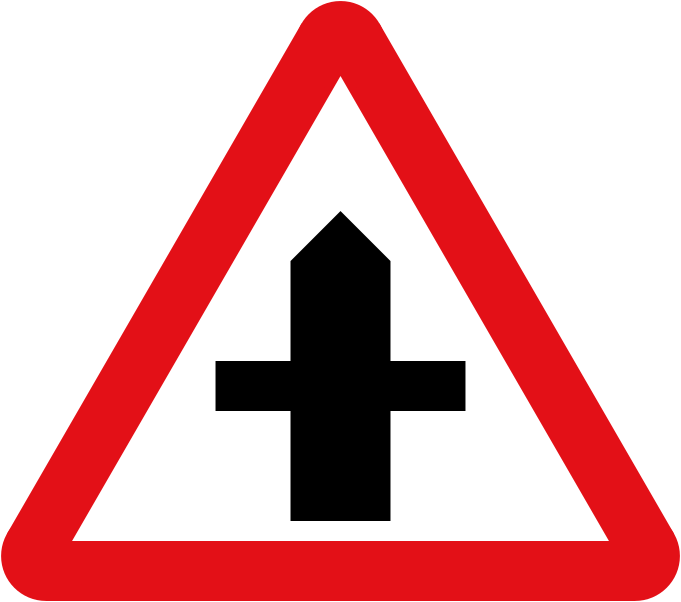
- For meeting traffic, practise early planning: who has priority, where is the safe hold-back point, and what is behind you.
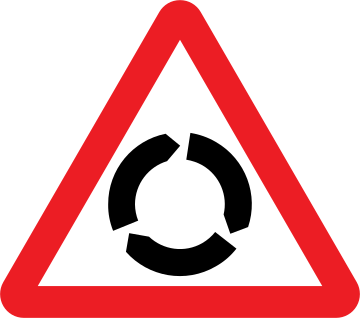
- For roundabouts, work on approach speed, lane choice, signal timing and committing only when the gap is genuinely safe.
- For manoeuvres, focus on control and observation, not perfect kerb distance. A small correction is fine if it is safe.
- For nerves, do mock tests with quiet feedback at the end, not constant help during the drive.
Common reasons learners fail after a good drive
Many failed tests are not dramatic. The drive can feel smooth, then one decision crosses the safety line. The common theme is usually timing. Learners look, signal, brake or decide slightly too late, so the car is technically under control but the examiner cannot be sure the decision is safe.
Junction observations are a regular example. A learner may move off when they think the road is clear, but they have not taken an effective final look. Another common one is changing lanes after checking the mirror too early, then not checking again as the car moves. The examiner marks what is happening now, not what was true three seconds ago.
Hesitation can also fail a test, but not because the examiner wants you to rush. You are expected to make safe progress. If you repeatedly miss safe opportunities at junctions or roundabouts and start holding up following traffic unnecessarily, that can become a serious fault. The answer is not to gamble into small gaps; it is to read the road earlier so you are ready when a safe gap appears.
Do not make these retest mistakes
After a fail, learners often change the wrong things. They ask for a different test centre, a different time of day or a “nicer” examiner. Those things can feel comforting, but they do not fix poor judgement, weak observations or inconsistent control. Examiners all use the same DVSA marking standard.
It is fine to change test centre if you have moved area or if your instructor genuinely thinks another centre gives more suitable training access. But changing because one route had a difficult roundabout is usually avoiding the problem. If that roundabout is open to normal traffic, a qualified driver needs to handle it safely.
Also, do not try to drive like a robot. Examiners are not looking for exaggerated head movements, crawling everywhere or saying a commentary unless asked for something specific. They want safe, legal, independent driving. Clear observations matter, but theatrical observations do not earn extra marks if the decision is still poor.
- Do not book a retest you cannot prepare for properly.
- Do not ignore minor faults that show the same pattern as the serious fault.
- Do not rely on test route videos instead of real driving practice.
- Do not change instructor just because they were honest about needing more hours.
- Do not practise only the manoeuvre if the fail was really about observation or judgement.
Use the waiting time well
The gap before your next test is valuable. If you have a theory test still to pass or it is close to expiring, check your dates on GOV.UK because you must have a valid theory certificate on the day of your practical test. Fast Track Driving Lessons also offers free theory test practice at /theory, which can help keep road signs, rules and hazard awareness fresh.
Between tests, aim to drive in the conditions that found you out. If you failed in busy traffic, only practising on quiet Sunday mornings will not help much. If you failed on dual carriageways, you need proper work on slip roads, lane discipline, following distances and planning well ahead.
A good instructor will know when to stop drilling and start testing. Once the weak area improves, I would run a mock test with minimal help, including independent driving and a manoeuvre. The point is to check whether the new skill survives under test pressure. If it only works while the instructor talks you through it, it is not ready yet.
- 1Book two or more focused lessons rather than one vague pre-test drive, if time allows.
- 2Recreate the failed situation on different roads, not just the exact same location.
- 3Run at least one mock test with a proper debrief afterwards.
- 4Practise the first five minutes of the test routine: moving off, settling nerves and following directions.
- 5Arrive for the retest rested, legal to drive and with the correct licence.
Common questions
How soon can I retake my practical driving test after failing?
You must wait at least 10 working days before taking another practical driving test. You can book a date earlier than that if the system allows, but the actual test date must be after the waiting period. Sundays and bank holidays do not count as working days.
Do I have to use the same test centre again?
No, you can book a different test centre if there is availability. However, changing centre rarely solves the reason for a fail. It is usually better to fix the weak skill, unless there is a practical reason such as moving area or training more regularly somewhere else.
Will the next examiner know I failed before?
The examiner is not marking you based on your previous result. They assess the drive in front of them using the DVSA standard. You do not need to explain your last test unless you want to discuss it with your instructor before the test.
How many lessons do I need after failing?
It depends on the fault. A one-off mistake may need a short focused refresher, while repeated observation, judgement or confidence issues may need several hours. At Fast Track Driving Lessons, intensive courses run from 10 to 40 hours at £61.23 per hour, but your instructor should recommend a plan based on your driving, not a fixed guess.
Can I fail for being too slow or too hesitant?
Yes, if hesitation becomes unreasonable and affects other road users, it can be marked as a serious fault. The examiner is not asking you to rush or take unsafe gaps. They want you to recognise safe opportunities and make normal progress when it is safe and legal.
Does the number of driving faults matter if I failed on one serious fault?
Yes, but it is not the main issue. The serious or dangerous fault is what caused the fail, but the driving faults can show patterns that need work. If several minors are linked to mirrors, positioning or judgement, your retest plan should deal with that pattern as well as the single serious fault.
See our pass guarantee
Reading about it only gets you so far. Our instructors drill this with you in the car, on the roads around your test centre.