
The short version
- A serious or dangerous fault means you will not pass, even if the rest of the drive is good.
- You can pass with up to 15 driving faults, but repeated faults in one area can become serious.
- Most serious faults come from observation, judgement, positioning and speed, not complex manoeuvres.
- Treat the test like a safe independent drive, not a performance where every small mistake is fatal.
What the examiner is actually marking
On the UK practical driving test, the DVSA examiner records faults in three main categories: driving faults, serious faults and dangerous faults. Learners often call driving faults “minors”, but the official term is driving fault. The difference is not about whether the examiner liked your driving. It is about risk: what happened, who was affected, and what could reasonably have happened next.
You do not need a perfect drive. You need to show you can drive safely and independently on real roads, including when things change. A clipped gear change, a slightly late signal that affects nobody, or choosing the wrong lane and correcting safely may not matter much. What matters is whether your actions create risk, inconvenience other road users, or show you have not understood the situation.
In lessons, I tell pupils to stop chasing a fault-free test. The better target is boring, legal, predictable driving. Examiners are not looking for advanced driving; they are looking for a newly qualified driver who can be trusted without an instructor beside them.
Driving faults, often called minors
A driving fault is a mistake that is not potentially dangerous on its own. You can still pass with driving faults, provided there are no serious or dangerous faults and you do not build up too many. As of DVSA rules, you can get up to 15 driving faults and still pass. Sixteen or more is a fail. This rule can change, so always check the current GOV.UK driving test guidance if you are unsure.
The important bit is repetition. One missed mirror check before slowing, when nobody is behind, may be a driving fault. Do it repeatedly and the examiner may decide there is a pattern: you are not using mirrors effectively. That can become a serious fault. What I see most often in the mirror is a learner doing the right thing once, then forgetting under pressure when the route becomes busier.
Driving faults are not free points to spend. They are warnings that the drive is becoming untidy or inconsistent. A good instructor will drill the habit behind the fault rather than simply saying “don’t do that again”. For example, if you keep getting mirror faults, we will link mirrors to actions: mirrors before signal, mirrors before position, mirrors before speed change.
- Common driving faults include a late but harmless signal, slight hesitation where nobody is affected, minor steering correction, brief loss of smoothness with clutch or gears, or not checking a mirror at the ideal time when there is no consequence.
- A driving fault can become serious if it is repeated, if it affects another road user, or if it happens in a higher-risk situation.
- The examiner looks at the whole situation, not the mistake in isolation.
Serious faults explained
A serious fault is something that has the potential to be dangerous. It may not cause a crash, and nobody has to sound a horn or brake sharply for it to count. If your action creates a real possibility of danger, or makes another road user change speed or direction unnecessarily, it can be marked serious. One serious fault means you do not pass.
This is where many learners feel confused. They say, “But nothing happened.” The examiner is not waiting for a crash to prove the fault. If you emerge at a junction when an approaching car is close enough that it has to brake, that is serious. If you change lanes without a proper blind spot check and there is a vehicle nearby, that is serious. If you stop at a green traffic light with no reason and confuse the driver behind, that can be serious because your driving is unpredictable.
In instructor training, we call this reading the effect of your action. On test, ask yourself: did I make someone else deal with my mistake? If the answer is yes, you are moving into serious fault territory.
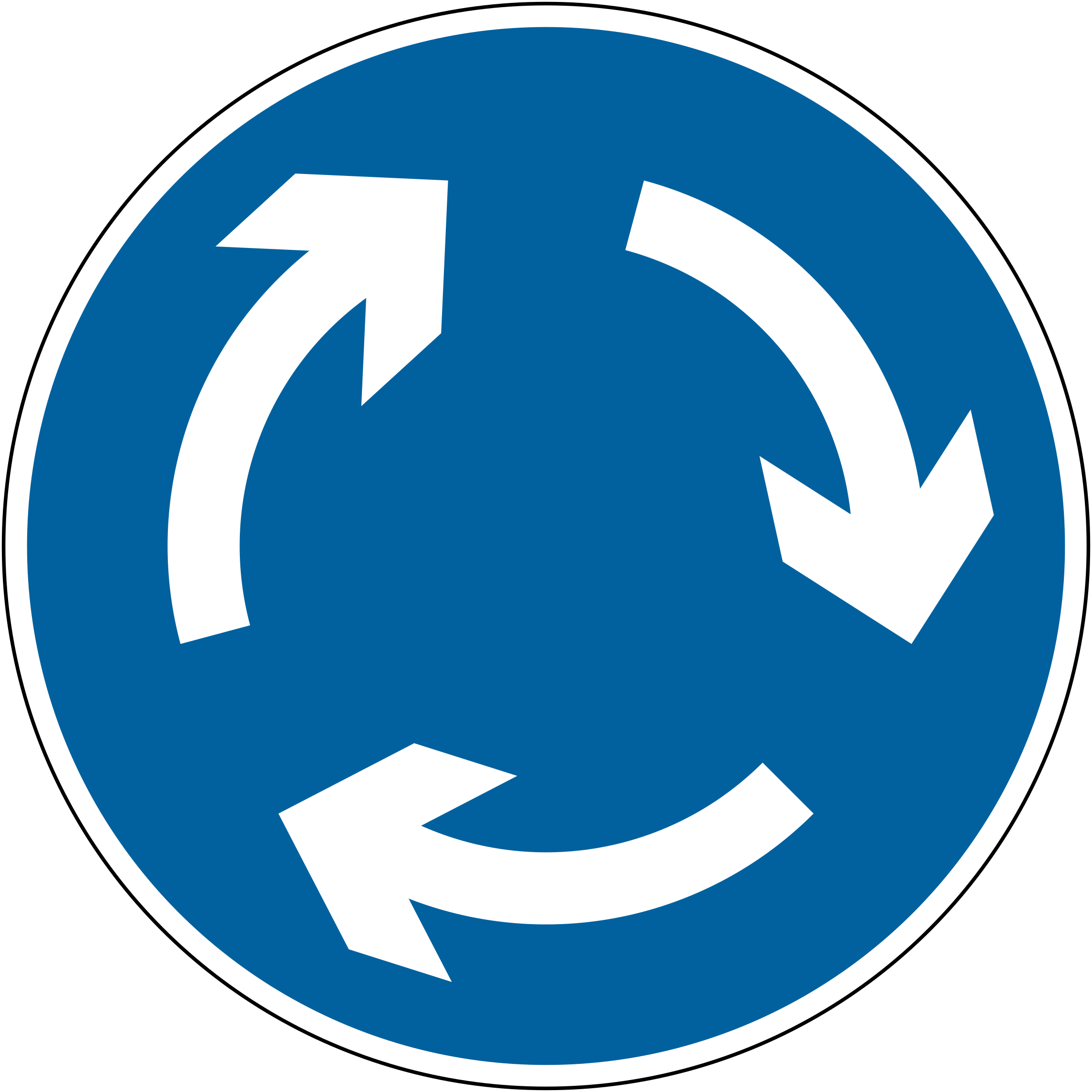
- Typical serious faults include poor observations at junctions, moving off without checking properly, incorrect lane use at roundabouts, speeding, driving too slowly without reason, poor response to road signs or road markings, and causing another road user to brake or steer around you.
- A serious fault can be marked even if the examiner does not intervene.
- You cannot cancel out a serious fault with a good manoeuvre later.
Dangerous faults explained
A dangerous fault means actual danger occurred. This normally involves the examiner, another road user, a pedestrian, or property being put at immediate risk. If the examiner has to use dual controls, grab the steering wheel, give an urgent verbal instruction, or another road user has to take emergency action, the fault is likely to be dangerous rather than just serious.
A dangerous fault is an automatic fail. The examiner will usually allow the test to continue unless it is unsafe to do so, but the result is already decided. They are trained to stay calm, and they may not tell you at the roadside. That is why trying to read the examiner’s face is pointless. I have had pupils think they failed after a stall and then pass, and pupils think everything was fine after a major lane error because the examiner stayed quiet.
The word “dangerous” can sound dramatic, but it covers practical examples: pulling out when a cyclist is alongside, driving through a red light, mounting the kerb near a pedestrian, or failing to stop for a zebra crossing where someone is waiting and clearly intending to cross.

How examiners decide between minor, serious and dangerous
The same type of mistake can be marked differently depending on timing, location and consequence. A slightly wide turn on an empty, quiet road may be a driving fault. A wide turn that enters the path of an oncoming vehicle is likely to be serious or dangerous. A stall at the side of the road is usually not the problem; failing to secure the car, rolling back, or moving off again without observations is the problem.
Examiners mark against the DVSA test report categories, such as control, move off, use of mirrors, signals, junctions, positioning, response to signs and signals, progress, and judgement. They are not marking your personality, your chat, or whether your parking looks beautiful from the pavement. What matters is safety, control and legality.
In lessons, I often recreate the same fault three ways so pupils understand it. For example, we practise a late signal on an empty road, then near a following car, then before a busy mini-roundabout. The signal itself is the same mistake, but the risk is not the same.
- 1Identify the action: for example, mirror check, signal, lane choice, speed or observation.
- 2Look at the road users nearby: vehicles, cyclists, pedestrians and anyone who could reasonably be affected.
- 3Ask whether anyone had to slow, stop, swerve or wait because of you.
- 4Decide whether the mistake was isolated or repeated.
- 5Fix the habit in practice, not just the individual example.
Faults learners worry about that often do not matter
Learners waste a lot of energy worrying about things that are not test issues if they are handled safely. The examiner does not expect you to drive like an experienced taxi driver. They expect safe decisions, reasonable progress and good control. If you go the wrong way on the independent driving section, you do not fail for that. You only fail if you deal with it unsafely, such as swerving late across lanes or ignoring road signs.
You also do not fail simply for asking the examiner to repeat an instruction. You do not fail for taking a bay park correction, provided it is safe and controlled. You do not fail for a stall if you recover properly: secure the car if needed, restart, observe all around and move off safely. In my car, we practise recovery deliberately because the panic after a small mistake causes more failures than the original mistake.
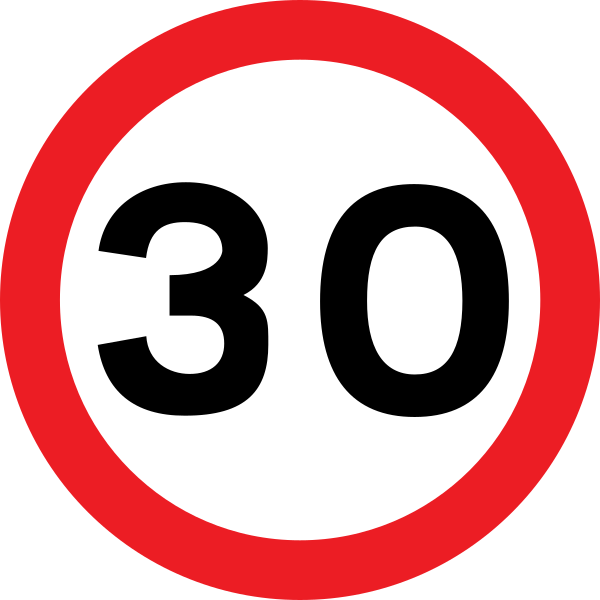
What does not impress an examiner is rushing to look confident. Speeding at 34 mph in a 30 mph limit is not “making progress”; it is illegal. Forcing your way into a gap at a roundabout is not positive driving; it is poor judgement.
- Going the wrong way is not a fault if you stay legal and safe.
- A correction during a reversing exercise is allowed if observations and control are good.
- A stall is not automatically a fail.
- Silence from the examiner does not mean you have failed or passed.
- You do not need perfect gear changes, but you must remain in control.
How to reduce faults before your test
The best way to reduce faults is to train decision-making, not just test routes. Test routes can change, roadworks appear, and sat nav instructions may take you somewhere you did not expect. A proper lesson should include busy junctions, right turns across traffic, roundabouts of different sizes, meeting traffic, pedestrian crossings, dual carriageways where available, and independent driving with a sat nav or traffic signs.
At Fast Track Driving Lessons, intensive courses run from 10 to 40 hours at £61.23 per hour, so we use the time to target the faults most likely to cost a pass. If a pupil is close to test standard, that might be 10 hours on sharp observation routines and judgement. If the basics are weaker, a longer course gives time to build habits under pressure. Theory knowledge also matters on the practical test, especially signs, speed limits, road markings and priorities; free theory test practice is available at /theory.
A useful final test drill is a mock test, but only when you are ready to learn from it. A mock test too early just proves you are not ready. A good instructor will debrief the exact fault, the risk, and the fix, then practise it until the safer habit is automatic.
- 1Practise mirror routines before every change of speed, position or direction.
- 2Use commentary driving for five minutes at a time: say what you can see, what might happen, and what you will do.
- 3Repeat your weakest junctions at different traffic levels, not just once when it is quiet.
- 4Practise safe recovery from stalls, wrong lanes and missed directions.
- 5Do at least one realistic mock test close to your practical test date.
Common questions
Can I pass with 15 minors?
Yes, under DVSA rules you can pass with up to 15 driving faults, often called minors, as long as you have no serious or dangerous faults. Sixteen or more driving faults is a fail. Repeated faults in the same area may be marked serious before you reach 16.
Is one serious fault an automatic fail?
Yes. One serious fault means you will not pass the practical driving test. The examiner will usually let the test continue unless it is unsafe, so you may not know until the end.
What is the difference between a serious and dangerous fault?
A serious fault means there was potential danger, even if nobody had to take emergency action. A dangerous fault means actual danger occurred, such as the examiner intervening or another road user being put at immediate risk. Both mean a fail.
Do I fail if the examiner uses the dual controls?
If the examiner uses the dual controls to prevent danger, it is very likely to be marked as a dangerous fault. There are rare situations where an intervention may be discussed in context, but you should treat any examiner intervention as serious. Your instructor’s aim is to make your decisions early enough that intervention is never needed.
Will I fail for going the wrong way on the test?
No, not if you stay safe and legal. The examiner is testing your driving, not your memory of the route. If you miss a turn, continue safely and wait for the next instruction rather than making a late or unsafe change.
Can I ask how many faults I have during the test?
No, you should not ask for a running score during the test. The examiner’s job is to give directions and assess safely, not coach you. Keep driving properly until the vehicle is parked and the test has finished.
See our pass guarantee
Reading about it only gets you so far. Our instructors drill this with you in the car, on the roads around your test centre.