
The short version
- There is no DVSA limit on practical driving test attempts.
- You must usually wait at least 10 working days before taking another practical test.
- A fail is most useful when you understand the exact fault that caused it.
- Do not rebook just because a test slot appears if the driving problem is still there.
- The quickest route to passing is targeted practice, not simply more attempts.
So, how many attempts does it take to pass the driving test?
Some learners pass the practical driving test first time, and others need two, three or more attempts. There is no official number that you are supposed to achieve, and there is no DVSA rule that says you have failed too many times. In the car, I have seen very capable learners fail a first test through one moment of poor judgement, then pass comfortably next time. I have also seen learners scrape through a mock test too early, book the real thing, and need several attempts because the same fault has not been fixed.
The direct answer is this: it takes as many attempts as it takes for you to demonstrate safe, legal and independent driving for around 40 minutes under test conditions. The examiner is not marking your confidence, your personality or how many hours you have had. They are marking what they see: control, observation, judgement, planning and how you respond to other road users.
Try not to measure yourself against friends. One person may have years of private practice with a parent, another may only drive once a week with an instructor, and another may be learning in a busy city with complex roundabouts and heavy traffic. The attempt number is far less important than whether your test report shows a pattern you can correct.
Is there a limit on how many times you can take the practical test?
No. For a car practical driving test in Great Britain, there is no published DVSA limit on the number of attempts you can make, provided you meet the normal booking requirements. You need a valid provisional licence, a valid theory test certificate, a suitable car if you are not using an instructor's car, and you must pay the test fee each time. DVSA fees are published on GOV.UK and can change, so check the official booking service before you pay.
At the time of writing, GOV.UK lists the car practical driving test fee as £62 on weekdays and £75 for evenings, weekends and bank holidays. Those figures are official DVSA fees but may change. Be careful with unofficial booking sites that charge extra admin fees or make the process look more complicated than it is.
If you fail, you cannot simply take another practical test the next day. GOV.UK states that you must wait at least 10 working days before taking another car practical test. That waiting time is meant to give you a chance to practise, not just to cool off. General guidance only, not legal advice.
- No maximum number of practical test attempts is set by DVSA.
- You must normally wait at least 10 working days after a fail before another practical test.
- Your theory test pass certificate is valid for 2 years from the date you passed.
- If the theory certificate expires before you pass the practical, you must retake and pass the theory test first.
- Only use the official GOV.UK service or a trusted booking route, and check current fees.
Why learners fail more than once
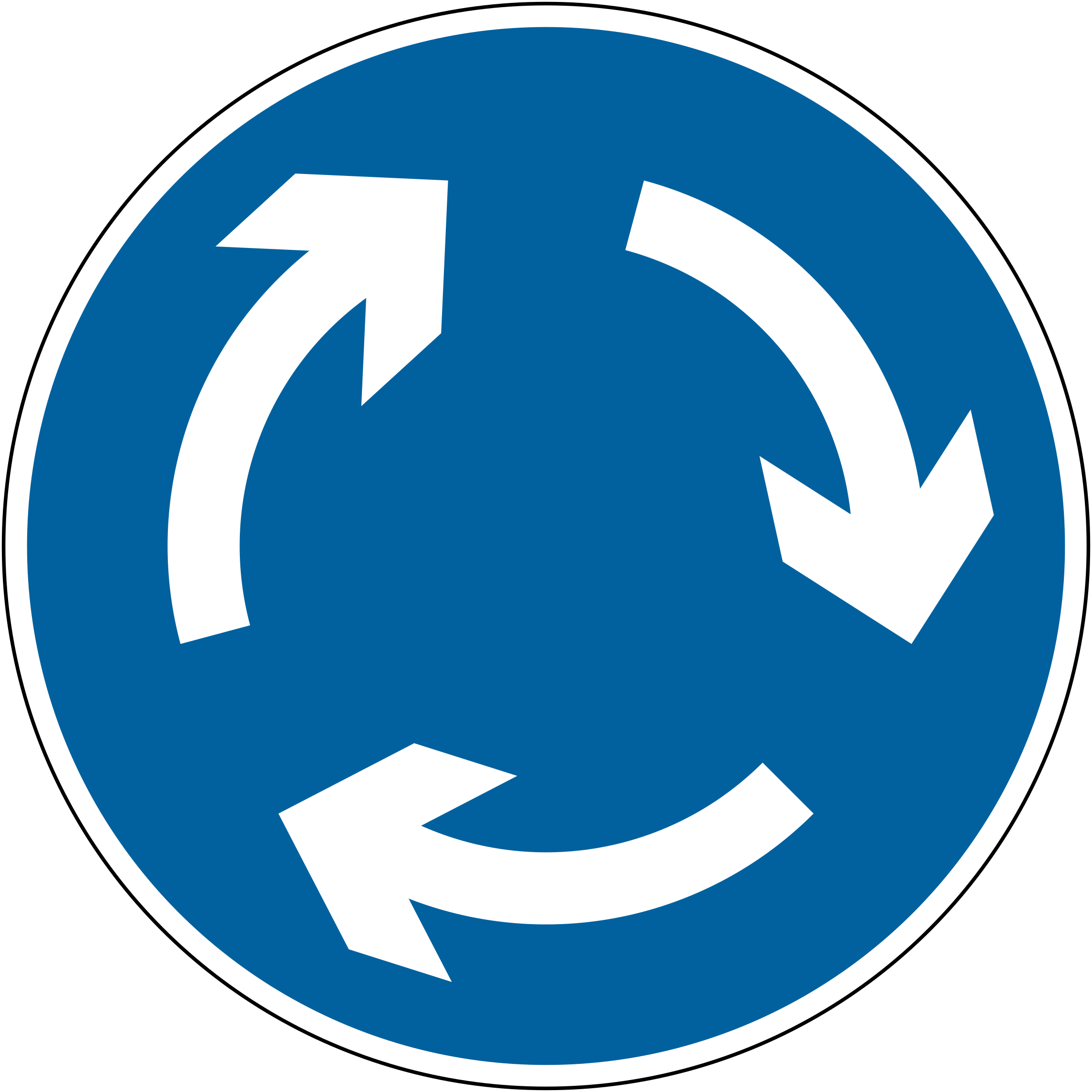
Most repeat fails are not because the learner cannot drive at all. They happen because one or two faults appear under pressure, especially at junctions, roundabouts, lane changes and meeting situations. On lessons, a learner might do nine good roundabouts and one rushed one. On test, if that one rushed decision makes another vehicle brake or swerve, it can become the serious fault that ends the pass.
The faults I see cost people most often are not dramatic. They are ordinary moments done slightly too late: checking the mirror after signalling instead of before, creeping out at a closed junction without proper observation, choosing the wrong lane and then trying to fix it too late, or approaching a mini-roundabout too quickly to judge it properly. Examiners mark the effect of the fault. A small steering correction in an empty road may be a driving fault. The same poor position causing risk to a cyclist may become serious.
Another reason is test readiness. Some learners are ready on familiar roads but not independent enough on roads they do not know. The driving test includes around 20 minutes of independent driving, usually following a sat nav, and you are expected to deal with the route safely even if you miss a turn. The examiner does not fail you for going the wrong way if you do it safely. They can fail you for panic braking, sudden lane changes, or ignoring road markings while trying to get back on route.
What the examiner is actually marking
The practical test is not a search for perfection. You can pass with some driving faults, but you cannot pass if you make a serious or dangerous fault. A driving fault is something that is not potentially dangerous on that occasion. A serious fault is something that could be dangerous, and a dangerous fault involves actual danger to you, the examiner, another person or property. Repeating the same driving fault can also become serious if it shows a pattern.
In real terms, the examiner is watching whether other road users have to react because of you. Did a driver have to brake because you emerged too late? Did you move off without seeing a cyclist? Did you drive too close to parked cars and leave no escape space if a door opened? These are the moments that matter more than whether your bay park was perfectly centred.
The Highway Code gives the baseline. Rule 159 covers moving off safely, including using mirrors and checking blind spots. Rule 161 reminds drivers to use mirrors frequently and before signalling, changing direction or speed. Rule 124 covers speed limits, but examiners also mark whether your speed is appropriate for the conditions, not just whether you stayed under the limit.
- Observation: late or missing checks before moving off, changing lane or emerging.
- Judgement: taking gaps that are too small or hesitating so long that you confuse others.
- Positioning: wrong lane, drifting, cutting corners or sitting too close to parked vehicles.
- Speed: too fast for hazards or too slow without good reason, affecting following traffic.
- Response to signs and markings: missing stop lines, bus lanes, box junctions or lane arrows.
- Control: stalling is not always serious, but poor recovery in a risky place can be.
Should you rebook straight away after failing?
It depends why you failed. If the test report shows one clear, unusual mistake and your instructor agrees it was out of character, rebooking promptly may be sensible, subject to the 10 working day rule and test availability. If the report shows the same issue your instructor has been warning you about for weeks, rushing into another test is usually just paying to repeat the lesson.
After a fail, emotions are high. Learners often remember the moment the examiner said the result but not the detail of the drive. Ask for the debrief, read the test report, and be honest about whether the fault was a one-off or part of a pattern. I like to take pupils back to the same type of road, not necessarily the same place, and recreate the decision. For example, if the serious fault was at a right turn across traffic, we practise judging oncoming speed, waiting position, clutch control and when to commit.
Do not let a cancellation slot bully you into a bad decision. A test in three days looks tempting, but if you have not fixed the fault, it is not a bargain. The best rebook date gives you enough time to practise the exact skills that broke down under pressure.
- 1Read the driving test report and identify the fault category, not just the location.
- 2Ask your instructor whether the fault was unusual or part of a repeated habit.
- 3Book one or two focused lessons on that weakness before choosing a new date.
- 4Do a mock test with normal examiner-style silence and independent driving.
- 5Only keep the new test date if the same fault no longer appears in practice.
How to reduce the number of attempts you need
The biggest mistake is treating the practical test as a way to find out whether you are ready. Your lessons and mock tests should do that before you pay the DVSA fee. When I prepare a learner, I want them able to drive safely on roads they do not know, with normal traffic pressure, while dealing with small mistakes calmly. If they only drive well when I prompt them, they are not ready yet.
Private practice can help a lot if it is structured. It should not just be ten minutes to the supermarket on the same route. Practise different times of day, different junction types, hill starts, meeting traffic, rural roads if local, and parking in real car parks. The supervising driver must meet the legal requirements, and the car must be insured, taxed, MOT'd where required, and roadworthy. General guidance only, not legal advice.
Build test conditions into practice. That means less talking, clear directions, no hints before hazards, and a proper review afterwards. Learners often drive better when an instructor is coaching them through every decision, but the test asks whether they can make those decisions themselves.
- Do mock tests, but use them to diagnose faults rather than to chase a fake pass.
- Practise the manoeuvres until you can correct them safely, not just complete them once.
- Drive on unfamiliar roads so your planning is not based on memory.
- Work on nerves by rehearsing the first five minutes of the test route routine.
- Learn to miss a sat nav direction safely rather than making a rushed correction.
Common repeat-test fault table
When someone has failed more than once, I stop talking about the number and start looking for the repeating fault. The location may change, but the cause is often the same. A learner who fails at a roundabout one week and a lane change the next may have one underlying issue: mirrors and planning are happening too late.
Use the table below as a practical self-check. If one of these sounds familiar, ask your instructor to design a lesson around the cause, not just the place where the fail happened.
- Fault: late mirror checks. What it looks like: signalling or changing speed before knowing who is behind. Fix: mirrors before any change of speed or direction, in the order that matches the risk.
- Fault: poor emerging judgement. What it looks like: edging out without seeing enough or taking a gap that makes others brake. Fix: improve position, look both ways more than once, and commit only when the gap is safe.
- Fault: roundabout rushing. What it looks like: arriving too fast, choosing late, or entering when a vehicle from the right is already a risk. Fix: slow earlier, read signs and lane markings, and separate looking from going.
- Fault: lane discipline. What it looks like: drifting between lanes or trying to change late after a wrong turn. Fix: follow the lane you are in unless it is safe and necessary to change.
- Fault: speed choice. What it looks like: doing the limit past parked cars, schools or tight bends when conditions need less. Fix: ask what you can see, what you cannot see, and who could step out.
- Fault: panic after a mistake. What it looks like: abrupt braking, steering or lane changes after missing a direction. Fix: continue safely and let the examiner or sat nav reroute you.
When multiple attempts start to affect confidence
Failing a driving test can feel personal, but the result is a snapshot of one drive. The danger after several attempts is that learners start driving to avoid faults rather than driving to manage risk. They become stiff, over-cautious, and so focused on the examiner that they stop reading the road. I have sat beside learners who could handle complex traffic on lessons but froze at a simple T-junction because they were thinking, "I cannot fail again."
Confidence returns through evidence. You need repeated successful drives where the old fault does not appear, not just reassurance. If nerves are the main issue, practise silence, unfamiliar routes and mock-test starts. Also sort the practical things: arrive early, bring the correct licence, know how the eyesight check works, and make sure the car is suitable if using your own.
If you keep failing for different reasons, step back and review your overall standard. It may be a sign that you can perform individual skills but have not yet joined them into independent driving. That is fixable, but it usually needs varied practice, not a quick rebook.
A sensible plan after each attempt
Whether it was your first attempt or your fourth, treat the result as information. A pass means you have met the minimum standard on the day, but you still have years of learning ahead. A fail means the examiner saw a risk that needs work. Neither result defines you as a person.
The learners who move forward fastest are the ones who are specific. They do not say, "I am bad at tests." They say, "I need to spot lane arrows earlier on multi-lane roundabouts," or "I need to check the right blind spot before moving off at an angle." That gives your practice a target.
Before you book again, use this checklist honestly. If you cannot tick most of it, more attempts may not help yet.
- I understand exactly why I failed, including the driving situation and the risk created.
- I can reproduce the same type of situation in practice without the fault recurring.
- I can drive independently for 40 minutes with only normal, minor coaching afterwards.
- I can recover safely from wrong turns, stalls or missed sat nav directions.
- My instructor or supervising driver agrees the test date is realistic, not hopeful.
- My theory certificate, licence, insurance and test booking details are all valid and checked.
Common questions
How many times can you fail your driving test in the UK?
There is no DVSA maximum number of times you can fail or retake the car practical driving test. You can keep booking further tests as long as you meet the normal requirements, including having a valid theory test certificate. You must usually wait at least 10 working days before taking another practical test.
Is it normal to fail the driving test first time?
Yes, many capable learners do not pass first time, and it does not mean they will be unsafe drivers. What matters is the reason for the fail. A clear, fixable fault is very different from a general pattern of poor observation, judgement or control.
Should I change driving instructor after failing more than once?
Not automatically. First ask whether you and your instructor have identified the exact faults and practised them properly under test-like conditions. If you are repeatedly going to test before you are ready, or you do not understand what you are working on, a second opinion may help.
Can I pass my driving test after several attempts?
Yes. The examiner is not marking your history, and they do not fail you because you have taken tests before. They mark the drive in front of them, so if your standard is safe, legal and independent on the day, you can pass.
How soon should I book another test after failing?
You must leave at least 10 working days before another practical test, according to GOV.UK. Whether you should book the earliest available slot depends on the fault. If the issue is not fixed in lessons or private practice, a quick retest often leads to the same result.
Does failing the practical test affect my theory test?
Failing the practical test does not cancel your theory test pass. However, the theory certificate lasts 2 years from the date you passed it. If it expires before you pass the practical test, you must pass the theory test again before booking or taking another practical.
See our pass guarantee
Reading about it only gets you so far. Our instructors drill this with you in the car, on the roads around your test centre.