
The short version
- Many disabled learners pass with standard or adapted controls.
- Tell DVLA about any notifiable condition that may affect driving.
- Choose an instructor who will plan around your needs, not guess.
- DVSA can offer reasonable adjustments for theory and practical tests.
- Examiners mark safety and control, not your diagnosis.
Can you learn to drive with a disability or health condition?
Yes, many people learn to drive with a disability, long-term health condition, neurodivergence, injury or sensory impairment. The real question is not whether you have a diagnosis, but whether you can meet the legal and practical standard for safe driving, with adaptations if needed. In lessons I have seen learners make excellent progress once the car, lesson structure and communication style match their needs.
Your first priorities are straightforward: check whether you must tell DVLA, make sure you can meet the eyesight and fitness-to-drive rules, and find an instructor or assessment route that understands adaptations. Some learners use a standard manual or automatic car. Others use hand controls, a steering aid, a left-foot accelerator, pedal extensions, extra mirrors or a fully adapted vehicle.
The driving test standard is the same for everyone, but the route to reaching it can look different. A learner with fatigue may need shorter lessons. A learner with autism or anxiety may need a predictable routine and clear briefings. A learner with restricted movement may need extra practice building a safe mirror and blind-spot routine that works for their body.
- Start by checking DVLA medical rules before you book a block of lessons.
- Consider an automatic if clutch control, gear changes or coordination are a barrier.
- Ask early about adapted vehicles, as not every instructor has access to one.
- Build lessons around safe observation, control, planning and judgement.
- Tell the test booking service about support needs rather than waiting until test day.
DVLA medical rules: what you must do before lessons
This is general guidance, not legal advice. In the UK, DVLA is responsible for driver licensing and medical fitness to drive. You must tell DVLA if you have a notifiable medical condition or disability that could affect your driving. GOV.UK says you can be fined up to £1,000 if you do not tell DVLA about a medical condition that affects your driving, and you may be prosecuted if you are involved in an accident.
Not every diagnosis needs to be reported, and the rules depend on the condition and how it affects you. DVLA publishes an A to Z list of medical conditions on GOV.UK, including conditions such as epilepsy, blackouts, diabetes treated with insulin, certain heart conditions, sleep apnoea, vision problems, strokes, neurological conditions and some mental health conditions. If you are unsure, check the official DVLA page or ask your GP or consultant for guidance, but remember the licensing decision sits with DVLA.
If DVLA needs medical information, your provisional licence may take longer than a standard application. That is why I tell learners with known conditions to apply early and avoid booking a test before the licence position is clear. DVLA may issue a licence, issue a shorter medical licence, add licence codes for adaptations, ask for further medical evidence, or decide you must not drive until a condition is controlled.
- 1Check the DVLA medical conditions A to Z list on GOV.UK.
- 2Apply for your provisional licence early and answer medical questions honestly.
- 3Speak to your doctor if you are unsure how your condition affects driving.
- 4Wait for DVLA’s decision if they say they need medical enquiries.
- 5Show your instructor any relevant licence codes before driving.
- 6Update DVLA if your condition changes after you start learning.
Eyesight, medication and being fit to drive
Highway Code Rule 90 says you must make sure you are fit to drive. Rule 92 covers eyesight and says you must be able to read a vehicle number plate from 20 metres, with glasses or contact lenses if you need them. On the practical test, the examiner checks this at the start. If you cannot read the number plate, the test will not continue and it is recorded as a failed test.
Medication is a common issue learners underestimate. Highway Code Rule 96 says you must not drive under the influence of drugs or medicine, and you should check labels or ask a doctor or pharmacist. I have sat next to learners who drive well for 30 minutes, then their concentration drops sharply because of pain relief, antihistamines, sleep medication or a change in dose. That can become a serious safety fault if it causes late braking, poor lane discipline or missed signs.
Fitness to drive is not only about a permanent condition. A bad pain day, migraine, low blood sugar, panic symptoms, poor sleep or a flare-up can make a normally safe learner unsafe on that day. A sensible cancellation or shorter lesson is better than pushing through and building dangerous habits. Examiners do not give extra allowance because you felt unwell on test day; they mark what happens on the road.
- Bring the glasses or contact lenses you need for driving.
- Check medicine labels for drowsiness or driving warnings.
- Avoid lessons when symptoms make concentration or control unreliable.
- Carry any medical items you normally need, such as glucose, inhalers or emergency medication.
- Tell your instructor if you feel unwell during a lesson, before your driving deteriorates.
Choosing lessons, instructors and vehicle adaptations
A good first conversation with an instructor should be practical and respectful. You do not need to share private medical details that are irrelevant, but the instructor does need to know anything that affects control, observation, communication, stamina or emergency action. I would rather know before the first lesson that a learner has limited neck movement, uses hearing aids, processes instructions slowly, or cannot use one leg reliably.
Vehicle adaptations can make driving possible and safe, but they must be fitted and used correctly. Common examples include hand controls for accelerator and brake, steering balls or knobs, left-foot accelerators, pedal guards, pedal extensions, altered seating, extra mirrors and wheelchair transfer solutions. Some learners benefit from an assessment at a specialist driving assessment centre, such as those in the Driving Mobility network, before choosing a car or instructor.
One mistake I see is learners trying to adapt themselves to the wrong car for too long. If every junction is a battle because the seating position hurts, the clutch is too heavy, or mirror checks require excessive twisting, the learning suffers. Sometimes the best progress comes from switching to automatic, changing the seating set-up, or using a vehicle with appropriate controls rather than repeating the same struggle every week.
- Ask whether the instructor teaches in an automatic, manual or adapted vehicle.
- Check whether you can safely reach and operate all primary controls.
- Practise emergency braking with the adaptations once you are ready.
- Make sure any steering aid does not obstruct the airbag or your control.
- If you will drive your own adapted car, check insurance and dual-control arrangements.
How lessons may be adjusted without lowering the standard
Reasonable adjustments in lessons are about access, not making driving easier than the law allows. I might use shorter lessons, more regular breaks, written lesson plans, diagrams, quieter routes, consistent language, or extra time to practise a routine. The end target remains the same: you must drive safely, independently and legally in real traffic.
For learners with anxiety, ADHD, autism, dyslexia or processing difficulties, the biggest gain is often reducing surprise. I explain the goal before we move off, keep instructions simple, and debrief one issue at a time. On test, however, the examiner will still give directions, ask you to follow signs or a sat nav, and expect you to prioritise road safety when things change.
For physical disabilities, lesson planning often focuses on observation and car control. If turning your head is difficult, you still need an effective way to check mirrors and blind spots before moving off, changing lanes and emerging. If grip strength varies, we practise steering accuracy and recovery at low speed first, because poor steering near parked cars is one of the quickest ways to pick up a serious fault.
- 1Agree a communication style, such as short instructions or early route briefings.
- 2Set up the seat, mirrors and adaptations before every drive, not after moving off.
- 3Start on quiet roads and build the same routine into busier situations.
- 4Practise one new demand at a time, such as roundabouts before adding dual carriageways.
- 5Review symptoms and fatigue at the halfway point of longer lessons.
- 6Record what worked so the next lesson starts consistently.
Theory test and practical test reasonable adjustments
DVSA can provide support for candidates with a disability, health condition, reading difficulty or other need. For the theory test, support may include things such as extra time, a voiceover, British Sign Language support, a reader, a recorder or a separate room, depending on what you ask for and what DVSA approves. The exact options and evidence requirements can change, so use the official GOV.UK booking guidance.
For the practical test, tell DVSA about your needs when you book. This can help with arrangements such as allowing extra time for the examiner to discuss your needs, communication preferences, mobility considerations or an adapted vehicle. If you are using your own car or an adapted car, it still has to be suitable, roadworthy, insured for test use and meet DVSA test vehicle rules.
The practical test fee for a car test is published by DVSA on GOV.UK and can change, so check the current figure when booking. At the time of writing, the standard weekday car practical test fee listed by GOV.UK is £62, with a higher fee for evenings, weekends and bank holidays. Do not pay anyone unofficial fees for medical adjustments; book through official channels.
- Request theory test support when booking, not at the test centre desk.
- Bring any approved evidence or confirmation emails DVSA asks for.
- Tell DVSA if you use an adapted car or have mobility needs at the test centre.
- Check your car meets DVSA test rules if you are not using an instructor’s car.
- Arrive early enough to set up seating, mirrors, controls and any aids calmly.
What examiners actually mark on test
Examiners do not mark your disability or health condition. They mark driving faults, serious faults and dangerous faults against the same national standard. A driving fault is something that is not potentially dangerous in that moment, but it can become serious if repeated or if it creates risk. A serious fault is something potentially dangerous. A dangerous fault involves actual danger to you, the examiner, the public or property.
The most common test-losing issue I see with disabled learners is not the disability itself, but an uncorrected workaround. For example, a learner with restricted neck movement may roll away from the kerb without an effective blind-spot check. A learner using hand controls may steer one-handed while also trying to brake, causing poor lane position. A learner with anxiety may freeze at a roundabout, then rush into an unsafe gap because they feel pressured.
The examiner will take account of approved vehicle adaptations, but the outcome must still be safe. If your method gives you full control and proper observation, that is fine. If it causes late decisions, missed mirrors, harsh braking, poor steering or failure to respond to hazards, it will be marked like any other unsafe driving.
- Fault: moving off without an effective blind-spot check. Why it matters: cyclists and vehicles can be hidden alongside you.
- Fault: relying on extra mirrors but not acting on what they show. Why it matters: observation must lead to safe decisions.
- Fault: letting adapted controls distract from steering. Why it matters: lane discipline and clearance still count.
- Fault: hesitating for too long, then rushing. Why it matters: pressure often leads to unsafe gaps.
- Fault: continuing when symptoms affect control. Why it matters: the examiner can only mark the drive they see.
After you pass: licence codes, insurance and safe independence
Passing the test is a major step, but it is not the end of your responsibilities. If DVLA issues your licence with codes, those codes matter. They may show that you must use specific adaptations, wear corrective lenses, drive an automatic, or follow another restriction. Driving outside your licence conditions can create legal and insurance problems.
Tell your insurer about relevant adaptations, medical conditions where required by the insurer, and any licence restrictions. If your condition changes, or you have a new episode such as a seizure, blackout or significant eyesight change, check DVLA rules again before driving. The duty to be medically fit does not stop once you have passed.
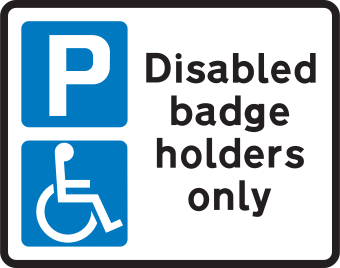
Blue Badge rules, parking concessions and mobility support can make day-to-day driving easier, but they do not change the Highway Code rules on observation, speed, signalling or priority. As a new driver, give yourself time to build independent experience gradually. Use familiar routes first, avoid the most tiring journeys until you are ready, and do not let passengers push you beyond your safe limit.
- Check your full licence for DVLA codes as soon as it arrives.
- Keep adaptation servicing and vehicle maintenance up to date.
- Inform your insurer accurately before driving alone.
- Review DVLA medical guidance if symptoms or treatment change.
- Plan early solo drives for low-stress times and familiar roads.
Common questions
Do I have to tell DVLA if I have a disability but it does not affect my driving?
Not every disability has to be reported. The key question is whether it is a notifiable condition or affects safe driving, so check the DVLA medical conditions A to Z list on GOV.UK. If in doubt, ask DVLA or your doctor before driving.
Can I take my driving test in an adapted car?
Yes, if the car is suitable for the test, roadworthy, insured for test use and meets DVSA rules. Tell DVSA about the adaptations when booking so the examiner is prepared and any practical arrangements can be made.
Will the examiner be more lenient because I have a health condition?
No. The examiner can allow for approved communication needs or adaptations, but the driving standard is the same. They mark whether your driving is safe, controlled and legal on the day.
Can I learn to drive if I have anxiety or autism?
Many learners with anxiety or autism learn successfully with the right lesson structure. Clear routines, quieter starting areas, simple instructions and gradual exposure to busy roads can help, but you still need to manage decisions safely in real traffic.
What happens if my medication makes me drowsy before a lesson or test?
You should not drive if medication affects your ability to drive safely. Highway Code Rule 96 says you must not drive under the influence of drugs or medicine, and you should check labels or ask a doctor or pharmacist. It is better to rearrange than risk an unsafe drive.
Do I need a specialist driving assessment before starting lessons?
Not always, but it can be very useful if you may need vehicle adaptations or are unsure which controls are safest. A specialist assessment can help identify suitable adaptations before you spend money on lessons in the wrong vehicle.
Find your course length
Reading about it only gets you so far. Our instructors drill this with you in the car, on the roads around your test centre.