
The short version
- Learning to drive is hard at first because the brain is handling too many new tasks at once.
- Most learners struggle more with observations, planning and decision-making than with basic car control.
- The practical test is marked on safety, not perfection.
- Private practice helps most when it is structured and legal.
- Progress is rarely a straight line, so a bad lesson does not mean you are failing.
So, is learning to drive hard?
Yes, learning to drive can be hard, especially in the first few lessons, but it is not hard in the way many learners imagine. You are not expected to be naturally good at it. You are building a new set of habits: steering, pedals, gears if you are in a manual car, mirrors, road position, speed judgement, signs, other road users and the legal rules that sit behind it all. That is a lot to ask of one brain at 20 or 30 mph.
In the car, I usually see learners worry about the wrong thing. They think the hard part is changing gear smoothly, parking perfectly or not stalling. Those things matter, but they are teachable mechanical skills. The real challenge is learning to notice risk early enough to make calm decisions. A learner who spots a pedestrian near a zebra crossing early is already safer than a learner who changes gear beautifully but reacts late.
The first honest answer is this: driving feels hard until enough of it becomes automatic. Once mirror checks, clutch control, braking pressure and lane discipline stop taking all your attention, you have more mental space for judgement. That is when learners often say, “It suddenly clicked.” It usually does not click in one dramatic moment. It comes from repeated, coached practice in real traffic.

Why driving feels so difficult at the beginning
The early difficulty comes from task overload. A new learner pulling away from the kerb might be thinking: clutch up slowly, a bit of gas, handbrake off, steer out, check mirrors, signal, blind spot, do not hit the kerb, watch the parked car, and do not annoy the driver behind. An experienced driver does most of that without conscious effort. A learner has to process every item separately.
This is why a good lesson does not throw everything at you at once. I would rather a learner spends time mastering moving off and stopping in a quiet area than rush into busy roundabouts before they can control the car. If the foundation is weak, the later topics feel frightening. If the foundation is solid, busier roads become a manageable step rather than a shock.
This article is general guidance for learners, not legal advice. You should always follow the Highway Code, your instructor’s advice, and the conditions of your provisional licence and insurance.
- Mental load: you are learning control, observation and judgement together.
- Timing: you need to act early enough, not simply know the correct answer.
- Traffic pressure: other road users do not always give learners space.
- Fear of mistakes: nerves can make simple routines feel harder.
- Changing situations: no two junctions, roundabouts or parking spaces are exactly the same.
What learners usually find hardest
From the passenger seat, the hardest topics are not always the ones learners expect. Many pupils fear hill starts, but once they understand the bite point and handbrake control, hill starts become repeatable. The more persistent problems tend to be observations, speed on approach, meeting traffic and reading junctions. These are judgement skills, so they take more varied practice.
Roundabouts are a classic example. Learners often ask, “Which lane do I need?” but the lane is only part of it. You also need to approach at a speed that gives you time, choose a safe gap, understand where other vehicles may be going, maintain lane discipline, signal correctly and exit without drifting. The fault I see most is approaching too fast, then trying to solve everything at the give-way line.
Another common struggle is mirrors. Learners may physically look in the mirror, but too late for it to change the decision. Examiners are not impressed by a mirror glance after you have already moved. The useful habit is mirrors before you change speed or direction, then act on what you see. That is the difference between a routine and a safety decision.
- Junctions: late observations and rushing the final approach.
- Roundabouts: speed too high, unclear lane discipline or weak signalling.
- Meeting traffic: poor judgement of priority and available space.
- Mirrors: checking them as a gesture rather than using the information.
- Parking: steering too early or too late, then forgetting all-round observation.
Is the UK driving test hard?
The UK practical test is demanding because it checks whether you can drive safely and independently, not whether you can repeat a memorised route. A DVSA examiner will assess your control, observations, planning and response to normal road situations. You may make small mistakes and still pass, but one serious or dangerous fault will result in a fail. More than 15 driving faults also results in a fail. That is DVSA test marking guidance and the details can change, so check GOV.UK for current information.
Learners sometimes think examiners are looking for perfection. They are not. They are looking for safety. If you stall, recover safely, observe properly and do not affect anyone, it may only be a minor issue or may not matter much at all. If you pull out from a junction and make another vehicle brake sharply, that is the sort of mistake that can become serious because of the risk created.
The cost can add pressure. GOV.UK lists the car theory test at £23 and the standard weekday car practical test at £62, with higher fees for some evening, weekend and bank holiday tests. Fees can change, so always check the official DVSA booking service. Avoid unofficial booking sites that add extra charges unless you are clear what you are paying for.
The faults that quietly cost learners their test
Most test fails I have discussed with learners are not dramatic. They are ordinary situations handled a little too late: a missed mirror before changing lanes, creeping out without a proper view, braking sharply because the approach speed was wrong, or not responding to a road sign. The examiner is marking the risk and the effect on other road users.
A useful way to prepare is to stop asking, “Can I do this manoeuvre?” and start asking, “Can I do this safely while the road changes around me?” Parking in an empty road is a skill. Parking while a cyclist appears, a van blocks your view and a pedestrian walks behind you is test-standard driving. That is why all-round observation matters during manoeuvres, not just at the start.
- Mirrors before changing speed: forgetting the centre mirror before braking can show poor awareness of following traffic.
- Moving off safely: not checking the blind spot before leaving the kerb is a common serious fault risk.
- Junction observation: looking but not seeing, then emerging when another vehicle is close, is often marked seriously.
- Speed choice: driving too fast for a narrow road, parked cars or poor visibility can be unsafe even if you are under the limit.
- Signals: signalling late, misleadingly or not at all can affect other road users and lead to faults.
- Positioning: drifting lanes at roundabouts or cutting corners on right turns can create real danger.
How long does it take to stop feeling difficult?
There is no reliable number of lessons that applies to everyone. DVSA has previously published guidance that many people need a substantial amount of professional tuition and private practice, but individual progress varies with age, confidence, road experience, lesson frequency, practice quality and whether you are learning manual or automatic. What is known is that cramming without reflection is rarely as effective as regular, well-planned practice.
I often see a pattern. The first stage is basic control, where every pedal movement needs thought. The second stage is road routines, where you can drive but still need prompting. The third stage is independent decision-making, where you begin spotting hazards before I mention them. The fourth stage is test readiness, where your safe decisions hold up even when you are tired, nervous or on unfamiliar roads.
A bad lesson does not mean you have gone backwards. Some of the most useful lessons feel messy because they expose the next layer of learning. If you keep making the same fault, though, you need a specific plan rather than more general driving. For example, “more roundabouts” is vague. “Approach roundabouts in second gear where appropriate, identify lane signs early, and narrate gaps before entering” is a plan.
- 1Control: you can move off, stop, steer and change gear without panic.
- 2Routines: mirrors, signals, position, speed and look become consistent.
- 3Judgement: you choose safe gaps and speeds without heavy prompting.
- 4Independence: you follow signs or sat nav while maintaining safety.
- 5Test standard: your driving stays safe when something unexpected happens.
Does manual or automatic make learning easier?
Automatic can make the control side easier because you are not managing a clutch or manual gear changes. For some learners, especially those who feel overloaded, that can free up attention for observation and planning. Automatic is not an easy pass button, though. You still need safe judgement, positioning, speed control, mirror use and proper response to hazards.
Manual gives you more flexibility after passing because a manual licence allows you to drive both manual and automatic cars, while an automatic licence limits you to automatics. That is the current DVLA position, but always check GOV.UK if your circumstances are unusual. If clutch control is the only thing holding you back, it may be worth giving manual proper time before switching. If anxiety or coordination issues are stopping you from learning safely, automatic may be a sensible route.
What I would not recommend is switching simply because of one difficult week. Stalling in a manual car is normal. The question is whether the stalls are reducing and whether you understand why they happen. If you are improving, stay patient. If every lesson is dominated by clutch stress and your road awareness cannot develop, have an honest discussion with your instructor.
How to make learning to drive easier
The learners who improve fastest are not always the most confident. They are the ones who practise deliberately. They know the focus of the lesson, they ask what the recurring fault is, and they work on one or two habits at a time. Trying to fix everything at once usually means nothing sticks.
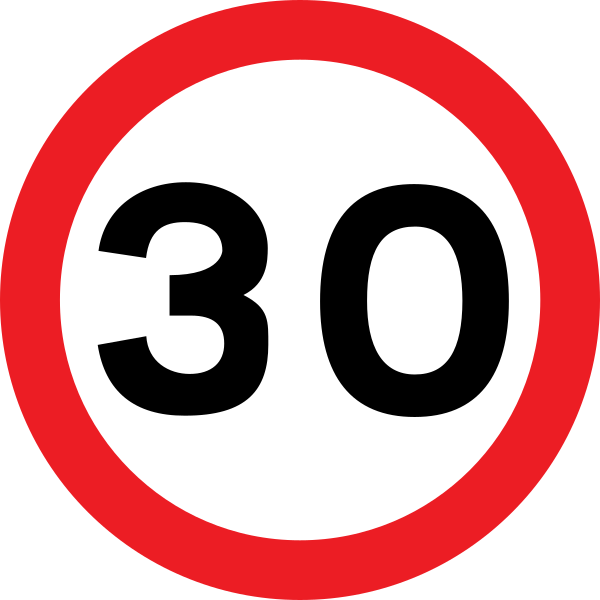
Use the Highway Code as a practical tool, not just a theory test book. Rule 159 covers checks before moving off, including mirrors, signalling where necessary and looking round for blind spots. Rule 170 is important at junctions, including looking out for pedestrians crossing or waiting to cross. Rule 124 covers speed limits, including the point that street lights usually mean a 30 mph limit unless signs show otherwise. These rules are not trivia; they explain what safe driving should look like.
Private practice can help, but only if it is legal and structured. You need the correct supervising driver, insurance and L plates, and you must not drive on motorways unless accompanied by an approved driving instructor in a car fitted with dual controls. Check GOV.UK for the current learner driver rules. Practising the same mistake for two hours can make it harder to correct later.
- Before each lesson, choose one main goal, such as approach speed at junctions.
- After each lesson, write down the top recurring fault and the fix.
- Practise in varied conditions gradually, not all at once.
- Ask your instructor to explain whether a mistake was control, observation or judgement.
- Use commentary driving for a few minutes, saying what you see and what you plan to do.
- Do not book a test just because you can complete a route; book when your safety is consistent.
A learner driver confidence checklist
Confidence is not the same as feeling fearless. Good driving confidence means you trust your routines and you know what to do when something changes. Overconfident learners can be just as risky as nervous learners because they stop checking properly. The aim is calm, alert and repeatable driving.
If you are finding driving hard, use this checklist with your instructor or supervising driver. It will show whether you need more basic control, more road experience or more test-style independence. Be honest. A tick only counts if you can do it consistently without being talked through it.
- I can move off and stop smoothly while completing the correct observations.
- I check mirrors before changing speed, changing direction or signalling.
- I approach junctions slowly enough to look properly and stop if needed.
- I can deal with meeting traffic without rushing into narrow gaps.
- I understand when to give way to pedestrians, cyclists and other vehicles.
- I can make a mistake, recover safely and continue without panicking.
Common questions
Is learning to drive harder than the theory test?
For most learners, yes, practical driving feels harder because you must apply the rules in real time while controlling the car. The theory test is still important because it gives you the knowledge behind speed limits, signs, hazards and priorities. Treat theory study as part of practical preparation, not a separate hurdle.
Why do I feel worse after some driving lessons?
That often happens when you move from a simple skill to a more complex version, such as quiet junctions to busy junctions. You may not be worse; you may just be seeing more hazards and needing more time to process them. Ask your instructor which fault to focus on next so the lesson has a clear purpose.
Is it normal to keep stalling when learning manual?
Yes, stalling is normal early on and it does not automatically mean manual is wrong for you. What matters is whether you are learning why it happens, such as lifting the clutch too quickly or not using enough gas when needed. On test, a stall is usually judged by how safely you recover and whether it affects other road users.
Can I pass if I am a nervous driver?
Yes, nervous learners pass when their safety routines are reliable under pressure. Examiners do not mark nerves; they mark the driving. Build confidence through repeated practice in the situations that trigger you, such as roundabouts, hill starts or independent driving.
Is learning automatic much easier for anxious learners?
It can be easier because it removes clutch control and manual gear changes, which reduces workload. However, automatic learners still need strong observations, judgement and planning. Remember that passing in an automatic currently gives you an automatic-only licence in the UK.
How do I know if I am ready for my practical test?
You are close when you can drive safely on unfamiliar roads, follow signs or sat nav, handle mistakes calmly and need little or no prompting from your instructor. Being able to complete manoeuvres is not enough on its own. Test readiness is about consistent safe decisions, not one good mock test.
Find your course length
Reading about it only gets you so far. Our instructors drill this with you in the car, on the roads around your test centre.