
The short version
- Book your theory test early and use free practice before spending heavily on lessons.
- Choose intensive learning if you can practise most days and cope with tiredness.
- Choose weekly lessons if you need more time to build judgement and confidence.
- Ask for an honest assessment drive before choosing a 10, 20, 30 or 40 hour course.
- Do not book a practical test until your instructor says your driving is independently safe.
The real difference between intensive and weekly lessons
An intensive driving course means learning over a short period, often with lessons close together across days or weeks. Weekly lessons usually mean one or two hours a week over several months. Both can produce a safe, test-ready driver. The right choice depends less on the label and more on how quickly you absorb information, how well you handle pressure, and how much time you can give to driving between now and your test.
In the passenger seat, what I see most often is not that one method is automatically better. I see learners improve fastest when the lesson pattern matches their concentration span. A learner who can focus for three or four hours and correct mistakes quickly may benefit from intensive training. A learner who needs time to sleep on things, reflect, and practise routines gradually may do better weekly.
The DVSA practical test is the same either way. The examiner does not care whether you learned over ten days or ten months. What matters is that you can drive safely, legally and independently for about 40 minutes, including normal roads, one manoeuvre, possibly an emergency stop, and roughly 20 minutes of independent driving.
When an intensive course works well
Intensive courses suit learners who can keep momentum. If you already understand the basics, have passed or are close to passing your theory test, and can clear your diary, an intensive course can reduce the stop-start feeling of weekly lessons. You spend less time re-learning last week’s roundabouts and more time polishing judgement, planning and test standard driving.
At Fast Track Driving Lessons, intensive courses are commonly arranged from 10 to 40 hours at £61.23 per hour. The right number of hours depends on your current ability, not just how quickly you want to pass. A 10-hour course is usually more realistic for someone who has already had good training and needs test preparation. A 30 or 40-hour course is more suitable for a newer learner, although some complete beginners still need more time.
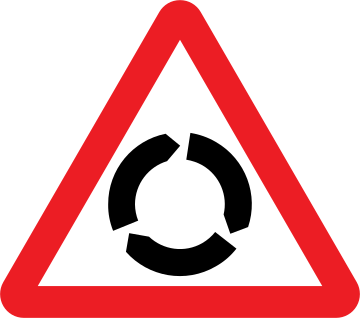
How I would drill this in a lesson is simple: we would repeat the same skill in varied places, not just on the same easy road. For example, with roundabouts, I would first check lane discipline on a quiet two-lane roundabout, then move to busier ones, then add independent driving so you must read signs and plan without prompting. That is what builds test readiness, not just covering hours.
- Good for learners with flexible time over a short period.
- Useful if you forget skills between weekly lessons.
- Works best when theory test preparation is already under control.
- Can suit learners who have a practical test date approaching and need focused training.
When weekly lessons are the better choice
Weekly lessons are often better for learners who are nervous, very new, or juggling school, work or childcare. Driving uses a lot of mental energy at first: steering, clutch control if learning manual, mirrors, signals, speed, road position and hazards all compete for attention. Some learners need repetition spread over time before those routines become automatic.
Weekly learning also gives you time to practise between lessons if you have access to a suitable car, insurance and a supervising driver who meets the legal requirements. Private practice can be very useful, but only if it supports what your instructor is teaching. Repeating poor observation habits for ten hours can make my job harder, not easier.
From an examiner’s point of view, it does not matter whether you took weekly lessons. There is no mark for speed of learning. The test report is about driving faults, serious faults and dangerous faults. A steady learner who takes longer but reaches a calm, independent standard is in a better position than a rushed learner who only drives well when prompted.
How to decide: a practical checklist
Before choosing, be honest about your starting point. Many learners underestimate how much is involved after they can move off and change gear. Test standard means you can deal with meeting traffic, pedestrian crossings, spiral roundabouts, dual carriageways, sat nav instructions, parking and unexpected behaviour from other road users without needing help.
I normally suggest an assessment lesson before committing to a course length. In that lesson I am not looking for perfection. I am checking how quickly you respond to coaching, whether you can maintain control while observing properly, and whether your nerves affect decision-making. That tells us more than your number of previous hours.
- 1Check your theory test position first. You must pass the theory test before booking a car practical test, and the theory certificate lasts two years.
- 2Look at your diary honestly. If you can only manage one lesson after a long shift, intensive training may not be the best use of money.
- 3Ask for an assessment drive if you have previous experience. Choose hours based on ability, not optimism.
- 4Plan rest time. A tired learner makes late mirror checks, rushes junctions and misses speed limit changes.
- 5Book the practical test only when your instructor agrees you are consistently safe without prompts.
Cost, tests and what can change
Fast Track Driving Lessons courses are priced at £61.23 per hour, with options from 10 to 40 hours. The lesson cost is only one part of the total. You also need to budget for the theory test, practical test, possible use of the instructor’s car for test, and any extra lessons if you are not ready. GOV.UK test fees can change, so always check the official booking pages rather than relying on old screenshots or social media posts.
Fast Track also offers free theory test practice at /theory. I would use that early. There is no advantage in delaying theory revision until you feel confident behind the wheel. The hazard perception part links directly to real driving: spotting developing hazards early is the same skill we use when approaching parked cars, junctions and pedestrians near crossings.
Waiting times for practical tests vary by area and date, and they can change quickly. Be careful with anyone promising a guaranteed quick pass or a guaranteed test date. An instructor can help you prepare properly and may advise on sensible test timing, but no one can guarantee examiner availability or a pass.
What matters on the test, and what does not
For the practical test, the examiner is looking for safe control, effective observations, correct response to signs and markings, and sound judgement. They are not looking for a performance. You can ask the examiner to repeat directions. You can correct a parking manoeuvre if it is safe. You do not have to drive like someone with ten years’ experience, but you must be safe without your instructor helping.
What does not matter is whether you learned manual or automatic in a moral sense. It only affects your licence entitlement: passing in an automatic car gives you an automatic-only licence, while passing in a manual allows you to drive both manual and automatic cars. It also does not matter whether you use a sat nav in lessons; the test may include following a sat nav or traffic signs, and both are normal parts of training.
In lessons, I drill test skills by removing help gradually. Early on, I might say, “check the right mirror, signal, move out.” Later I will ask you to follow signs to the town centre and watch whether you plan early enough. Near test standard, I should be mostly quiet. If you only drive well with commentary from the passenger seat, you are not ready yet.
- Test readiness means safe independent decisions, not perfect confidence.
- One serious or dangerous fault normally means a fail, even if the rest of the drive is good.
- Repeated driving faults in the same area can also become a serious fault.
- The examiner will not fail you for being slightly nervous; they assess what you do with the car.
My instructor advice: choose the pattern you can sustain
If you learn quickly, have time off, and want focused progress, an intensive course can be a strong option. If you are anxious, very busy, or still building basic coordination, weekly lessons may give you better value because your brain has time to settle each skill. Neither route is a shortcut around safe driving.
The best plan is usually the one you can sustain without panic. Pass the theory early, get an honest assessment, choose a realistic number of hours, and keep your test booking aligned with your actual driving standard. A good instructor will not just get you around test routes; they will prepare you to drive safely when there is no dual control, no prompt, and no examiner beside you.
Common questions
Can a complete beginner pass with an intensive course?
Yes, some complete beginners can learn intensively, but it must be a realistic number of hours and not rushed. A 30 or 40-hour course may be suitable for some new learners, while others need more time. The deciding factor is whether you can drive safely and independently, not the course title.
Should I pass my theory test before starting lessons?
You can start practical lessons before passing the theory test, and many learners do. However, you must pass the theory test before booking the practical car test, and the certificate lasts two years. I advise starting theory practice early because road signs, rules and hazard perception help your real driving.
Are intensive courses more stressful than weekly lessons?
They can be if the learner is tired, under pressure, or trying to force a test too soon. A well-planned intensive course includes breaks, varied roads and honest feedback. If your concentration drops badly after two hours, shorter regular lessons may suit you better.
How many driving lessons do I need before a test?
There is no legal minimum number of professional lessons in the UK. The DVSA does not assess how many hours you have taken; it assesses whether you drive safely during the test. An assessment lesson is the best way to estimate whether you need 10, 20, 30 or 40 hours, or more.
Will I learn faster in an automatic?
Many learners find automatic easier at first because there is no clutch or gear changing. That can free up attention for observations, planning and speed control. Remember that if you pass in an automatic, your licence is for automatic cars only unless you later pass a manual test.
Is it worth booking a test before I am ready because waiting times are long?
Be careful. Waiting times can be frustrating and vary by test centre, but booking too early often creates pressure and poor decisions. A practical test should be timed for when you are consistently safe without prompts, not just when a slot appears.
Find your course length
Reading about it only gets you so far. Our instructors drill this with you in the car, on the roads around your test centre.