
The short version
- There is no legal minimum number of driving lessons in the UK.
- DVSA does not set instructor lesson prices or publish an official national average.
- GOV.UK lists fixed learner costs such as the provisional licence, theory test and practical test fees.
- Cheap lessons are not always cheaper if progress is slow or the car is poorly suited to learning.
- Private practice can reduce costs, but only if it is legal, insured and structured.
How much are driving lessons in the UK?
The direct answer is that driving lesson prices vary by area, instructor, car type, lesson length and availability. DVSA does not set lesson prices and there is no official UK national average that every learner can rely on. A lesson in a busy city, at peak evening times, in an automatic car, may be priced differently from a weekday daytime manual lesson in a quieter town.
As an instructor, I would tell any learner to budget in two parts. First, check the fixed fees that are published by GOV.UK. Second, get actual local quotes from approved driving instructors and multiply the hourly rate by the number of hours you are likely to need. That second number is the big unknown, because learners do not all start at the same point.
There is no legal minimum number of professional lessons before you take a car practical test. I have taught confident learners with good private practice who needed fewer paid hours, and nervous learners who needed more time because clutch control, judgement at junctions or independent driving took longer to settle. The expensive mistake is guessing a test date first and then trying to squeeze the learning into whatever time is left.
The published learner driver fees to check on GOV.UK are: a provisional driving licence, the car theory test, and the car practical driving test. At the time of writing, GOV.UK lists the car theory test at £23 and the car practical test at £62 on weekdays or £75 for evenings, weekends and bank holidays. GOV.UK also lists a provisional licence at £34 online or £43 by post. These figures can change, so check GOV.UK before paying.
- No official DVSA national average lesson price exists.
- No minimum number of lessons is required by law.
- Published GOV.UK fees can change, so check before booking.
- Your biggest cost is usually tuition, not the test fee.
What affects the price of a driving lesson?
The main factor is local demand. If an area has long test waiting times, lots of learners and fewer instructors, lesson slots are harder to get and prices often reflect that. Instructors also price for fuel, insurance, vehicle finance or maintenance, franchise costs where applicable, admin time and unpaid gaps between lessons.
Lesson length matters as well. A one-hour lesson may look cheaper, but two-hour lessons often give better value once you remove the time spent meeting, briefing and driving back. For beginners, I often use 90 minutes or two hours because it gives enough time to practise, make mistakes, correct them and repeat the skill before the lesson ends.
Manual and automatic prices can differ. Automatic lessons may cost more in some areas because there are fewer automatic instructors and cars can be more expensive to run. The trade-off is that some learners progress faster without clutch and gear work. That does not make automatic automatically cheaper overall, because if you pass in an automatic you are licensed to drive automatics only.
Your availability can change what you pay. Learners who can do weekday daytime lessons usually have more choice. If you can only learn after work, on Saturdays or around school runs, you are competing for the busiest slots. I see learners save money simply by being flexible and taking a regular slot that lets the training build without long gaps.
- Location and instructor availability.
- Manual or automatic tuition.
- Lesson length and frequency.
- Peak or off-peak lesson times.
- The instructor's experience, car and operating costs.
The full budget: lessons, licence and test fees
A sensible learner budget includes more than the hourly lesson price. You need a provisional licence before you drive on the road, a theory test pass before booking the practical test, and the practical test fee itself. If you use your instructor's car for the practical test, you will usually pay for the time needed before, during and after the test, but that is the instructor's own charge rather than a DVSA fee.
This is general guidance, not legal advice. For legal and fee information, use GOV.UK and the DVLA or DVSA pages directly. The Highway Code also matters before you start, particularly Rule 97, which reminds drivers to make sure they are fit to drive, properly licensed and insured, and that the vehicle is legal and roadworthy.
Private practice can reduce paid lesson time, but only if it is done properly. The supervising driver must meet the legal requirements, the car must be insured for you as a learner, L plates must be displayed, and the practice needs to match what you are learning with your instructor. Random driving around with a relative can build bad habits just as quickly as confidence.
Do not forget possible repeat costs. If you fail the theory test, you pay again. If you fail the practical test, you pay the DVSA test fee again and will probably need more tuition before the next attempt. Most failed tests I see are not because the learner cannot drive at all, but because one serious fault appears under pressure, often at a junction, roundabout, lane change or meeting situation.
- Provisional licence: check the current DVLA fee on GOV.UK.
- Theory test: check the current DVSA fee on GOV.UK.
- Practical test: check weekday and out-of-hours fees on GOV.UK.
- Instructor car use for test: ask your instructor before booking.
- Retests and extra lessons: budget for the possibility.
How many lessons will you need?
There is no honest way to promise a learner a fixed number of lessons without seeing them drive. I assess steering, coordination, observations, road judgement, speed awareness, response to instructions and how quickly the learner corrects a mistake. Two pupils can both be complete beginners, but one may understand road position immediately while the other needs several sessions just to stop drifting towards parked cars.
The DVSA has previously given broad guidance that many learners need professional tuition plus private practice, but it is not a rule and it is not a guarantee. What matters is whether you can drive consistently without help. On test, the examiner is not looking for a perfect performance. They are looking for safe, legal and independent driving that does not require intervention.
The learners who spend more than they expected usually have gaps between lessons, change instructors late, avoid difficult roads, or book a test before they can drive independently. A test date can focus the mind, but it cannot replace skill. If I am still having to talk you through every mirror check, gear choice or gap decision, you are not test-ready yet.
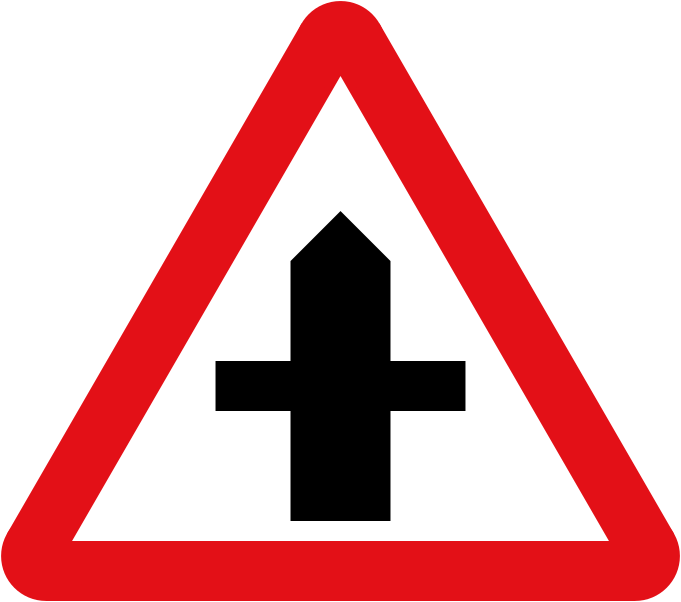
A useful way to budget is to review progress every few lessons. Ask your instructor which DVSA syllabus areas are secure, which are inconsistent and which have not been covered. If you know that crossroads, dual carriageways and bay parking still need work, you can budget realistically instead of hoping the examiner simply does not ask much of you.
- 1Start with an assessment lesson if you have previous experience.
- 2Agree a regular lesson pattern so skills do not fade between sessions.
- 3Track progress against the DVSA driving syllabus, not just lesson count.
- 4Add private practice only when it supports your instructor's plan.
- 5Book the practical test when serious faults are rare in mock-test conditions.
Cheap driving lessons: when are they false economy?
I understand why learners search for the cheapest lessons. Learning to drive is expensive, especially with insurance, work and study costs. But the cheapest hourly price is not always the cheapest route to passing. A slightly dearer lesson with clear coaching, proper route planning and honest feedback can save money if you progress faster and avoid wasted test attempts.
Watch how the lesson is run. You should not spend large chunks of paid time sitting at the roadside while the instructor talks for too long. Equally, you should not be thrown into busy traffic with no structure. Good tuition has a goal, a recap, practice, feedback and a plan for next time. You should know what skill you are paying to improve.
The car also matters. It should be clean, roadworthy and fitted with dual controls if used for professional tuition. It should suit your size and confidence. I have seen learners lose weeks because they were fighting a seating position, biting point or visibility issue that was never addressed properly.
Be careful with very large upfront payments if you have not met the instructor. Block bookings can be good value, but read the terms: expiry dates, refund rules, cancellation notice and what happens if the instructor becomes unavailable. A reputable instructor will be clear about price, lesson length and cancellation policy before you pay.
- A low hourly rate is poor value if lessons lack structure.
- You should receive clear feedback, not vague reassurance.
- The training car should feel safe, suitable and properly maintained.
- Check refund and cancellation terms before block booking.
- Avoid booking a test just because lessons were cheap to buy.
How exam faults turn into extra cost
The practical test fee is only part of the cost of failing. After an unsuccessful attempt, you may need more lessons, another test fee and more waiting time. In the car, I see the same expensive faults again and again: rushing out of junctions, missing mirrors before changing speed, poor lane discipline on roundabouts and hesitating so long that other road users are affected.
Examiners mark what actually happens on the drive. They do not mark how many lessons you have paid for, how nervous you are, or how well you drove last week. A driving fault is less serious, but repeated driving faults in the same area can become serious. A serious or dangerous fault means the test is not passed, even if the rest of the drive felt good.
One of the most common money-wasting habits is relying on prompts. If your instructor is still saying, "check your mirrors", "move left", or "second exit, keep your lane" at the point you book the test, those prompts are hiding faults. On test, the examiner will give directions, not coaching. That silence can expose weak planning very quickly.
Mock tests are worth doing because they show whether your driving holds together without help. I would rather a learner make the serious fault with me beside them two weeks before the test than pay for a DVSA test to find out the same thing. A mock test is not about knocking confidence; it is about finding the expensive fault before the examiner does.
- Junction observation: emerging when the view is not safe.
- Mirrors: changing speed or direction without effective checks.
- Roundabouts: wrong lane, poor signal timing or cutting across.
- Meeting traffic: forcing through when you should give way.
- Control: rolling back, stalling repeatedly or losing steering accuracy.
- Planning: reacting late to signs, lanes, pedestrians or parked vehicles.
Can private practice lower the cost?
Yes, private practice can lower the cost of learning, but only when it is legal, insured and purposeful. The best private practice reinforces what happened in the lesson: moving off and stopping smoothly, quiet junctions, mirror routines, meeting traffic, or parking between marked bays. The worst private practice is an unplanned drive to the shops where the supervising driver gives different instructions from the instructor.
If you are practising in a family car, make sure the clutch, brakes, mirrors and seating position are suitable. A learner who can drive a diesel tuition car may struggle in a small petrol car at first, especially with hill starts and slow control. That is normal, but you should practise in quiet areas until you understand the car.
Supervising drivers need patience. Shouting "go" at roundabouts or grabbing the wheel late does not help a learner develop judgement. I often give parents or partners a simple plan: let the learner narrate what they can see, ask what they plan to do, and avoid giving last-second commands unless safety demands it.
Private practice is not a replacement for professional tuition if you are missing key skills. Motorways, complex roundabouts, dual carriageways, independent driving and manoeuvres all need proper instruction. Learners in England, Scotland and Wales may drive on motorways only with an approved driving instructor in a car fitted with dual controls, according to GOV.UK guidance.
- 1Check the learner is insured on the practice car.
- 2Display legal L plates clearly at the front and rear.
- 3Choose quiet roads before attempting complex traffic.
- 4Practise the same skill your instructor has set as homework.
- 5Stop if either the learner or supervisor becomes angry or unsafe.
- 6Tell your instructor what went well and what caused difficulty.
A practical checklist before you pay for lessons
Before paying for lessons, ask enough questions to understand what you are buying. A professional instructor should be comfortable explaining lesson length, hourly rate, cancellation notice, payment method and whether the price changes for evenings, weekends, test-day hire or longer journeys to the test centre.
Also ask how progress will be measured. I use lesson goals and test-standard outcomes, because "you are doing well" is too vague. You want to know whether you can deal with crossroads, spiral roundabouts, pedestrian crossings, meeting traffic, sat nav driving and manoeuvres without help.
Finally, be honest about your own availability and budget. One lesson every three or four weeks is often more expensive in the long run because you spend time relearning. If money is tight, it may be better to save for a short run of regular lessons than to keep restarting.
Use this checklist to compare instructors and avoid surprise costs:
- Confirm the price per lesson and the exact lesson length.
- Ask whether block booking discounts have expiry or refund rules.
- Check the cancellation policy and how much notice is required.
- Ask what test-day car use costs and how much time is included.
- Confirm whether lessons are manual or automatic and where they start.
- Ask how your progress will be recorded and reviewed.
Common questions
How much should I budget for learning to drive in the UK?
There is no official total because instructor prices and the number of lessons needed vary. Build your budget from the current GOV.UK fees for the provisional licence, theory test and practical test, then add your local instructor's hourly rate multiplied by your expected training hours.
Is there a minimum number of driving lessons before the test?
No. There is no legal minimum number of professional driving lessons before a UK car practical test. You must be properly licensed, insured and able to drive safely to test standard, but the DVSA does not require a set lesson count.
Are two-hour driving lessons worth the money?
Often, yes. Two-hour lessons give more time for practice and feedback, especially for manoeuvres, roundabouts and test routes. For some beginners, 90 minutes may be better at first if concentration drops quickly.
Do automatic driving lessons cost more than manual?
They can cost more in some areas, but there is no official national price. Automatic tuition may help some learners progress faster, but passing in an automatic means your licence covers automatic cars only unless you later pass a manual test.
Can I save money by practising with my parents?
Yes, if the practice is legal, insured and structured around what your instructor is teaching. Poorly planned private practice can create habits that take paid lesson time to fix, so agree practice goals with your instructor.
Do I pay for my instructor's car on the driving test?
Usually, if you use your instructor's car, you pay for their time and car use around the test appointment. This is not a DVSA fee, so ask your instructor in advance what is charged and what the booking includes.
Find your course length
Reading about it only gets you so far. Our instructors drill this with you in the car, on the roads around your test centre.