
The short version
- Use the DVSA average as a guide, not a target: many learners need around 45 hours of lessons plus private practice.
- Count quality hours, not just calendar time; gaps between lessons can mean re-learning skills.
- Book more time for independent driving, junctions, roundabouts and manoeuvres if these are still inconsistent.
- Private practice helps most when it repeats what your instructor has already taught, safely and legally.
- You are test-ready when your driving is safe without prompts, not when you reach a set number of hours.
The honest answer: there is no fixed number
The DVSA has long used a useful guide that many learners need about 45 hours of professional driving lessons plus around 22 hours of private practice to reach test standard. That is not a rule, and it is not what an examiner looks at. Some learners pass with fewer hours, and some need more, particularly if they have long gaps, high anxiety, little road experience or difficult local test routes.
As an instructor, I do not count hours as the main measure. I look for repeatable safe decisions: choosing the correct lane without help, judging gaps, checking mirrors before changing speed or position, and recovering calmly when something changes. What I see most often in the mirror is a learner who can control the car quite well after 10 or 15 hours, but still needs much more time reading the road ahead.
For intensive courses, the same principle applies. Fast Track Driving Lessons offers 10 to 40 hour courses at £61.23 per hour, but the right course length depends on where you are starting from. A 10 hour course is usually for someone close to test standard, not a brand-new driver.
What affects how many hours you need?
Two learners can do the same number of lessons and finish at very different standards. The biggest difference is usually how much they think between lessons. Learners who reflect on mistakes, practise theory, and arrive rested tend to improve faster than learners who simply turn up and hope it sticks.
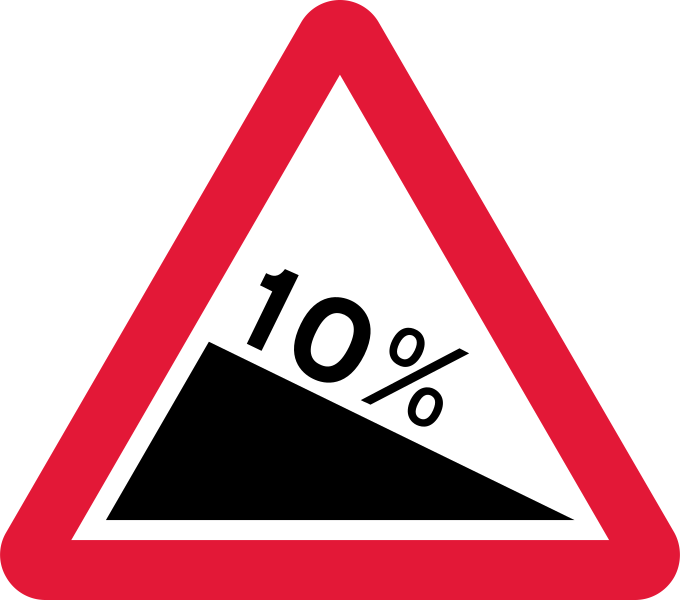
Your local area also matters. Busy multi-lane roundabouts, tight residential meeting situations, steep hill starts, fast rural roads and complex one-way systems all take time to learn properly. You do not need to memorise test routes, and that does not matter for the test, but you do need enough variety to deal with unfamiliar roads safely.
- Previous road experience, such as cycling or moped riding, can help with observation and hazard awareness.
- Manual cars often take longer at the start because clutch control, gear choice and stalling recovery use more brain space.
- Automatic lessons can reduce workload, but you still need judgement, positioning and planning.
- Long gaps between lessons usually increase the total hours needed because confidence and routines fade.
- Private practice can reduce professional lesson hours if it is regular, safe and based on correct technique.
A rough guide by starting point
These ranges are not guarantees, but they are realistic enough to help you plan. I would rather a learner book the right amount of training than rush into a test and pay to confirm what we already knew in lessons.
If you are using an intensive course, be honest about your current level. A nervous beginner booking too few hours normally spends the first part of the course just getting settled, then runs out of time before independent driving and test pressure have been covered properly.
- Complete beginner: often 35 to 50+ professional hours, depending on confidence, area and practice.
- Beginner with good private practice: often 25 to 40 professional hours, if the practice is structured and legal.
- Partly trained learner returning after a break: often 15 to 30 hours, depending on what has stuck.
- Test-ready but rusty, or changing instructor: often 10 to 15 hours to check habits, local roads and test readiness.
- Recent unsuccessful test candidate: often 6 to 12 focused hours if the faults are clear and not deep-rooted.
What actually has to be learned in those hours
At first, learners usually think driving is about making the car move. The examiner is looking for much more than that. The test checks whether you can drive safely and independently on different roads while following the Highway Code, road signs and lane markings.
In lessons, I drill this by repeating short sections until the routine becomes automatic. For example, we may spend 20 minutes just on emerging left and right from closed junctions, with me asking what you can see, what you cannot see, and when you would wait. That is more useful than simply driving around hoping the same junction appears again.
- Car control: steering, clutch or accelerator control, braking, gears, hill starts and stopping accurately.
- Observation: mirrors, blind spots, scanning ahead, and checking before changing speed or direction.
- Junctions and roundabouts: approach speed, lane choice, priority, positioning and timing.
- Road positioning: parked cars, meeting traffic, bus lanes, cycle lanes and lane discipline.
- Manoeuvres: one reversing exercise on test, plus a possible emergency stop, but all parking skills still need control and observation.
- Independent driving: following sat nav or traffic signs for about 20 minutes on the test.
How to make each lesson hour count
The learners who progress fastest do not try to cover everything every lesson. They pick the weakest area, practise it properly, then connect it back into normal driving. If roundabouts are weak, for example, we do not just do one roundabout and move on; we repeat different types until the mirrors, speed, gear and lane decisions happen early enough.
Theory knowledge also saves practical time. If you do not understand road signs, stopping distances, lane markings or who has priority, your instructor has to teach that in the car while traffic is moving. Fast Track Driving Lessons includes free theory test practice at /theory, and it is worth using before and during your practical training.
- 1Ask your instructor what one skill is currently costing you the most time.
- 2Practise the related theory before your next lesson, especially signs, priorities and hazards.
- 3Start the lesson with a clear aim, such as right turns at busy junctions or meeting traffic.
- 4Repeat the skill in several locations, not just one familiar road.
- 5Finish by agreeing whether the skill is safe independently or still needs prompts.
Private practice: useful, but only if it is done properly
Private practice can be excellent, but it can also build bad habits quickly. Legally, a supervising driver must be at least 21 and must have held a full licence for the type of vehicle for at least 3 years. The car must be properly insured for the learner, display L plates, and be roadworthy.
What I see most often after unstructured private practice is late mirror checks, coasting, rushing junctions and parking by guesswork. Family members often mean well, but they may not explain things in DVSA terms or notice small safety faults. The best use of private practice is to repeat what your instructor has already taught, on roads suitable for your level.
Private practice should not become a mock test every time. Early on, it might be quiet roads, moving off, stopping and left turns. Later, it can include independent drives, following sat nav, bay parking at a quiet car park and dealing with busier junctions.
When are you ready for the driving test?
You are ready when your safe driving is consistent without help. Not perfect, because nobody drives perfectly, but safe, legal and controlled even when the plan changes. Examiners do not care whether you had 20 hours or 70 hours; they assess what happens on the day against the DVSA driving test standard.
The practical car test currently lasts about 40 minutes. You will do an eyesight check, vehicle safety questions, general driving, around 20 minutes of independent driving, and one manoeuvre. You may also be asked to do an emergency stop. Test fees and waiting times can change, so check GOV.UK before booking.
A good instructor should be willing to tell you if you are not ready. That can be frustrating, but it is cheaper and safer than using the test as practice. A mock test with another instructor can also help, because learners often drive differently when the person beside them is not coaching.
- You can drive for 40 minutes with no serious or dangerous faults in a mock test.
- You notice hazards early enough to slow down smoothly, not suddenly.
- You choose lanes and follow signs without regular help.
- Your manoeuvres are controlled, with effective observation, even if the final position is not millimetre-perfect.
- You can recover calmly from a missed direction, wrong lane or unexpected vehicle.
Common questions
Can I pass my driving test in 10 hours?
It is possible only if you are already close to test standard, perhaps after previous lessons or plenty of legal private practice. For a complete beginner, 10 hours is usually enough to cover basics and identify weaknesses, not to build consistent independent driving.
Do automatic learners need fewer hours?
Some do, because there is no clutch or manual gear changing to manage. However, the test still assesses planning, observation, judgement, lane discipline and response to hazards, so automatic is not a shortcut around safe driving.
Should I book my test before I know how many hours I need?
You can book a test once you have a valid theory test pass, but booking too early often creates pressure to rush. A better approach is to ask your instructor for a realistic training plan, then book when your driving is developing consistently towards test standard.
How many lessons should I have each week?
Most learners progress well with one or two lessons a week, especially if each lesson is 90 minutes or 2 hours. Intensive courses can work well when you can concentrate for longer periods and there is enough time to practise between key skills.
Does learning test routes reduce the number of hours needed?
Knowing local roads can help confidence, but memorising test routes is not the goal and examiners can vary routes. You need the skill to deal with unfamiliar junctions, signs, speed limits and traffic safely.
What if I keep failing on the same type of fault?
That usually means the fault has not been trained deeply enough, not that you are incapable. Ask your instructor to isolate it, drill it in easier locations first, then rebuild it into normal driving and mock-test conditions.
Find your course length
Reading about it only gets you so far. Our instructors drill this with you in the car, on the roads around your test centre.