
You're probably here because the car feels manageable in a quiet space, then oddly untidy the moment there's a kerb, a parked van, or a mini-roundabout involved. You turn the wheel, the car turns, and yet it still doesn't seem to go where you meant it to. That's one of the most common early frustrations in driving.
Most beginners don't struggle with the act of turning a steering wheel. They struggle with coordinating eyes, posture and hands at the same time. If you can learn to sit properly, look to the right place, and let your hands follow that picture, it becomes much easier to steer a car calmly and accurately on real UK roads.
Table of Contents
- Why Steering Feels Harder Than It Looks
- Setting Up Your Seat, Mirrors and Posture First
- Hand Positions and the Pull-Push Technique
- Where You Look Controls Where the Car Goes
- Steering in Different Cars and Conditions
- Steering Faults That Catch Out Test Candidates
- A Simple Practice Plan for the Week Ahead
Why Steering Feels Harder Than It Looks
A learner can often drive neatly around cones in an empty car park, then drift towards the kerb as soon as another vehicle appears. I've seen that happen on first lessons for years. The usual reaction is, “I don't know why the wheel suddenly feels twitchy.”
It usually isn't the wheel.
What changes is the learner's attention. In a quiet space, they look up, breathe, and give themselves time. In traffic, they stare at the bit of road just beyond the bonnet, tighten their shoulders, and start making little rushed corrections. The car then wanders, not because they can't steer, but because their eyes and hands have stopped working together.
What beginners often feel
Some learners say the steering feels heavy. Others say it feels too light, as if the car darts about with every tiny movement. Both feelings can come from the same three problems:
- Looking too close ahead so every small bend seems urgent
- Sitting too low or too far away so the arms have to reach
- Gripping too high or too tightly so the shoulders tense up
Practical rule: If your shoulders are lifted, your elbows are locked, and your eyes are down near the bonnet line, steering will feel harder than it needs to.
There's a useful bit of history in this too. The steering wheel became standard on cars in Britain in 1898, when Charles Rolls imported a 6 hp Panhard from France. It's widely cited as the first car in Britain fitted with a steering wheel, helping move cars away from tillers and towards the layout learners still use today, as noted in this history of the steering wheel. So when instructors tell you to steer a car smoothly, they're talking about a control system that has shaped driving for well over a century.
The real skill behind neat steering
Good steering is less about “how fast do I spin the wheel?” and more about this chain:
- See the path early
- Sit in balance
- Move the wheel smoothly
- Let the car settle without snatching it back
Once that clicks, the car stops feeling random.
Setting Up Your Seat, Mirrors and Posture First
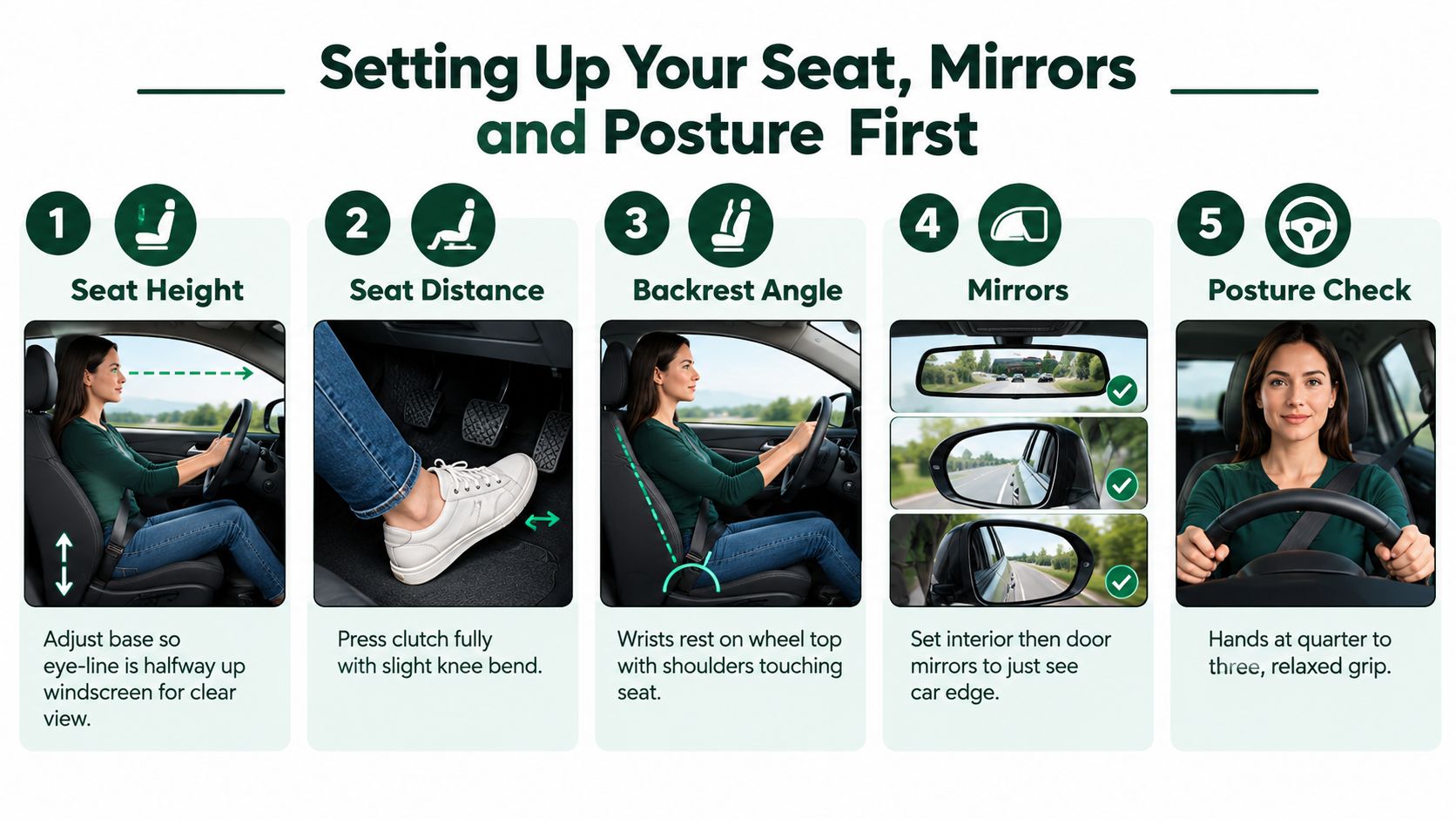
Before you touch the wheel, set the seat base high enough that your eye-line sits comfortably above the dashboard and gives you a clear view through the windscreen.
Slide the seat so you can press the pedals fully while keeping a slight bend in your knees.
Adjust the backrest so your shoulders stay against the seat rather than rolling forward.
Set the interior mirror so it frames the rear window cleanly without you moving your head.
Adjust each door mirror so you can just see the side of the car and a sliver of road behind.
Check your reach by placing a wrist on the top of the steering wheel without locking the elbow or leaning off the seat.
Settle both shoulders down and let your elbows stay soft rather than straight.
Rest your hands lightly at quarter to three once everything else is in place.
Why this matters before moving off
A poor seating position makes steering feel awkward long before the car starts rolling. If you're stretched forward, your hands can only make steering inputs from the wrists. If you're too close, your elbows bunch up and larger turns feel clumsy.
Mirror setup matters too, because nervous learners often move the wheel when they should only be moving their eyes. If your mirrors are already set clearly, you won't fidget in the seat every time you check around.
A quick posture check
Use this simple check before every drive:
- Head level so you're not peering up through the top of the windscreen
- Shoulders back so the seat supports you
- Hands light so the wheel can move through your fingers
- Heels grounded so the lower body stays steady while the upper body steers
Sit so the car comes to you. Don't curl yourself around the car.
Hand Positions and the Pull-Push Technique
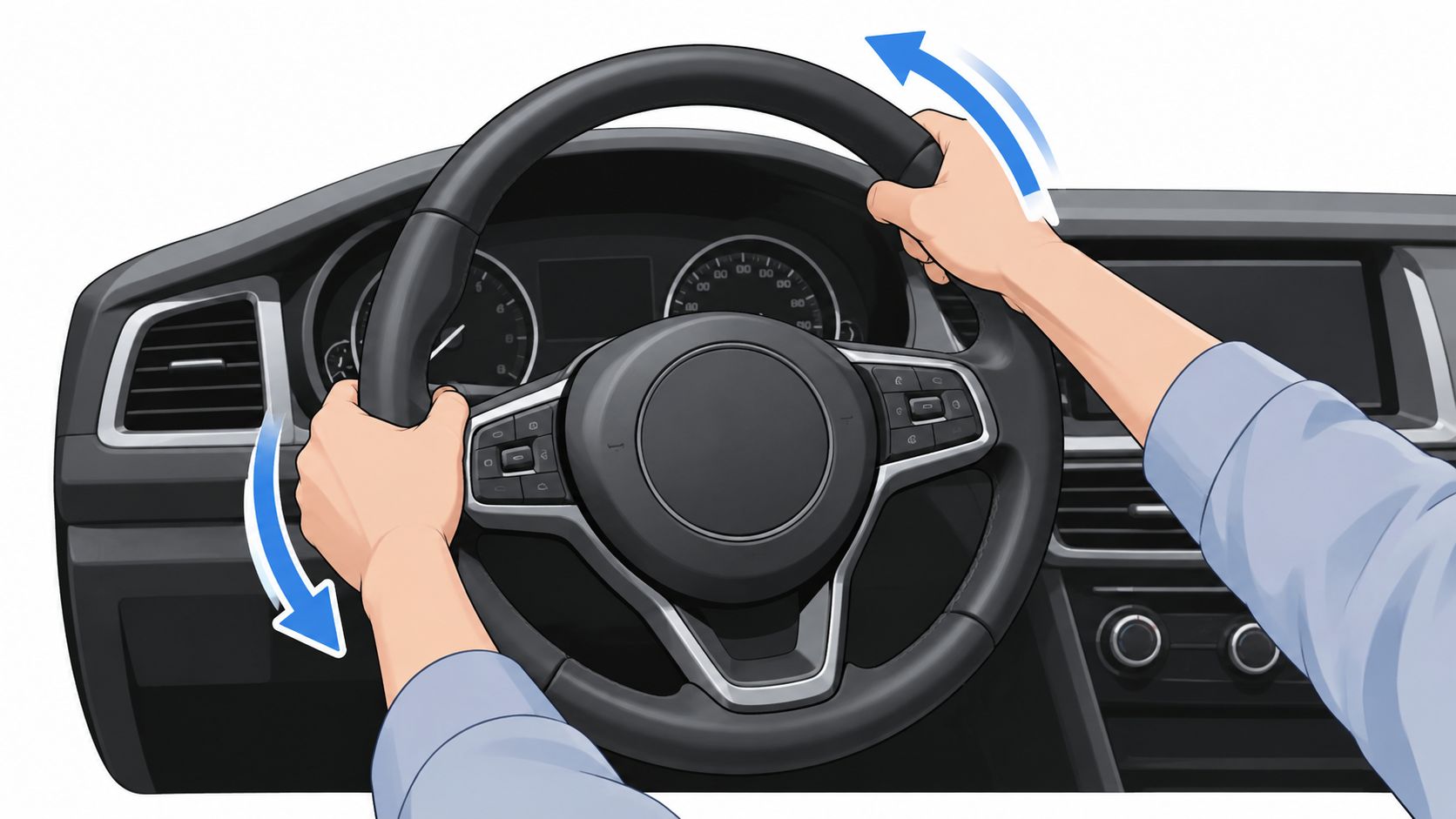
The hand position I teach most often is quarter to three, sometimes described as 9 and 3. It gives you balanced reach to the left and right, keeps the shoulders relaxed, and makes it easier to use indicators, gears and other controls without losing shape at the wheel. UK learner guidance aligned with DVSA also notes that this modern position supports smoother steering and better access to secondary controls than the older 10 and 2 habit, as reflected in the official road safety data pages and related guidance context.
DVSA competence guidance says learners must hold the steering wheel correctly to maintain full control, use it to keep a straight course and corner safely, keep one-hand control only when changing gear or using an ancillary control, and use maximum steering lock where needed during manoeuvring, as set out in the Category B driver competence framework.
What quarter to three should feel like
Your thumbs should rest lightly along the rim, not hook tightly inside it. Your palms should feel connected to the wheel, but not glued to it. Your shoulders should stay down, with no hunching.
If the wheel feels slippery, most learners grip harder. That usually makes steering rougher. A lighter hold lets you feel the wheel self-centre after a bend.
How pull-push works in practice
For a left turn, your left hand pulls the wheel down while the right hand slides and feeds the rim across. For a right turn, your right hand does the pulling and the left hand feeds. The movement is smooth and shared between both hands, rather than one arm crossing over the top in a rush.
Think of it as shuffle steering with purpose. One hand pulls. The other receives. Then both reset.
This method helps because it keeps your chest facing forward, your shoulders square, and your steering measured. That's especially useful on test routes where lane changes and roundabout exits need tidy, controlled inputs rather than sudden armfuls of lock.
Here's a visual demonstration that helps many nervous learners make sense of the rhythm:
When other hand positions appear
There are moments, especially when reversing or parking, where your hands won't stay perfectly at quarter to three. That's normal. Low-speed manoeuvres may need more lock and more wheel movement.
What matters is control. Don't let both hands come away from the wheel, and don't cross your arms so tightly that you can't unwind the steering cleanly.
- On normal roads use quarter to three as your base
- During gear changes return the second hand promptly once the gear is selected
- While parking use as much steering as needed, but keep the movement smooth and planned
Where You Look Controls Where the Car Goes
Many steering mistakes are really vision mistakes in disguise. The learner thinks, “I turned the wheel wrong,” but the problem started earlier. They looked at the kerb, the parked car, or the patch of tarmac right in front of the bonnet.
DVSA-aligned marking guidance includes not having proper control of the steering among common faults, and learner-focused guidance repeatedly links over-steering, under-steering, kerb strikes and late steering to poor visual targeting rather than hand movement alone, as explained in this guide to driving test faults and results.
Five common problems that begin with the eyes
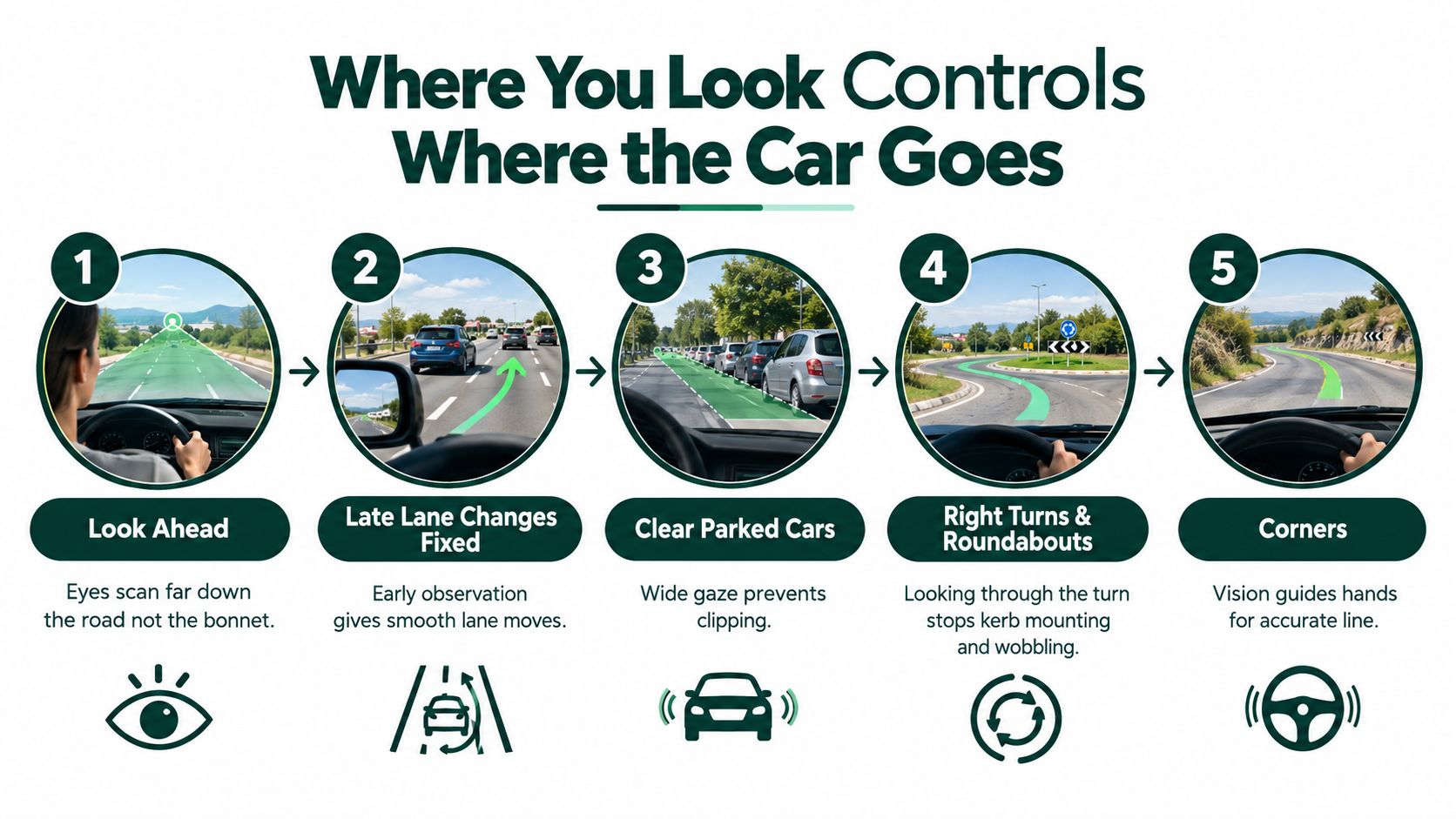
These are often blamed on “bad steering”, but they usually begin with looking too close:
- Late lane changes because the driver only notices the need to move when they're already beside the hazard
- Clipping parked cars because the gaze fixes on the obstacle instead of the safe gap
- Mounting kerbs on right turns because the eyes drop to the kerb line
- Wobbling through roundabouts because the learner keeps changing visual targets
- Cutting corners because they stare at the near edge instead of the exit path
Lift the eyes further up the road and the body calms down. The neck softens. The shoulders stop bracing. The hands stop chasing every tiny movement.
A better visual habit
Pick a point in the middle distance and steer towards it. On an ordinary urban road, that might be a lamppost, the centre of your lane beyond a parked car, or even a letter on a shop sign.
When you need to check around you before changing position, proper scanning matters as much as steering input. This short guide on checking blind spots fits well with that habit, because observation and steering should happen as one joined-up process.
Look where you want the car to be in a second or two, not where it is this instant.
Try these drills on a quiet practice route:
Sign target drill
Choose a fixed point ahead and hold a steady line towards it.Slow slalom drill
In a safe open space, let your eyes move to the next gap before your hands begin steering.Junction exit drill
As you turn, look into the new road early instead of down at the kerb.
That's the difference between car-park steering and real-road steering in the UK. Real roads ask more from your eyes.
Steering in Different Cars and Conditions
The basic method doesn't change from car to car. You still want a balanced seat, a light grip, and smooth pull-push steering. What changes is the size of the input and when you start it.
An automatic often gives beginners a little more spare attention because the left hand isn't busy with gear changes as often. A manual asks you to return the hand to the wheel neatly after each gear change. Neither is harder by default, but they do feel different in traffic.
How the same technique changes by situation
On a tight car park turn, the wheel may need much more movement, often at walking pace. On a residential road at around 30 mph, steering inputs should be smaller and earlier. On a dual carriageway, the best steering is usually almost invisible from the passenger seat.
If you're borrowing or hiring a car for extra practice, it helps to expect a different steering feel from model to model. A simple preparation guide like rent a car in Manchester can be useful because it gives learners and family supervisors a practical route into trying a different vehicle legally and sensibly before a longer trip.
Steering adjustments by car and condition
| Situation | Grip pressure | Input size | Timing note |
|---|---|---|---|
| Manual in town | Light, with prompt hand return after gear changes | Medium | Start turns a touch earlier so the car stays settled |
| Automatic in town | Light and even | Medium | Avoid over-correcting just because both hands are free more often |
| Slow car park manoeuvres | Relaxed, not clenched | Large | Feed the wheel continuously and unwind early |
| Residential streets | Gentle | Small to medium | Look past parked cars before steering around them |
| Dual carriageway or motorway lane-keeping | Very light | Small | Make tiny early corrections, not late swerves |
| Wet or greasy roads | Soft and patient | Slightly smaller | Steer progressively and avoid abrupt late inputs |
UK-specific situations that catch people out
Narrow terraced streets need patience more than wheel-spinning. The danger isn't lack of lock. It's starting too late because the eyes are fixed on the nearest mirror or kerb.
Mini-roundabouts in the rain often expose over-correction. The learner turns in, realises they're too close to the paint, then snatches the wheel back. On wetter tarmac, a calmer entry and earlier line usually fixes that.
Night driving adds another layer because road edges and parked vehicles can appear later in your vision. This guide to driving at night is helpful if steering feels less certain after dark.
For motorway practice, there's also a specific UK rule. Provisional licence holders can only drive on the motorway when accompanied by an approved driving instructor and in a car with dual controls, with red L plates or D plates in Wales, according to the Highway Code updates page. That matters because stable lane position and smooth lane changes are part of proper steering control at speed.
If you want a structured option for practising these differences, Fast Track Driving Lessons matches learners with DVSA-approved instructors for manual or automatic lessons in dual-control cars, including intensive and semi-intensive formats.
Steering Faults That Catch Out Test Candidates
On a mock test in a Vauxhall Corsa, the route often looks ordinary. A left turn, a parked-car squeeze, a dual carriageway stretch, maybe a bay park at the end. That's exactly why steering faults surprise people. They aren't always dramatic. They're often small control errors that keep repeating.
DVSA examiner guidance says the vehicle should be steered as smoothly as possible, and steering too early or too late may cause the car to hit the kerb or swing out towards another road user, as set out in the guide to assessment and marking. Examiners are also told to mark faults such as erratic steering, overshooting the correct turning point, having both hands off the wheel, or hitting the kerb, according to the car driving test examiner guidance.
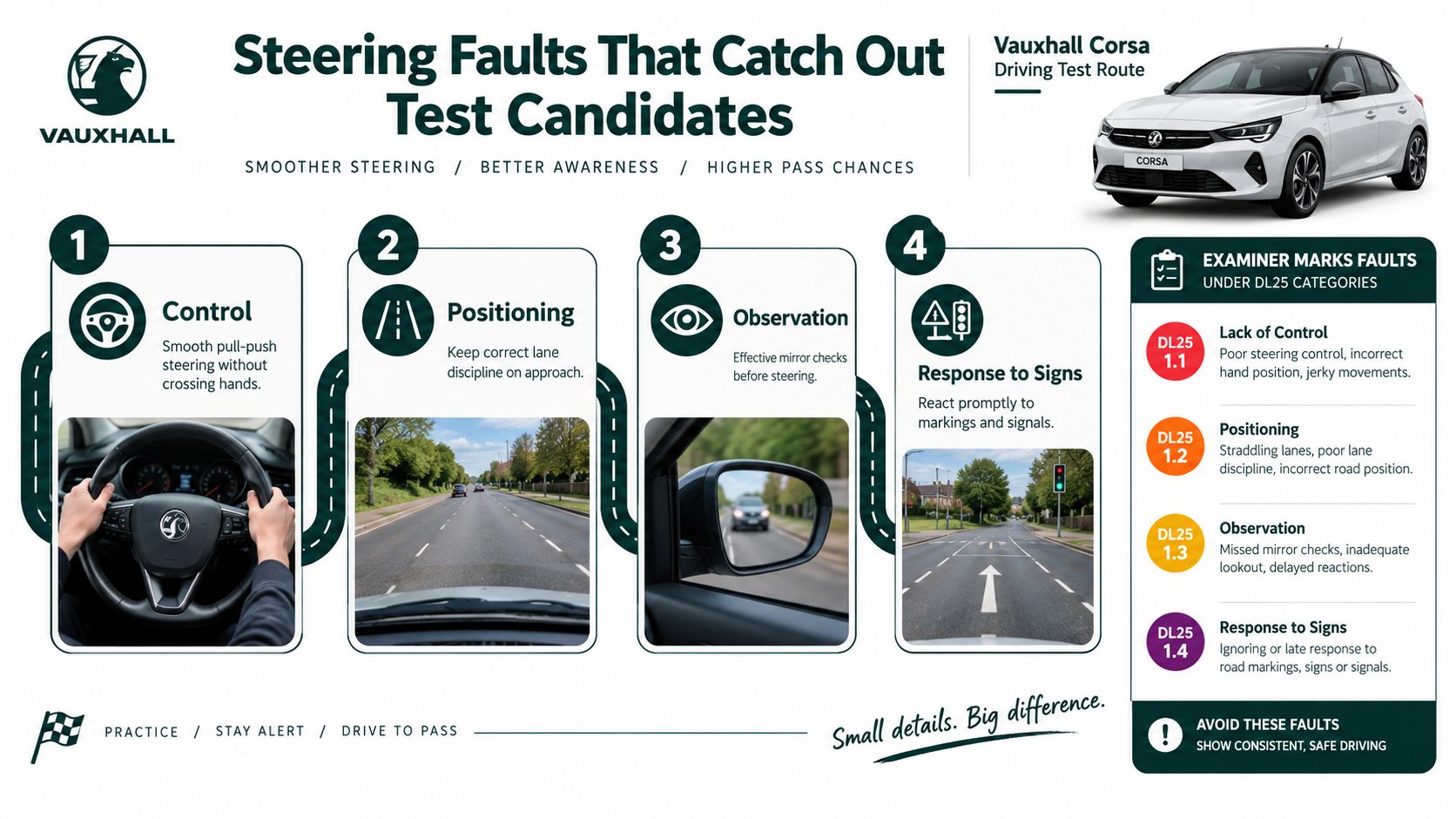
Three faults I see again and again
First, the candidate turns right into a side road and crosses their hands high at 10 and 2. The car gets round, but the steering is hurried and the wheel doesn't unwind cleanly. The habit to build is simple. Return your hands after every main input.
Second, during a parallel park, they stare at the kerb. The car drifts closer to the very thing they fear and mounts it lightly. The fix is to glance to the target space, not just the obstacle.
Third, on a faster road, their hands rest lazily on the spokes and the car drifts right within the lane. The answer is to rest thumbs on the rim and keep a live, balanced hold.
What the examiner is really judging
The DVSA says a candidate must show they can use all the car's primary controls smoothly and at the correct time, with steering listed alongside the other main controls in this driving test result guidance. Steering isn't a background skill. It's a core part of whether the examiner sees the car as under control.
If your steering suddenly feels heavier than usual or the wheel doesn't self-centre properly, that may be a vehicle issue rather than a learner issue. In that case, a rough guide to the average cost steering pump replacement can help you understand what might be involved before another lesson or test.
For a fuller breakdown of how faults are marked, this page on driving test faults explained is worth reading before a mock test.
A Simple Practice Plan for the Week Ahead
Keep this week simple. Short, focused practice beats aimless extra miles. The point is to repeat one good habit at a time until it starts to feel ordinary.
A realistic seven-day rhythm
Day 1
Spend a short session in a quiet open space doing slow figure-of-eight turns. Use the cue hands shuffle, not cross.Day 2
On a calm residential road with proper supervision, pull away and stop at the kerb a few times. Use the cue set hands first, then move off.Day 3
Rest. Write down what felt smoother and what still felt rushed.Day 4
Do another short figure-of-eight session, this time leading with your eyes earlier. Use the cue look through the turn.Day 5
Practise residential bends for a brief lesson or supervised drive. Use the cue aim the bonnet badge towards the space you want to enter, not the kerb you want to avoid.Day 6
Repeat the kerb-side move-off and stop routine. Add mirror checks and a tidy return to quarter to three after each movement.Day 7
Take an easier drive and focus only on calm steering. No chasing perfection.
The checklist before every drive
Run through these points before the engine work starts to occupy your attention:
- Seat height right for a clear eye-line
- Mirrors aligned without twisting in the seat
- Hands at quarter to three with a light grip
- Eyes up towards the vanishing point or next safe target
- Shoulders relaxed against the seat
Progress in steering often feels sudden. One day the car feels loose. A few sessions later, it starts holding its line because your eyes got quieter and your hands followed.
UK learner-driving statistics show how widely these control skills are assessed. DVSA data for Great Britain recorded 2,924,430 car practical tests in April 2025 to March 2026, with a 44.8% pass rate, while August 2026 recorded a 52.1% practical test pass rate, and other reporting on DVSA data noted that 40% of learners in Great Britain waited less than 7 weeks between booking and taking a driving test. By the end of April 2025, 603,352 future practical driving tests had been booked, up 16% year on year, according to this DVSA pass-rate and booking summary. That doesn't mean steering is impossible. It means many learners need steady, supervised repetition before smooth control becomes reliable under pressure.
If steering still feels inconsistent, Fast Track Driving Lessons can help you practise it in a more structured way with manual or automatic tuition in dual-control cars, mock tests near your chosen test centre, and lesson formats that suit complete beginners as well as nearly test-ready learners. If you want that kind of support, visit Fast Track Driving Lessons and look for a course or instructor match that gives you proper time to work on posture, vision and steering control.
Written by Fast Track editorial team.