
A UK practical driving test is almost a coin toss. From April 2025 to March 2026, 50.0% of practical tests were passed, with 1,000,043 passes from 1,998,621 tests, leaving roughly 998,578 unsuccessful attempts according to the latest DVSA-linked pass-rate data. Major fails in driving tests aren't rare surprises. They usually come from a small group of repeatable decisions, made at junctions, lane changes, move-offs, or manoeuvres when observation and control break down.
The useful question isn't, “What are the top faults?” It's what makes an examiner record a minor, a serious fault, or a dangerous fault, and how can you spot your own pattern before test day? Once you understand that judgement, lessons become more focused, mock tests become more realistic, and a failed attempt is less likely to feel mysterious.
Table of Contents
- How Often Learners Fail and Why It Matters
- What a Major Fault Actually Is
- The Fault Families That End More UK Tests Than Any Other
- The Surprising Rise of Parking Control as an Instant Fail
- When Minor Mistakes Quietly Turn Into a Serious Fault
- A Pre-Test Routine Built Around Your Major Fails
- Putting It All Together Before Test Day
How Often Learners Fail and Why It Matters
The 50.0% pass rate means roughly one learner in two did not pass during the stated period. That figure comes from pass-rate data compiled from DVSA figures, rather than a direct DVSA publication in this section. The result also needs context. Some candidates fail through one serious or dangerous fault, while others collect driving faults until their performance is no longer safe or consistent.
A practical test compresses several demands into one drive. You must manage traffic, signs, speed, lane position, mirrors, signals, independent driving and a manoeuvre while the examiner assesses decisions made in seconds. A learner may drive comfortably for most of the route, then fail after choosing a gap that is too small or making an unsafe lateral movement.
Treat the pass rate as a practical warning
The pass rate cannot predict your result. It shows why familiarity with local roads is not enough. You need a consistent standard under observation, including when traffic changes or a routine task becomes awkward.
Use lessons to separate the fault patterns that need different responses:
- High-risk faults, such as moving into another road user's path.
- Repeatable faults, such as late mirror checks or weak junction observation.
- Recoverable faults, such as a stall handled safely.
- Pressure faults, which appear when you rush or become hesitant.
Your instructor should record the situation, not just write “observation” or “parking”. Was the problem a late scan on approach, a failure to re-check after waiting, or moving before a blind spot was clear? That detail turns a broad label into a specific drill. The driving test fail reasons guide can help you build that vocabulary before a mock test.
Parking control deserves particular attention. Recent learner patterns suggest it may be a bigger instant-fail trigger than junctions in some settings, especially when observation, steering and speed deteriorate together. Treat it as a safety task, not a demonstration of neat positioning.
Passing is not about driving aggressively or trying to impress the examiner. Make safe routines automatic, keep attention available for changing hazards, and delay the test until your main fault pattern is under control. That approach makes practice more targeted and reduces lessons spent repeating vague advice.
What a Major Fault Actually Is
DVSA marking uses three practical categories. A driving fault, commonly called a minor, is an error that doesn't create a serious safety problem and is corrected appropriately. A serious fault is potentially dangerous or involves breaking the law. A dangerous fault creates actual danger for the candidate, examiner, another road user or property, as set out in the DVSA guidance for driving examiners.
One serious or dangerous fault is enough to fail. You can still pass with driving faults, provided you don't record more than 15, but the 16th driving fault takes you beyond the permitted limit. The important distinction is that a minor isn't a guaranteed free pass. Its meaning depends on what happened, what other road users were doing, and whether you corrected the error safely.
The examiner judges risk, not embarrassment
A stall at a quiet roundabout may be recorded as a driving fault if the car remains controlled, the correct observations are made, and nobody is placed at risk. The same stall in a live traffic gap could become serious if the learner loses control of the situation or causes another driver to take avoiding action.
Creeping over a white line is judged in the same context. If the car rolls slightly and stops safely with no conflict, the examiner may record a driving fault. If it crosses into a path where another vehicle has priority, the outcome can be more severe.
A missed mirror check doesn't automatically equal a major. The examiner looks for the consequence. Did you move laterally while a cyclist or vehicle was alongside? Did you change direction without knowing what was behind you? If the omission creates a potential danger or legal problem, it moves into serious territory. If you notice the omission before moving and complete the check, the issue may remain a minor or may not be recorded.
Practical rule: Don't ask whether the mistake felt small. Ask whether another road user had to change speed or direction because of it.
The DVSA explanation of driving test faults and results also matters because it clarifies the threshold candidates often misunderstand. A serious fault isn't necessarily an examiner intervention, and a dangerous fault isn't a more embarrassing version of a minor. The categories describe the safety and legal risk created at that moment.
The Fault Families That End More UK Tests Than Any Other
The pattern across UK tests is remarkably consistent. DVSA's first-year post-reform analysis recorded 368,047 failures involving insufficient observation at junctions and ineffective mirror use when changing direction, according to the DVSA report on top driving test faults. In a later 2023 snapshot, junction observation accounted for 114,357 major faults, while mirror use came second with 88,316, as summarised in UK driving test fault analysis.
| Fault Family | Typical Share of Major Fails | Example Serious Moment |
|---|---|---|
| Junctions and roundabouts | A leading family in DVSA fault patterns | Pulling out without confirming a safe gap |
| Mirrors and signalling | One of the most persistent families | Moving lanes while a vehicle is in the blind spot |
| Moving off and stopping | A frequent control and observation risk | Moving away before checking around the vehicle |
| Positioning | Common when roads become complex | Finishing a roundabout in the wrong lane |
| Speed control | Severity depends on the developing hazard | Approaching a junction too quickly to stop safely |
What the examiner sees in the car
Junctions and roundabouts fail learners when they look but don't properly assess. A quick glance isn't enough if the learner emerges into a vehicle's path, misses a pedestrian, or commits to a gap that isn't safe. At a roundabout, the serious moment may arrive before entry, during a lane change, or when the learner exits across another lane.
Mirrors and signalling are connected, but they aren't interchangeable. A signal tells others what you intend. It doesn't prove you've checked whether the movement is safe. The examiner is watching the timing of the mirror check, the signal, the blind-spot observation and the actual movement.
Moving off and stopping expose weak all-round observation. Learners may check the road ahead but fail to look for a cyclist approaching from behind, a pedestrian near the kerb, or a vehicle emerging as they pull away. A stalled engine is usually manageable. Moving off into conflict is not.
Positioning and speed control often deteriorate under pressure. The steering may drift towards a lane line, or the learner may enter a bend, junction or traffic queue with too much speed to respond comfortably. The examiner isn't looking for theatrical precision. They're looking for a decision that leaves a safe margin.
The practical routine is simple but must be applied intelligently: scan early, check mirrors before changing direction, reassess after waiting, and choose a speed that allows the car to stop. The five faults that fail most tests provides another useful checklist, but a list only helps when your instructor recreates the situations in which your observation breaks down.
The Surprising Rise of Parking Control as an Instant Fail
Junctions have dominated public discussion for years, but learner-facing data adds an important qualification. One recent UK learner-driver statistics summary reported 25% of instant fails linked to loss of control while forward parking, compared with 17% for insufficient observation at a junction and 10% for mirror misuse when changing direction.
Those figures shouldn't be treated as a universal ranking for every test centre. They do, however, challenge the assumption that busy roundabouts are always the main danger. The difference may reflect local routes, how faults are categorised, the parking environments used, or the types of learners represented in the dataset. It does show why parking control deserves deliberate practice rather than a quick run-through at the end of a lesson.
| Fault family | Approx. share of serious faults | Most common sub-fault |
|---|---|---|
| Forward parking control | 25% of instant fails | Loss of control while parking |
| Junction observation | 17% of instant fails | Insufficient observation |
| Mirrors when changing direction | 10% of instant fails | Ineffective mirror use |
Why manoeuvres unravel
Parking manoeuvres combine low speed, steering accuracy, clutch control and observation. A learner who rushes can mount the kerb, clip a cone, lose the reference point, or keep moving while attention is fixed on one corner of the car. A correction isn't automatically a failure. The risk appears when control, observation or the final position falls below a safe standard.
Reverse bay parking, forward bay parking and parallel parking each require a different visual plan. Reference points can help, but they're not a substitute for checking the actual space. Vehicle position changes with slope, road camber, car size and the placement of surrounding vehicles.
The parking control learning guide can support the rules and terminology. In the car, practise the skill as a sequence: slow the vehicle, observe all around, steer smoothly, pause when unsure, and correct without panic.
A learner who spends every session on difficult roundabouts may still fail during a parking exercise because control hasn't been measured. Ask your instructor to record steering smoothness, speed, observation and final position separately. That turns “parking feels awkward” into a clear training target.
When Minor Mistakes Quietly Turn Into a Serious Fault
A minor often starts as a warning, not a verdict. Consider a hill start. The car rolls back slightly, the learner misses a mirror glance, then stalls while trying to recover. Each event may be manageable in isolation. The situation changes if a following vehicle brakes sharply because the learner has allowed the car to move into its path.
DVSA confirms that when a repeated driving fault becomes serious, the driving faults and the serious fault are recorded separately on the test report, as explained in the DVSA webinar recap on common faults. That is why a learner shouldn't dismiss repeated minors as harmless marks. The repetition shows that the underlying routine isn't reliable, while the serious fault records the point at which safety deteriorated.
Three escalation patterns to watch
Creeping speed can appear harmless when approaching a 30 mph limit or a side road. If it keeps happening, the learner has less time to identify a hazard, judge a gap or stop smoothly. The serious fault comes when speed combines with a developing conflict, not because the approach looked untidy.
Late mirror checks at roundabouts may begin as a minor observation fault. Repeat the same omission during an exit or lane change, and the examiner may see a pattern of moving without knowing what is alongside or behind. A safe-looking road doesn't remove the need to check, because conditions can change while you're waiting.
Hesitant gear selection can create a chain reaction. The learner selects the wrong gear, slows unexpectedly, focuses on the pedals, then misses a safe gap or fails to respond to traffic behind. The gear mistake is not the same as the eventual serious fault. It can, however, contribute to the loss of control that produces it.
Treat clusters as red flags. If you record several faults in one family during a mock test, stop trying to “get through” the route and recreate that situation at a quieter pace. The examiner isn't counting isolated imperfections in a vacuum. They're deciding whether your driving remains safe, controlled and appropriately observed.
A Pre-Test Routine Built Around Your Major Fails
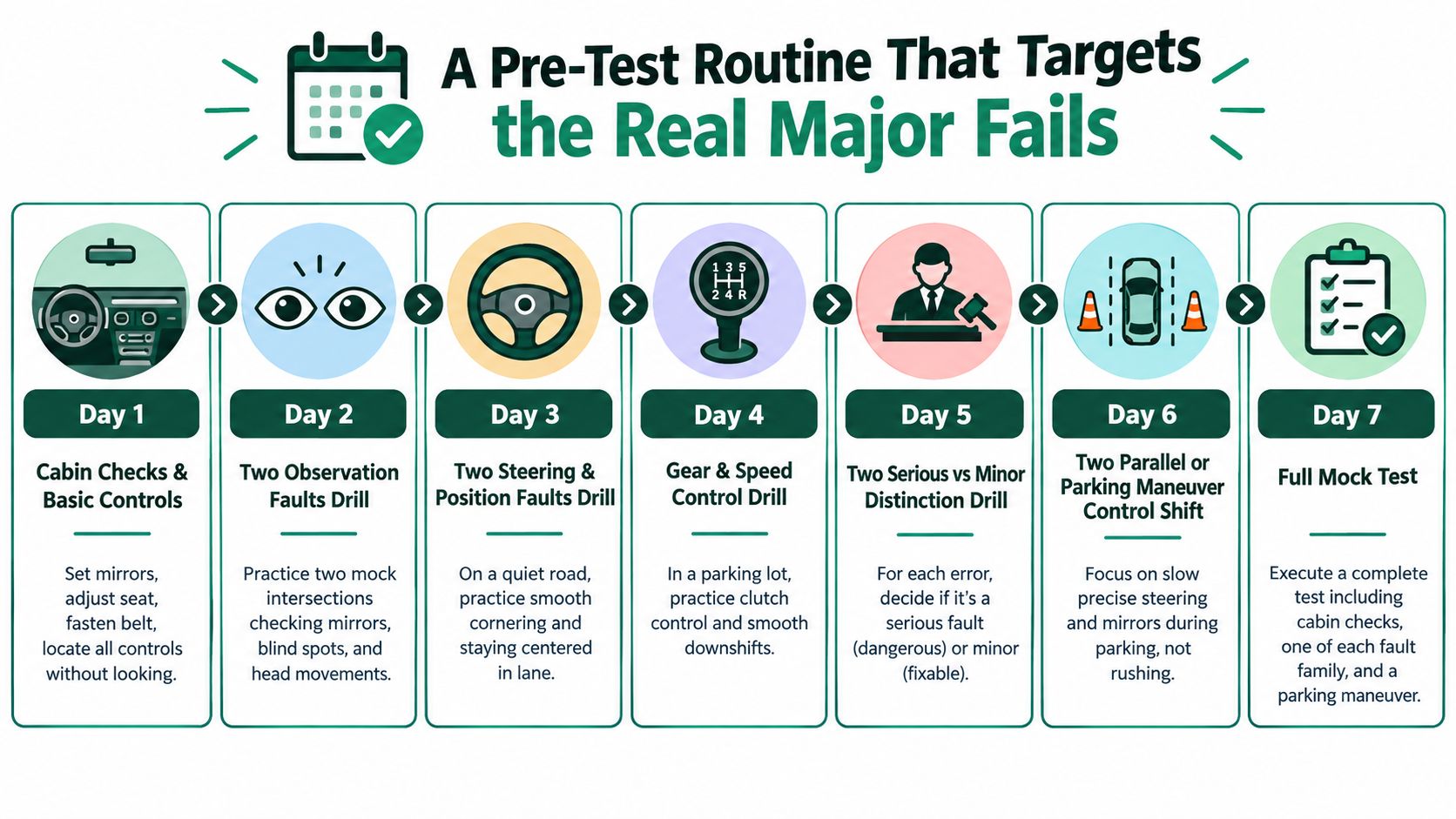
The final week should test specific behaviours, not add unstructured road time. Build each session around evidence from your mock-test marking sheet. A vague result such as “I felt better” hides the exact situation that could still produce a major fault.
Build the week around repeatable drills
Start with cabin checks. Set the seat and mirrors, fasten the belt, and locate the controls without looking down. Then work through targeted scenarios:
- Observation drills: Complete two junction or roundabout approaches, pausing and re-checking whenever the traffic picture changes.
- Parking practice: Perform one manoeuvre while recording steering, speed, observation and shunts. Use reference points, then verify the car's actual position through the windows and mirrors.
- Hill-start control: Practise on a genuine slope, concentrating on secure control, all-round observation and a safe move-off.
- Lateral movement: At every lane change or change of direction, rehearse the mirror, signal and blind-spot sequence. Repeat the check if you have waited before moving.
- Scoring review: Treat any repeated fault family as a serious-fault risk, even when each individual error was marked as a minor.
Reference points should guide judgement, not replace it. For bay parking, note where the bay line appears beside your mirror or door pillar, then confirm the vehicle's position before turning. For a parallel park, practise the relationship between the rear of the parked vehicle, the kerb and your car's angle. The correct reference point depends on the vehicle, so your instructor should help you establish and test it.
Finish with a realistic test rehearsal
Run at least one complete mock test without coaching. Include normal stops, junctions, a roundabout, a change of direction, independent driving and a parking manoeuvre. The debrief should identify where the decision failed, what you saw, what you missed and which action would have prevented the fault.
The night before, check that your licence is valid, confirm the test-centre address and parking arrangements, and rehearse your personal fault routine mentally. Allow enough time for the journey, but avoid driving unfamiliar routes or cramming every possible scenario. Review the specific pattern your mock test exposed, then picture the observation, control or decision that prevents it.
Putting It All Together Before Test Day
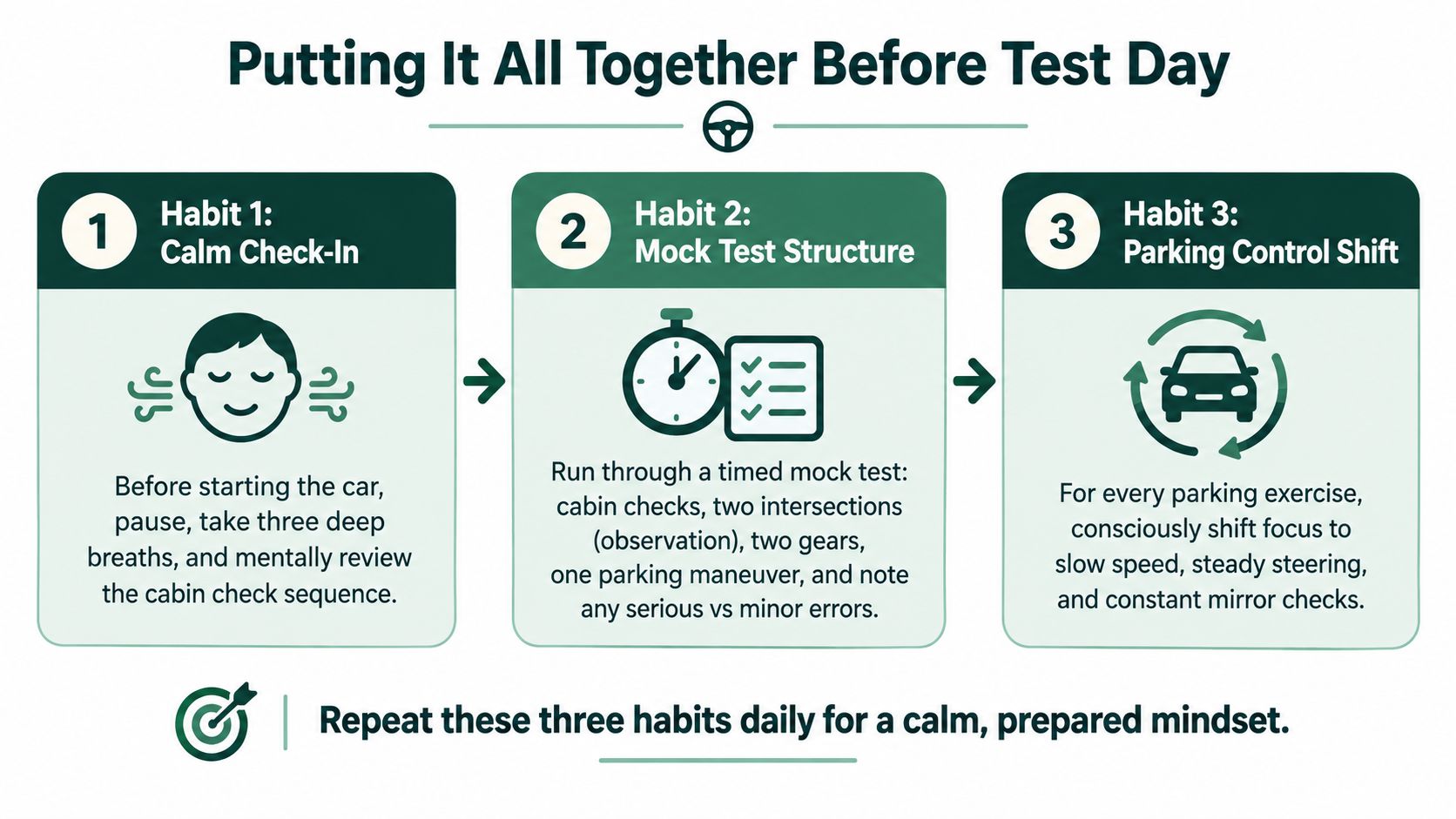
A calm test performance comes from having fewer decisions to improvise. The major fails in driving tests discussed here fall into connected groups: observation determines whether a junction or lane change is safe, control determines whether the vehicle responds accurately, and judgement determines whether your correction protects other road users.
Use the final week to collect patterns rather than chase a simple pass-or-fail score. A mock test that contains one serious fault and several clean areas still gives useful information. Record the location, traffic context, action taken, examiner-style category and the prevention routine needed next time.
Three habits that keep practice honest
Debrief the pattern. After every mock test, identify the fault family that appeared most often. “Observation” is too broad. Write “late right mirror before moving around a parked vehicle” or “looked left but didn't reassess the right side after waiting”. Specific notes produce specific practice.
Brief the instructor. At the start of the next lesson, name the two situations that caused trouble. Ask for them to be recreated with different traffic conditions, not merely repeated on the same quiet road. The trade-off is useful: route familiarity can build confidence, but variation proves whether the routine works beyond one memorised corner.
Enter the test knowing your risk. You shouldn't arrive hoping the examiner doesn't ask for your weakest manoeuvre. You should know whether your personal risk is parking control, emerging at junctions, lane positioning, speed choice or move-off observation, then apply the matching routine deliberately.
A structured course can make that process more consistent when mock-test findings feed directly into lesson plans. Fast Track Driving Lessons matches learners with DVSA-approved instructors for manual or automatic tuition, and its mock tests use routes near the chosen test centre while focusing on examiner-marked faults. That kind of structure is most useful when the instructor treats the marking sheet as a curriculum, rather than giving the same general advice after every drive.
Don't measure readiness by whether you can complete one familiar route without a mistake. Measure it by whether you can recognise the hazard, make the observation, control the vehicle and recover safely when the road changes. That is the standard that turns a list of major fails into a practical preparation plan.
If junction observation, parking control or repeated minor faults are holding you back, Fast Track Driving Lessons offers intensive and semi-intensive tuition, test-centre mock tests and instructor matching across England, Scotland and Wales. Share your examiner's report or mock-test pattern with an instructor, then book targeted practice that recreates the exact situations causing your major fails.
Written by Fast Track editorial team.