
The short version
- One serious or dangerous fault means a fail, even if the rest of the drive is good.
- The DVSA regularly lists junction observation as one of the top driving test fail reasons.
- Examiners mark what affects safety, not whether a drive looks stylish.
- Mirror faults usually happen because learners check too late or fail to act on what they see.
- Good planning before hazards prevents most last-second serious faults.
The most common driving test fail reasons in the UK
If you are searching for the most common driving test fail reasons, the direct answer is this: learners most often fail because they do not observe effectively at junctions, do not use mirrors properly before changing speed or direction, move off unsafely, position poorly, respond late to signals or lose control during everyday manoeuvres. These are not exotic situations. They are the normal moments you meet on almost every test route.
The Driver and Vehicle Standards Agency, the DVSA, publishes the top reasons for failing the car driving test in Great Britain. The order can change by year, but the same themes appear again and again: junction observations, mirror use, moving off safely, turning right at junctions, steering control, traffic lights, moving off control, normal road positioning, traffic signs and reverse parking control. Source: DVSA guidance on the top 10 reasons for failing the driving test. DVSA information and test fees can change, so always check GOV.UK for the current version.
In the passenger seat, I see the same pattern: the learner can drive, but under test pressure they deal with the road in pieces. They look at the junction but not far enough. They check the mirror but do not change what they are doing. They know the speed limit but miss the sign. The examiner is not looking for perfection. They are asking whether you are safe, legal, smooth enough and independent enough to drive without help.
How examiners mark faults, and why small mistakes become fails
On a UK practical driving test, the examiner records driving faults, serious faults and dangerous faults. A driving fault is something that was not ideal but did not create actual or potential danger on that occasion. A serious fault is something potentially dangerous. A dangerous fault involves actual danger to you, the examiner, another road user or property. Under DVSA rules, one serious or dangerous fault means you fail. You can make up to 15 driving faults and still pass, but 16 or more is a fail. Check GOV.UK for current DVSA test rules.
The mistake learners make is thinking, "I only did it once." Once can be enough. If you emerge from a junction and cause a vehicle on the main road to brake, that is usually serious. If you change lanes without a proper mirror and blind spot check and there is a car affected by it, that can be serious or dangerous. If you repeatedly miss mirror checks, those small faults can build into a pattern showing you are not taking enough information.
This is general guidance, not legal advice. The Highway Code, road traffic law and the examiner's professional judgement all matter on the day. Your job is not to guess whether something would be minor or serious. Your job is to drive in a way that gives other road users time, space and no surprises.
- Driving fault: a minor lapse, such as a slightly late signal where no one is affected.
- Serious fault: a potentially dangerous error, such as poor observation when emerging.
- Dangerous fault: actual danger, such as forcing another driver to take avoiding action.
- Repeated driving faults: the same habit appearing several times, such as late mirror checks.
- Examiner intervention: if the examiner uses the dual controls or gives urgent help, expect a serious or dangerous mark.
Junction observation: the number one fault I correct in lessons
Junction observation is one of the most common reasons learners fail. The classic version is creeping out, looking right and left once, then moving without checking again. The road picture changes quickly. A cyclist can appear from behind a parked van, a pedestrian may step towards the kerb, or a car may be hidden by a queue. At open junctions learners often rush because they think they can see. At closed junctions they sometimes stop too far back, cannot see properly, then guess.
What examiners mark is not just whether your head moved. They are judging whether your observations were effective. Did you look into the new road before turning? Did you check for pedestrians crossing, as required by Highway Code Rule H2 and the updated hierarchy of road users? Did you avoid making traffic on the main road slow, swerve or hesitate? Did you look again just before committing?
The costly fault is emerging or turning when the gap is not safe. Another common one is turning left while only looking right for traffic, missing pedestrians or cyclists on the left. I teach learners to separate the job: approach, position, slow, select the correct gear, look both ways, judge the gap, then move only when you can clear the junction safely. If you cannot see, creep and peep. That means very slow clutch control, tiny movement, repeated checks and no sudden commitment.
- 1Identify the junction early and check centre mirror before slowing.
- 2Position correctly for the turn without cutting corners or drifting wide.
- 3Slow enough to give yourself looking time, not just braking time.
- 4Look right, left and ahead, then repeat as the view changes.
- 5Check for pedestrians and cyclists before crossing their path.
- 6Commit only when your gap is safe and you will not make others brake.
Mirrors: checking is not enough if you do nothing with the information
Mirror faults are extremely common because learners treat mirrors as a ritual instead of a decision-making tool. They glance, signal or steer immediately, then hope that was enough. The examiner wants to see that you know what is behind and beside you before you change speed, change direction, signal, overtake, pull up or move off. Highway Code Rule 161 says you should use all mirrors effectively and check blind spots before changing course or direction.
In lessons, I often ask, "What colour was the car behind?" If the learner cannot answer, the mirror check was probably too quick to be useful. The worst test fault is changing lane or moving around parked vehicles after only checking the centre mirror. Door mirrors matter because the danger may be beside you, not directly behind you. Blind spots matter because a mirror will not show everything.
The timing is crucial. Mirror, signal, manoeuvre is not just a phrase from theory practice. It is a safety routine. If the mirror check is too early, the information is stale. If it is too late, you have already started the manoeuvre. A good mirror check gives you time to alter your plan. For example, if a motorcyclist is overtaking, you hold back rather than steering out.
- Before slowing: centre mirror, so you know whether following traffic is close.
- Before turning left: centre and left mirror, then check for cyclists and pedestrians.
- Before turning right: centre and right mirror, especially before positioning near the centre line.
- Before changing lanes: centre mirror, appropriate door mirror and a blind spot check if needed.
- Before moving off: all-round observation, including the blind spot on the side you will move towards.
Moving off safely and under control
Moving off sounds simple, but it causes many test fails because it happens repeatedly during the drive: from the test centre, after pulling up on the left, after an emergency stop if asked, at traffic lights, in queues and on hills. The examiner is looking for two things: safety and control. Safety means you look properly and do not affect anyone. Control means you move away smoothly without rolling back, stalling dangerously or swinging out.
The serious fault I see most often is the learner checking mirrors, then staring forward for too long before moving. By the time they release the clutch, the road has changed. A car has appeared, a cyclist is alongside, or a pedestrian is crossing near the front. Another common fail is signalling automatically when parked on the left. A signal is useful if someone will benefit, but it can be misleading if there is a vehicle passing and your signal suggests you are about to pull out in front of it.
If you stall on test, do not panic. A stall is not automatically a fail. It becomes serious if it happens in a dangerous place, if you roll back significantly, if you fail to secure the car, or if you restart without observation. Secure the vehicle, breathe, prepare, observe again and move when safe. Examiners see nerves every day; what matters is how safely you recover.
- 1Prepare the car with the correct gear, clutch bite and gas if needed.
- 2Check all around, finishing with the blind spot on the side you will move towards.
- 3Decide whether a signal will help or confuse other road users.
- 4Release the parking brake only when you are ready and it is safe.
- 5Move out smoothly, keeping good steering control and road position.
- 6Cancel the signal if used and build speed appropriately.
Positioning, steering and lane discipline
Poor positioning can look harmless to a learner but feel unsafe to an examiner. Driving too close to parked cars, drifting towards the kerb, cutting right turns, straddling lanes on roundabouts or sitting unnecessarily near the centre line all send the same message: you are not fully controlling the space around the car. Highway Code Rule 160 reminds drivers to drive with both hands on the wheel where possible, be aware of other road users and keep to the left unless signs or markings indicate otherwise.
Steering faults often appear when learners rush. They approach a bend too fast, then snatch the wheel. They turn right too early and cut the corner. They steer late around parked vehicles, creating a sharp movement that surprises following traffic. The test is not assessing textbook hand movements in isolation. It is assessing whether your steering keeps the car on a safe, predictable path.
Lane discipline matters especially on roundabouts and multi-lane roads. If road markings show lane arrows, follow them unless it is unsafe. If you realise you are in the wrong lane, do not force the correction. Go the wrong way safely if necessary. Examiners would much rather see a safe route error than a sudden lane change that cuts across another vehicle.
- Fault: driving too close to parked cars. Fix: leave door-opening space where possible and slow if space is tight.
- Fault: cutting right turns. Fix: wait until the front of your car reaches the correct turning point.
- Fault: drifting wide on left turns. Fix: reduce speed earlier and steer progressively.
- Fault: straddling lanes. Fix: read markings early and commit to one lane.
- Fault: correcting a wrong lane sharply. Fix: continue safely and let the examiner redirect you.
Traffic lights, signs, road markings and speed decisions
Response to signals is another major fail area. Learners usually know what a red light means, but they fail because they notice information late. They approach a green light too quickly with no plan if it changes. They stop beyond the stop line. They miss a filter arrow. They enter a yellow box junction without a clear exit. They see a speed limit sign but do not adjust in time.
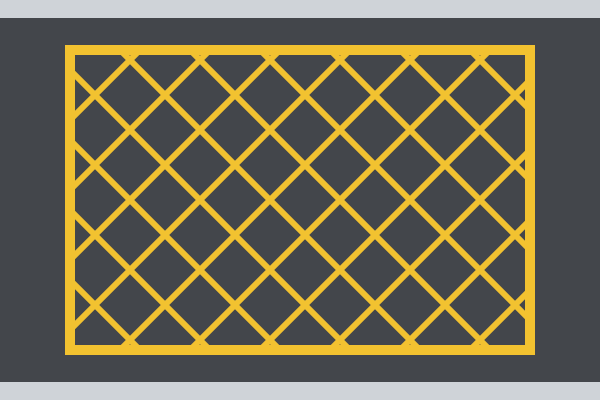
Highway Code Rule 175 covers box junctions: you must not enter the box until your exit road or lane is clear, except when turning right and prevented only by oncoming traffic or other vehicles waiting to turn right. Highway Code Rule 176 covers traffic lights, including stopping at the stop line when red. Rule 124 gives national speed limits, including 30 mph on roads with street lights unless signs show otherwise. These are legal basics, and on test the examiner expects you to apply them without prompting.
The specific fault that costs tests is late planning. If you brake sharply for an amber light when a safe stop was available earlier, that may be marked. If you continue through amber when you could have stopped safely, that may also be marked. The safe answer depends on speed, distance, following traffic and road conditions. You need to be looking well ahead, not just at the car in front.


- Scan for signs on both sides of the road, not only directly ahead.
- Look for road markings early, especially lane arrows and stop lines.
- Treat amber as stop unless it would be unsafe to do so.
- Do not enter a box junction unless your exit is clear, except for the right-turn exception.
- Match your speed to the limit, weather, traffic and visibility.
Reverse parking and manoeuvres: control plus observation
Manoeuvres do not need to be beautiful to pass. They need to be safe, controlled and reasonably accurate. The current car test may include a bay park, parallel park, pulling up on the right and reversing, or another DVSA-specified manoeuvre depending on the test format at the time. Always check the latest GOV.UK information because test content can change.
Reverse parking faults normally happen for two reasons. First, the learner focuses so hard on the reference point that they stop looking around. Second, they panic about being slightly out of position and rush the correction. The examiner does not expect a one-move masterpiece. You are allowed to correct, provided you keep observing and do not create danger.
During any reverse, the rear of your car is moving into a space you cannot see as easily. Pedestrians, children, cyclists and vehicles can appear quickly. If someone comes near, pause. If a vehicle waits for you, continue only when you are sure they have stopped and it is safe. The mark is not for being fast. It is for being in control and aware.
- 1Prepare slowly and choose a safe starting position.
- 2Check all around before the car moves, including blind spots.
- 3Move at walking pace using clutch or brake control.
- 4Keep looking around throughout, not just in mirrors or at a camera.
- 5Pause if another road user comes close or you are unsure.
- 6Correct calmly if needed, with fresh observations before moving again.
A practical pre-test checklist for avoiding common fails
The week before your test should not be about learning brand-new tricks. It should be about removing the habits that create serious faults. I like to run mock tests, then pick the top two repeat issues. If a learner tries to fix everything at once, they often drive stiffly and miss the road ahead. If they fix the biggest risk first, the whole drive usually improves.
Do not measure readiness by whether you can complete one perfect route. Measure it by whether you can make safe decisions on unfamiliar roads, recover from small mistakes and drive without your instructor talking you through hazards. The examiner will give directions, but they will not coach you. Independent driving is not about knowing the area. It is about reading signs, markings and traffic in good time.
Remember the practical cost too. The standard DVSA car driving test fee is published on GOV.UK and has been £62 for a weekday test and £75 for an evening, weekend or bank holiday test, but fees can change. More importantly, a fail usually means more waiting and more lessons. A calm, safety-first drive is the best way to protect your money and your confidence.
- Junctions: do I look again just before I go, especially at closed junctions?
- Mirrors: do I check early enough to change my plan, not just tick a box?
- Speed: do I spot new limits and adjust before I am too fast?
- Position: do I keep safe clearance from parked cars and choose lanes early?
- Moving off: do I complete fresh observations every time before the car moves?
- Manoeuvres: do I pause and observe when anything changes around me?
Common questions
What is the most common reason for failing a UK driving test?
DVSA lists junction observation as one of the most common driving test fail reasons in Great Britain. In plain terms, learners fail because they move at or through junctions without taking effective observations or without judging the gap safely.
Can you fail your driving test for one mistake?
Yes. One serious or dangerous fault is enough to fail the practical driving test. A single mistake may be marked serious if it creates potential danger, such as emerging and making another vehicle brake.
Is stalling on the driving test an automatic fail?
No, stalling is not automatically a fail. It becomes a bigger problem if it creates danger, happens repeatedly due to poor control, causes significant rollback, or you restart without proper observations.
How many minor faults are allowed on the practical driving test?
Under DVSA rules, you can make up to 15 driving faults and still pass, provided you do not make a serious or dangerous fault. Sixteen or more driving faults is a fail, and repeated faults in the same area can show an unsafe pattern.
Will I fail if I go the wrong way on my driving test?
Not necessarily. Going the wrong way safely is usually not a driving fault by itself. Forcing a late lane change, ignoring signs or cutting across traffic to follow the examiner's direction is the part that can fail the test.
What should I practise most before my driving test?
Practise the situations that create serious faults: junctions, mirror use, moving off, lane discipline, speed limit changes and manoeuvre observations. A mock test with clear feedback is useful because it shows your repeated habits, not just one-off mistakes.
See our pass guarantee
Reading about it only gets you so far. Our instructors drill this with you in the car, on the roads around your test centre.