
With a 44.8% national pass rate in 2025/26, the UK car theory test is clearly difficult for many learners. You must score 43 out of 50 in multiple choice and 44 out of 75 in hazard perception, and both thresholds apply in the same appointment.
That means the test isn't a casual warm-up before the practical. It checks two different abilities, accurate knowledge and timely hazard recognition, then requires you to meet the standard in both. The encouraging part is that difficulty becomes much easier to manage once you know where marks disappear and prepare for those weak points deliberately.
Table of Contents
- Why So Many Learners Ask if the Theory Test Is Hard
- Inside the Two-Part Test and Why It Punishes Weak Spots
- The National Picture and the Long Decline in Pass Rates
- Where Candidates Actually Lose Marks
- Common Beliefs About Hard Topics That Are Worth Questioning
- A Practical Study Plan That Eases the Difficulty
- Booking, Rescheduling and the Admin Side of Difficulty
- Turning the National Numbers Into Your Own Pass
Why So Many Learners Ask if the Theory Test Is Hard
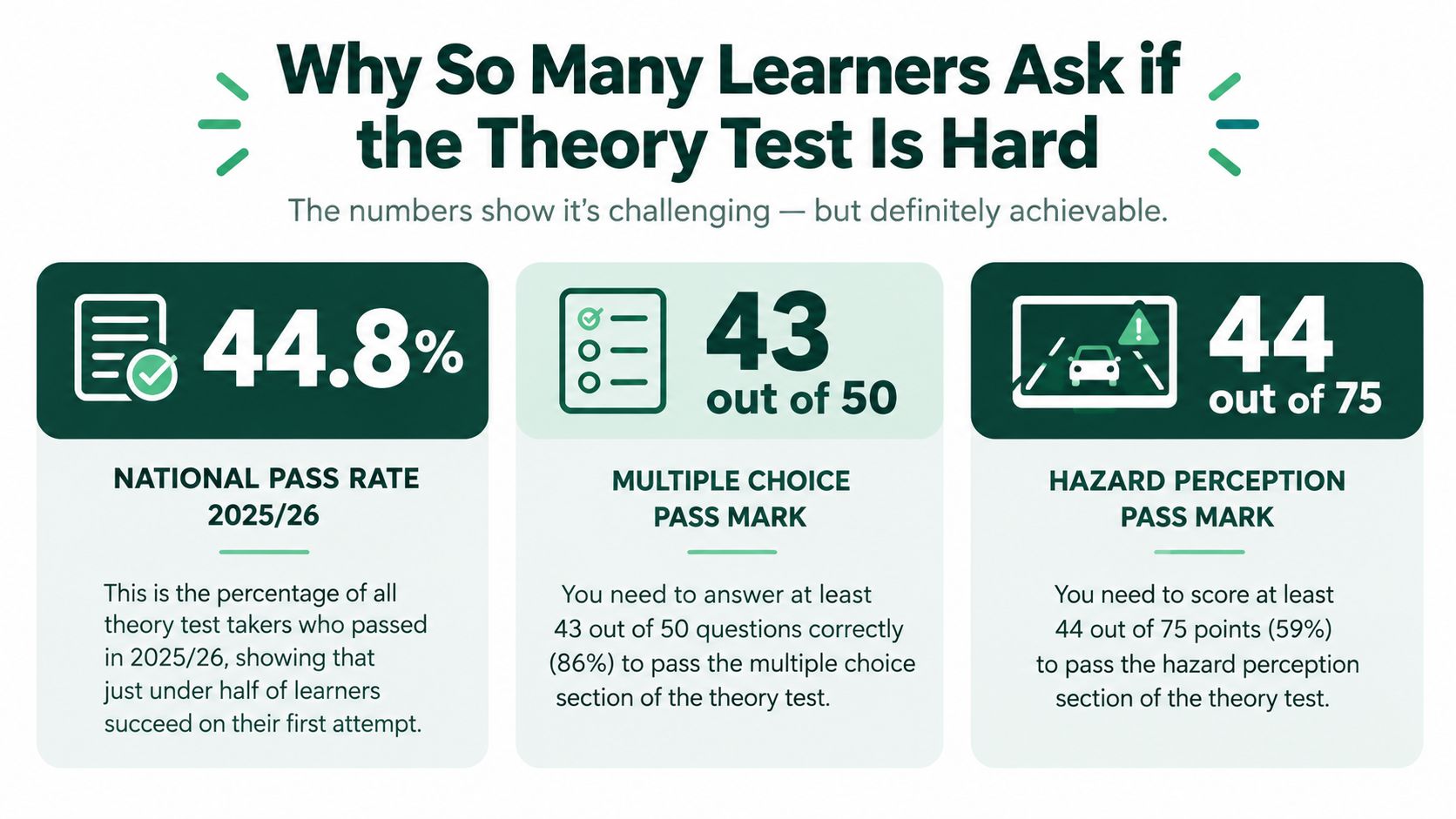
Only 44.8% of car theory test candidates in Great Britain passed between April 2025 and March 2026, according to the official DVSA car theory test statistics. The national figure explains why learners ask whether the test is hard, but it does not mean every candidate faces exactly the same experience. Local test centres can produce different results, reflecting differences in preparation, candidate groups and the conditions in which people take the test.
The scoring rules explain the pressure more clearly. The multiple-choice section requires 43 out of 50, while hazard perception requires 44 out of 75, according to the official theory test pass-mark guidance. These are two separate gates, so a strong score in one section cannot cover a miss in the other. A learner can know the rules well and still fall short through late hazard clicks, just as good hazard awareness cannot compensate for weak knowledge.
Why the test feels harder than expected
Roads and signs may look familiar, yet the questions often require a precise rule or the safest response in a less familiar situation. Everyday exposure is useful practice, not proof that revision is complete.
Weak spots usually decide the result. Stopping distances, detailed rules and hazard perception can drag down a learner who feels confident with signs and basic questions. Prepare for that unevenness rather than revising only the topics you already enjoy.
Instructor's rule: Treat the theory test as two exams taken together, not one quiz with a single score.
Use the Highway Code, practise questions across the syllabus, record repeated mistakes and train hazard perception separately. Start with the section producing the most errors, then keep checking both sections until each pass mark feels dependable.
Inside the Two-Part Test and Why It Punishes Weak Spots
The test's design explains much of the frustration. The first part examines knowledge through multiple-choice questions. The second asks you to spot developing hazards in video clips, so it tests observation and timing rather than simple recall.
The DVSA-focused guide to what appears in the theory test is useful for seeing how broad the subject matter can be. You may need to revise road signs, road rules, stopping distances, motorway driving, documents, vehicle handling and other areas covered by the official question bank.
Two sections, two different skills
The multiple-choice part presents 50 questions. You need 43 correct answers to pass, so you can miss only seven. The hazard perception part contains 14 video clips, including a clip with two developing hazards, and offers a possible score of 75 points. You need 44 points to pass that section.
| Component | Multiple Choice | Hazard Perception |
|---|---|---|
| What it tests | Knowledge of rules, signs, safe driving and vehicle use | Recognition and timing of developing hazards |
| Format | 50 questions | 14 video clips |
| Available marks | 50 | 75 |
| Pass mark | 43 | 44 |
| Main skill | Accurate recall and application | Observation and well-timed clicking |
The two parts are taken during the same appointment. If you fall below the pass mark in either section, the whole attempt is unsuccessful, even if your score in the other section is strong.
That all-or-nothing structure punishes one-sided revision. Reading the Highway Code won't automatically teach you when to click. Likewise, practising clips won't repair gaps in motorway rules or road-sign knowledge. Balanced preparation matters because the test's scoring structure gives you no alternative route around a weak section.
The National Picture and the Long Decline in Pass Rates
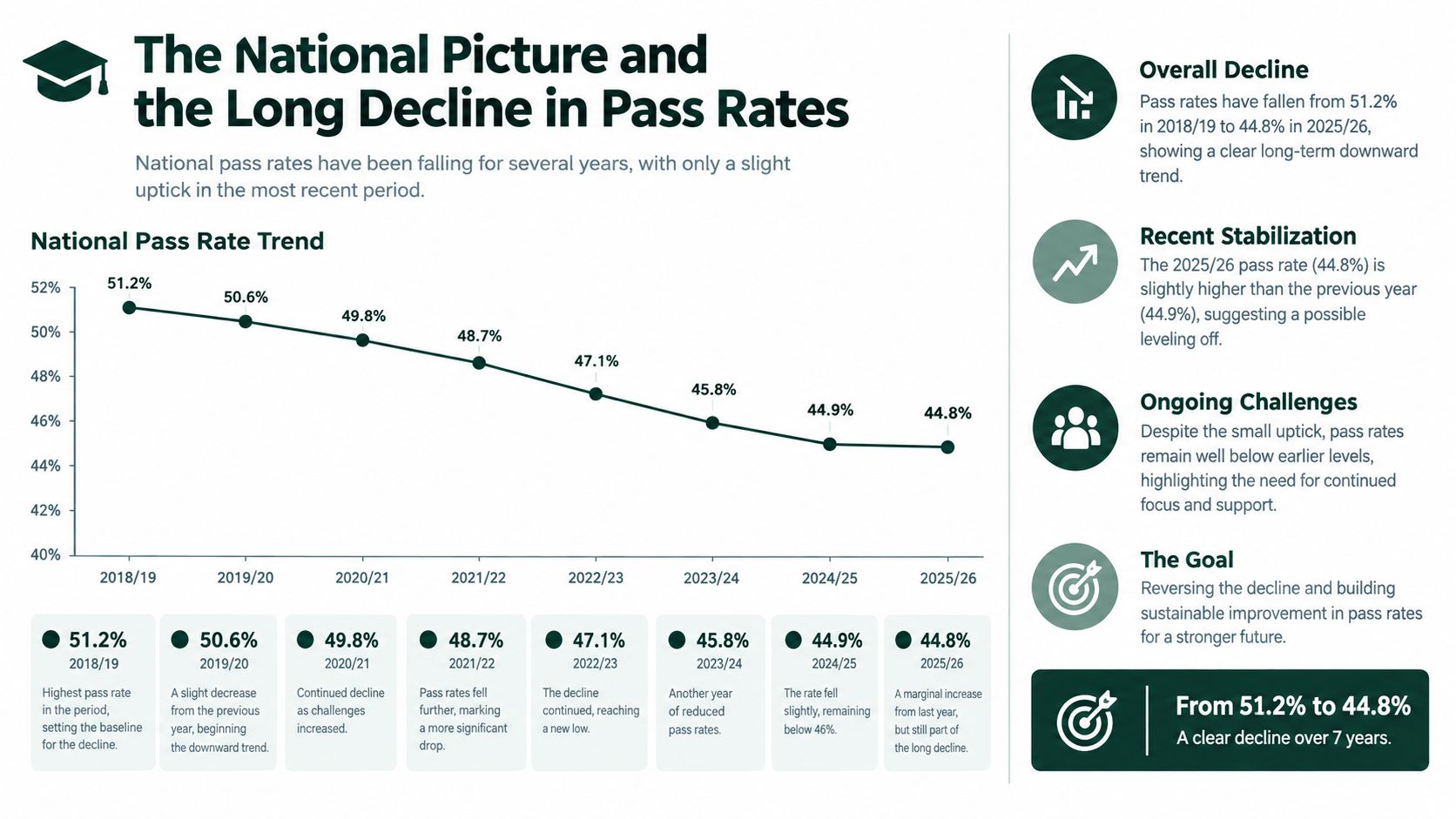
A national pass rate of 44.8% in 2025/26 means fewer than half of car theory-test candidates passed during that year. The previous result was 44.9% in 2024/25, according to the DVSA data. That small change suggests a steady level of difficulty, rather than a sudden change in one testing period.
The longer view shows a much larger shift. The pass rate stood at 65.4% in 2007/08, which is 20.6 percentage points higher than the 2025/26 figure, based on the historical figures in theory test pass-rate data. The comparison is useful, but it should not be read as a prediction for one learner. A national average describes the whole group, not your readiness.
Why your centre may feel different
Results can vary between test centres. DVSA records include national and centre-level information, and local figures reflect the candidates using each centre. Their driving experience, language confidence, revision habits and familiarity with hazard perception can all differ.
The questions are not necessarily easier at a centre with a higher pass rate. The candidate mix may be different. One local result can sit above the national figure, while another can fall below it, without either result changing the test's pass marks.
Use local results as background, not as a shortcut. Booking elsewhere cannot replace preparation. A better guide is your own mock-test record: whether you are consistently reaching the required scores, which topics cause errors, and whether those mistakes are becoming less frequent. Study the weaker area first, while keeping both parts of the test in regular practice.
Where Candidates Actually Lose Marks
The two pass marks reveal different kinds of pressure. In multiple choice, 43 out of 50 means each incorrect answer takes away one available mark. In hazard perception, 44 out of 75 leaves more room in the total score, but timing errors can still remove several points from an individual clip.
A multiple-choice mistake is often a breadth problem. You might understand the main rule but misread a question about a specific sign, document, vehicle condition or motorway situation. Hazard perception is more about timing. Clicking before a hazard develops may not register as useful, while clicking after the danger is obvious may be too late.
| Test Part | Questions or Clips | Pass Mark | Marks Lost Per Error | Typical Failure Pattern |
|---|---|---|---|---|
| Multiple choice | 50 questions | 43 out of 50 | One mark for each incorrect answer | Gaps across several topics, rushed reading or confusing similar rules |
| Hazard perception | 14 clips | 44 out of 75 | A developing hazard can lose points when timing is poor | Clicking too early, too late or failing to notice a changing road situation |
The phrase “which part is hardest?” doesn't have one universal answer. Learners with weak rule knowledge usually lose marks across multiple-choice topics. Learners who know the rules but haven't practised video clips may fail hazard perception despite feeling confident about revision.
Find the section that is holding you back
Look at your practice results by section rather than relying on your overall impression.
- Repeated multiple-choice errors: Group wrong answers by topic and return to the relevant Highway Code rule.
- Unstable hazard scores: Practise identifying when a situation starts to change, not merely spotting obvious danger.
- One-off mistakes: Check whether you misread the wording, rushed or changed a correct answer without a clear reason.
- Same error several times: Treat that topic as a priority, even if your total score sometimes looks acceptable.
Most useful revision is corrective. You aren't trying to complete endless questions. You're trying to understand why a particular answer was wrong and recognise the same pattern when the test presents it differently.
Common Beliefs About Hard Topics That Are Worth Questioning
Learners often name the same topics when they explain why the test feels difficult. Those concerns are understandable, but the label “hard” can hide a more useful diagnosis. A topic may feel difficult because it is unfamiliar, because the wording is precise, or because you haven't practised it often enough.
Distractions and alertness
Questions about tiredness, concentration and distractions matter because they test safe decision-making rather than a single fact. But they rarely explain every failed attempt by themselves. If you keep missing them, read the explanations and connect each answer to the driving risk it addresses.
Stopping distances
Stopping-distance questions deserve active practice because the answer depends on reading the situation accurately. A learner who remembers isolated figures but doesn't understand how speed, weather and road surface affect stopping may choose an answer that sounds familiar but doesn't fit the question.
Road signs
Road signs aren't necessarily tricky. Their difficulty usually comes from breadth. Revision that covers only the most familiar signs leaves gaps when the question uses a less common symbol or asks what a sign means in context.
Motorway rules
Motorway questions often respond well to short, repeated sessions. Separate rules about lanes, signals, safety and controlled motorway features, then test yourself until you can explain the answer rather than recognise it by appearance.
Use your mistakes as a checklist: distractions, distances, signs and motorway rules should become named revision categories, not a general feeling that “the test is hard”.
The official DVSA revision question banks should be your reference point. Third-party practice can help with repetition, but check uncertain answers against authoritative Highway Code material rather than memorising a pattern from one app.
A Practical Study Plan That Eases the Difficulty
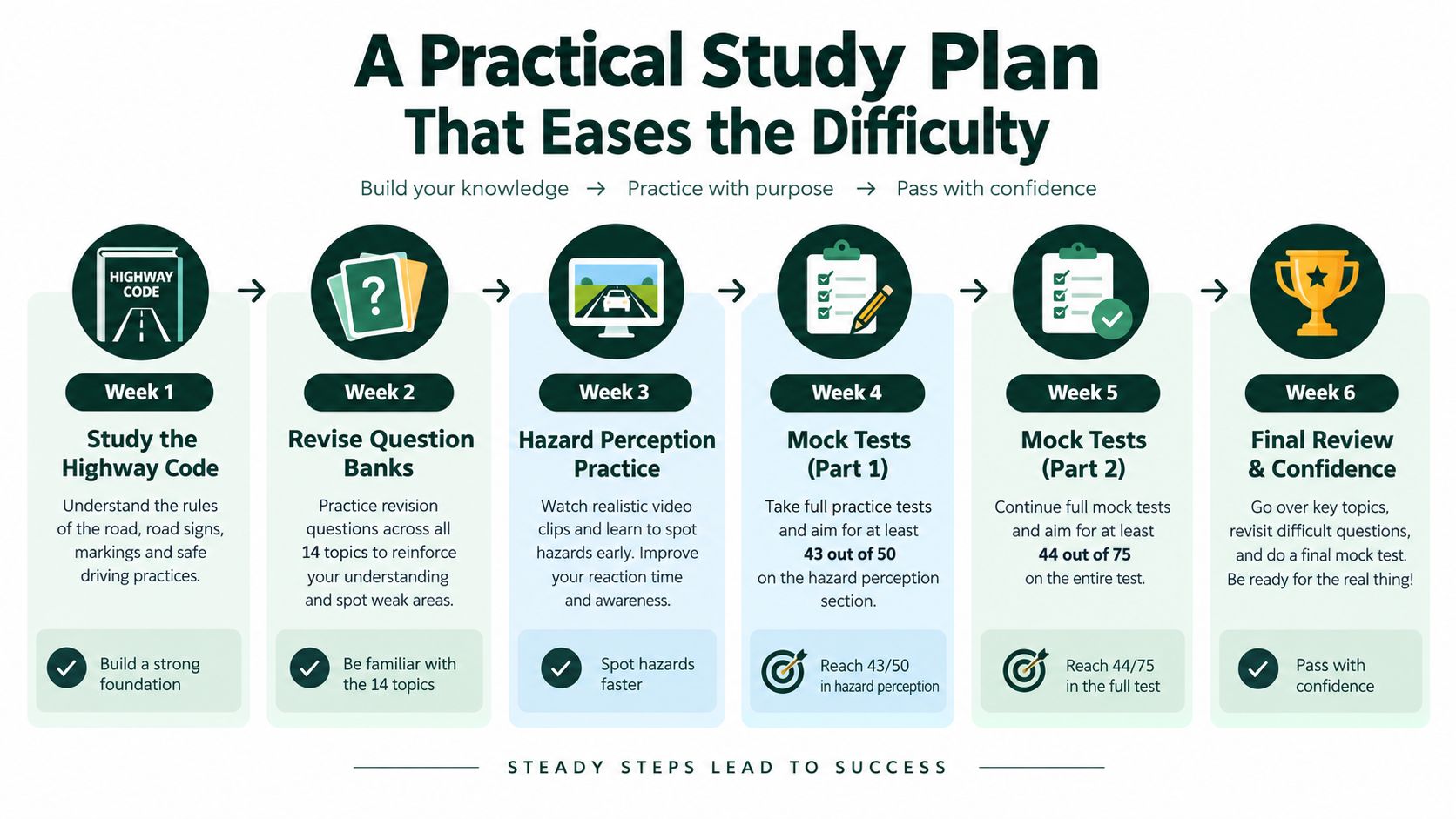
A four- to six-week plan works best when each stage has a clear purpose. You don't need to spend every evening revising for hours. Short, regular sessions make it easier to revisit mistakes and prevent one familiar topic from crowding out everything else.
Weeks one and two build the knowledge base
Start with the Highway Code and the DVSA-style revision question banks. Work through all 14 topic areas in short daily blocks, rotating subjects so you don't revise only signs or only rules.
Keep an error log. For every wrong answer, write the topic, the rule you misunderstood and the clue in the question that should have guided you. If you use spaced repetition, resources on better microlearning with VideoLearningAI can help you organise small recall sessions instead of rereading the same pages passively.
Weeks three and four add pressure
Move towards timed multiple-choice practice. Your immediate target is 43 out of 50, but don't stop at recording a pass. Review every wrong answer against the Highway Code and revisit any topic that produces the same mistake.
Use the guide to revising for the theory test to keep your sessions organised. A timed score tells you what happened. Your error log tells you what to fix.
Week five trains hazard perception
Introduce official hazard-perception practice clips. Watch for the point when a situation begins to develop, rather than clicking at every object or waiting until the risk is unavoidable.
The video below can provide another way to think about timing and recognition:
Week six checks readiness
Use full mock tests under realistic conditions. Complete the multiple-choice section without looking up answers, then practise hazard clips separately. Book the live test only when you can reach 43 out of 50 and 44 out of 75 reliably, not after one lucky attempt.
- Knowledge check: Every major topic has been revised.
- Multiple-choice check: Your mock results meet the required threshold consistently.
- Hazard check: Your clicking is controlled and your scores meet the required threshold.
- Review check: You understand your errors instead of memorising answer positions.
- Admin check: Your appointment date leaves enough time for a final review.
Booking, Rescheduling and the Admin Side of Difficulty
Preparation doesn't remove the administrative rules around testing. A learner can be ready academically and still create avoidable stress by booking too early, missing an appointment or trying to change a slot at short notice.
Use the official GOV.UK booking service and keep the appointment details somewhere you can check easily. Before paying, confirm the centre, date, time and the route you intend to use to reach the venue. The theory test booking and fees guidance can help you understand the practical choices before you commit.
Protect your appointment
The DVSA requires at least three full working days' notice to change a theory test appointment without paying the fee again, according to GOV.UK guidance on changing a theory test. Monday to Saturday count as working days, while Sundays and public holidays don't, so count backwards carefully rather than assuming “three days” means three calendar days.
Short-notice changes may be considered in exceptional circumstances, but the DVSA can ask for evidence. Examples include a medical certificate, a school or college letter, or a police crime number where a licence has been stolen.
- Before booking: Check your diary, travel arrangements and revision timeline.
- After booking: Set reminders for the appointment and the change deadline.
- If something goes wrong: Contact the DVSA promptly and keep any supporting evidence.
- If you fail: Treat the result as diagnostic information, then schedule further practice before arranging another attempt.
The wider driving-test process also uses strict cancellation rules. GOV.UK's driving test cancellation guidance explains that insufficient notice can mean losing the booking fee, while exceptions are limited and require suitable evidence. The principle is worth remembering for theory testing too. You remain responsible for managing your booking, even when an instructor is helping with preparation.
Turning the National Numbers Into Your Own Pass
The national theory test pass rate was 44.8% in 2025/26, following 44.9% in 2024/25, according to the latest DVSA statistics. That small change means waiting for the test to become easier is unlikely to help. Your result depends more on how precisely you prepare.
The longer decline, from 65.4% in 2007/08, shows why casual revision is a weak strategy, as recorded in historical theory test pass-rate data. National figures describe the whole road, not your local test centre. Pass rates can vary between centres, so treat the national percentage as context rather than a prediction.
Use the pass marks to plan your work. Multiple-choice practice needs to reach 43 out of 50, while hazard perception requires 44 out of 75. Since hazard perception commonly drags down otherwise prepared candidates, give it separate practice rather than repeating only familiar questions. Review every missed answer, identify the rule involved, and practise recognising developing hazards without clicking at random.
Your readiness checklist
Before booking or attending, confirm that you can:
- Explain each incorrect multiple-choice answer.
- Reach 43 out of 50 in realistic mocks.
- Reach 44 out of 75 in hazard-perception practice.
- Complete both sections without guessing.
- Produce two clean mock runs.
So, is the theory test hard? It can be, but the difficulty has a clear shape. Your errors show where to study, and steady mock results provide a better readiness signal than confidence alone.
Fast Track Driving Lessons offers a free theory practice hub with DVSA-style questions, mock tests and hazard-perception preparation, plus booking and resit support. Visit Fast Track Driving Lessons to prepare for the same two-part standard used on test day.
Written by Fast Track editorial team.