
You've been practising for months, finally found a test slot, and now the date is approaching faster than expected. Or perhaps you're facing the opposite problem: your booking is weeks away, your lessons have become irregular, and you're worried that your confidence will disappear before test day. Learning how to pass your driving test first time in the UK means preparing for both problems, not just learning how to steer, change gear and park.
The national practical pass rate was 48.7% in 2024–25, while the first-attempt rate was reported at about 48.9%, so roughly one in two candidates passes first time. (DVSA car test data) That result isn't a judgement on your potential. It shows why structured preparation, realistic practice and sensible booking decisions matter.
Table of Contents
- Why Most Learners Don't Pass First Time
- Choosing Your Lesson Plan Intensive or Semi-Intensive
- The Mock Test That Makes Test Day Feel Familiar
- Manoeuvres and Common Faults Examiners Spot Every Day
- Your Complete Test Day Checklist and Final Preparation
Why Most Learners Don't Pass First Time
A failed test often starts with a drive that feels almost good enough. The learner knows the roads, handles the car competently and completes the manoeuvre, but misses a mirror check, approaches a junction too quickly or hesitates when another road user needs a clear decision. Several small faults can make the examiner uncertain about whether the standard is consistent.
The practical test isn't asking for a flawless performance. Zero-fault passes are rare, at about 5.1% of all passes, according to analysis of DVSA data published by Bill Plant Driving School. Your target is controlled, safe and repeatable driving, not perfection.
Build consistency before you chase speed
Many learners practise only the parts they enjoy. They drive familiar roads, repeat comfortable junctions and leave awkward roundabouts or manoeuvres for later. That approach creates confidence without full readiness.
Use a simple preparation cycle:
- Identify recurring faults. Ask your instructor to name the habits that appear across different roads, not just the mistake from your last lesson.
- Practise the cause, not the symptom. If you miss a mirror check before changing direction, practise the full routine of mirror, signal, position, speed and look. Don't just repeat the same manoeuvre.
- Vary the setting. Drive at unfamiliar junctions, on busier roads and in changing traffic conditions. Familiarity should support observation, not replace it.
- Review after driving. Write down what happened, why it happened and what you'll do differently next time.
The common reasons learners fail their practical test are usually practical habits, not mysterious examiner tricks. A learner who understands the pattern behind a fault can correct it far more effectively than someone who memorises a list of mistakes.
Connect theory with practical decisions
The theory test has two separate parts. For cars, the multiple-choice section requires 43 correct answers out of 50, while hazard perception requires 44 out of 75. The hazard perception section uses 14 video clips, with up to 5 points for each developing hazard. (GOV.UK theory-test pass marks)
That matters during practical lessons. Don't study signs and stopping distances in isolation. Ask yourself where those rules appear on the road. When approaching a parked vehicle, for example, consider visibility, speed, oncoming traffic and the possibility that someone may step out. This is how knowledge becomes observation and planning.
Practical rule: If you can explain what risk you're looking for before you reach a hazard, you're preparing more effectively than if you're merely reciting the rule afterwards.
Age also appears in the UK data as a factor associated with first-attempt success. In 2024–25, the age 17 cohort had a first-attempt pass rate of 60.75%, based on 287,931 tests and 174,932 passes, compared with 51.81% for ages 18–19 and 49.82% for ages 20–24. (DVSA statistical tables) The useful lesson isn't that older learners can't pass. It's that continuous learning, regular driving and fewer long gaps help preserve developing habits.
Choosing Your Lesson Plan Intensive or Semi-Intensive
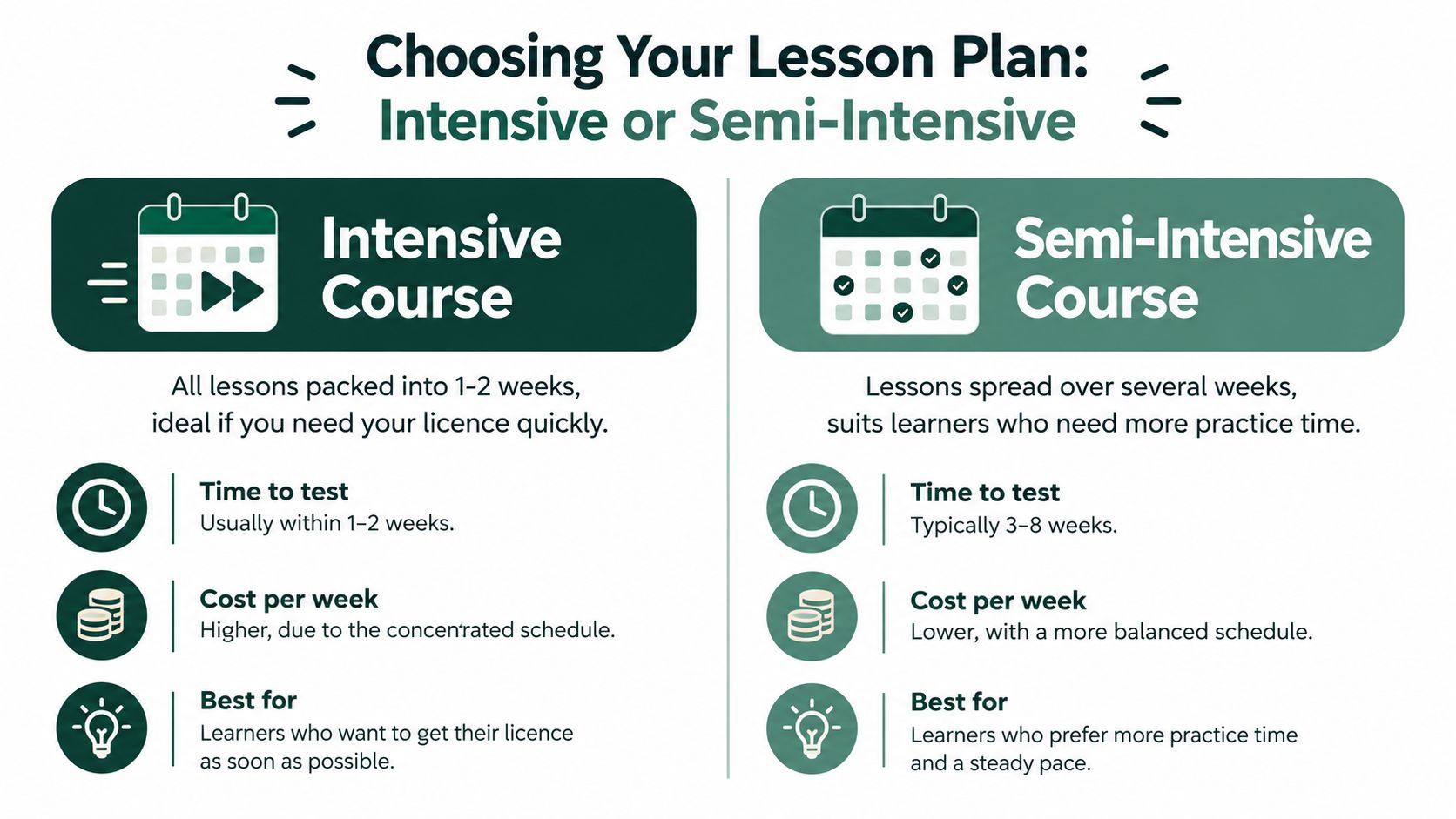
An intensive course compresses lessons into a concentrated period. A semi-intensive plan spreads them over several weeks, allowing more time between sessions to practise, reflect and consolidate. Neither approach guarantees a pass. The right choice depends on your current ability, available time, access to a suitable car and how well you retain skills between lessons.
When an intensive plan makes sense
Intensive tuition suits learners who can protect a block of time and who benefit from frequent repetition. Concentrated lessons can help you link separate skills quickly. Junction work from one session can be revisited before the habit fades, and an instructor can identify whether a problem is improving or just changing form.
It's particularly useful for:
- Nearly test-ready learners: You already control the car and need focused work on faults, manoeuvres and independent driving.
- Learners with a firm deadline: A concentrated schedule may help organise preparation around a test booking.
- People returning after a long break: Regular sessions can rebuild routines more efficiently than occasional lessons.
The trade-off is fatigue. Long or frequent sessions can reduce concentration, especially when every lesson covers demanding roads. If your accuracy drops because you're tired, more hours won't automatically produce better learning. A good instructor should adjust the pace and include purposeful review rather than filling time.
When semi-intensive tuition works better
Semi-intensive lessons suit learners who need to build confidence gradually or who can practise privately between professional sessions. The gap between lessons becomes useful when you have a specific task to complete, such as rehearsing mirror routines with a supervising driver or visiting a difficult junction safely.
This format can be preferable if:
- You're starting from scratch: Early skills need time to settle before more complex traffic situations are added.
- You learn through repetition: Regular weekly exposure can make routines feel natural without overwhelming you.
- Your schedule is fixed: A predictable pattern is easier to maintain than a compressed block.
The scheduling problem changes the calculation. The National Audit Office reported that the average wait to book a practical car test in Great Britain was 22 weeks in September 2025, compared with just over five weeks in February 2020, and that 70% of permanent DVSA test centres were at the 24-week maximum wait. (National Audit Office investigation into waiting times)
Don't complete an intensive course too early and assume you'll stay sharp automatically. Instead, agree a maintenance plan with your instructor. That might mean a short, targeted drive at sensible intervals, private practice with a clear objective, or a final polishing session closer to the test. The aim is to maintain habits without paying for repeated full refresher blocks.
You can compare course structures and learner suitability through intensive and weekly driving lesson options. Ask any provider how they handle a delayed test, instructor availability and a change in readiness. Those answers are as important as the advertised lesson format.
The Mock Test That Makes Test Day Feel Familiar
A mock test should create the pressure of an unfamiliar examiner without turning the lesson into a trap. Your instructor should let you make decisions, follow directions and recover from a minor error instead of rescuing you at every turn. The exercise works when it shows what happens while driving alone, managing instructions and correcting a mistake safely.
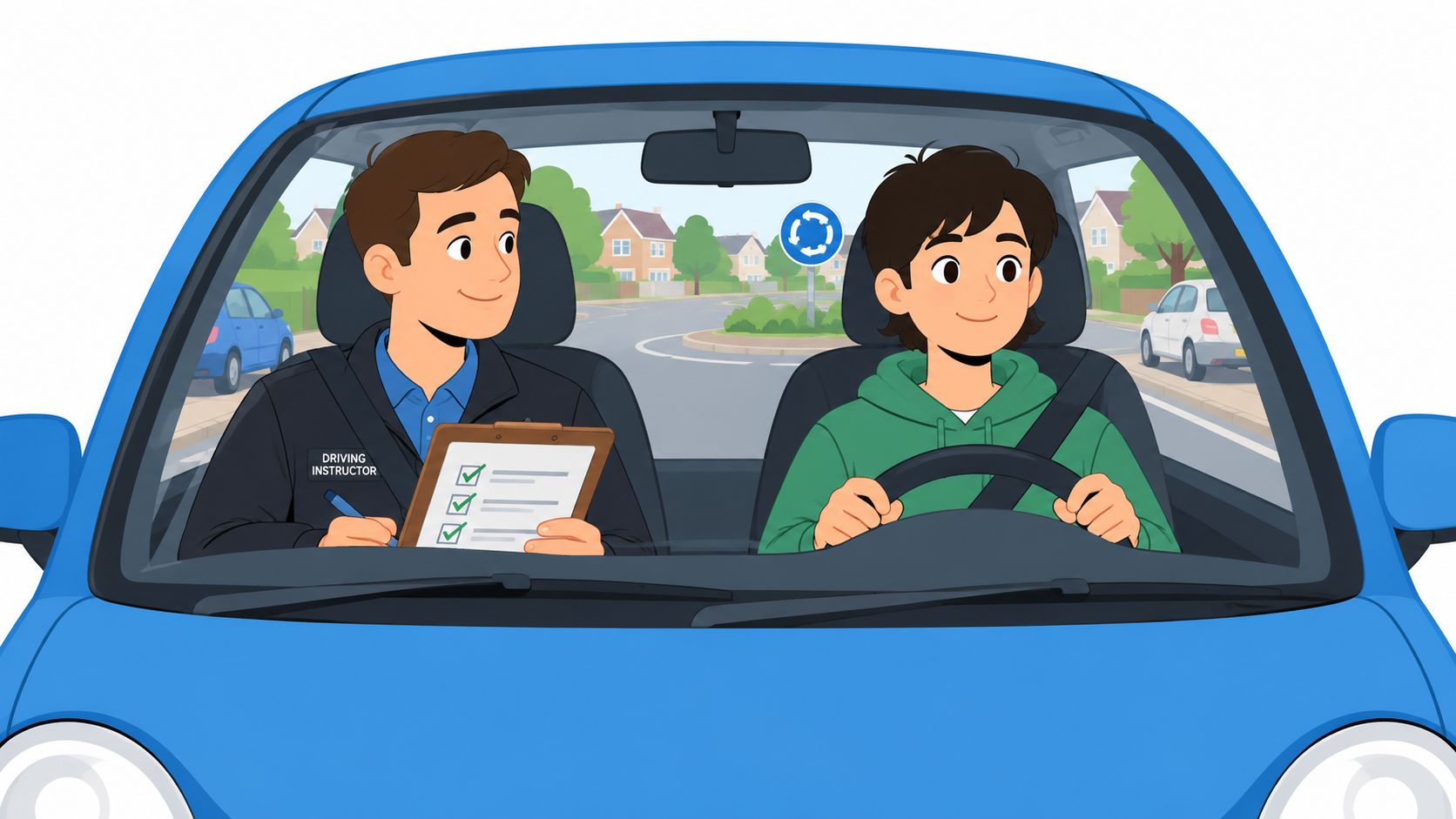
Choose the test centre you expect to use and practise on nearby roads, but avoid learning one route by memory. Routes can vary, traffic conditions change and the examiner may ask you to respond to something unfamiliar. Local practice should improve anticipation while your observation stays active.
The long wait for test slots adds another practical problem in the 2025–26 testing environment. A strong mock taken too early may show that you are ready, but readiness can fade during the wait. Schedule another assessment closer to the appointment, then use short, targeted drives or purposeful private practice to maintain standards instead of paying for repeated full refresher lessons. Ask your instructor how they handle a delayed test, changing availability and a learner whose confidence or skills change between assessments.
Run the mock like an assessment
Agree the conditions before setting off. Your instructor should give calm, examiner-style directions and limit coaching. Include normal road work, independent driving, a controlled stop where appropriate and practice relevant to the current test requirements.
Judge the process, not just the result:
- Listen fully to each instruction. Ask for repetition if necessary. Clarifying a direction is safer than guessing.
- Continue after a mistake. Missing a turn does not automatically end the test. Follow the road safely and wait for the next instruction.
- Make observations visible. Check mirrors effectively and look properly at junctions, crossings and developing hazards.
- Control speed early. Entering too quickly reduces the time available to assess risk.
- Treat independent driving as ordinary driving. Navigation comes after safety.
The video below shows how realistic test simulation should feel before you practise with an instructor.
Turn feedback into the next lesson
Useful feedback identifies the moment, the risk and the replacement routine. “Check your mirrors more” gives you little to practise. Your instructor should explain when the check was needed and how to build it into the sequence.
For example, a learner may signal before checking mirrors because attention has shifted to the next instruction. Slow the sequence down, verbalise the intended action when appropriate and repeat it in several unrelated situations until the order becomes reliable.
Use mock driving tests near your chosen centre as diagnostic sessions. An early mock exposes a weakness while there is still time to address it. A session designed only to reassure you can leave the same fault hidden until test day.
Manoeuvres and Common Faults Examiners Spot Every Day
The DVSA requires candidates to complete one manoeuvre from a defined set. The choices include reverse parking into a bay or on the road, forward parking into a bay, and pulling up on the right before reversing in a straight line. (DVSA examiner guidance)
Practise every broad category. You don't need a memorised diagram for each possible location, because bay sizes, kerbs and surrounding vehicles vary. You do need a reliable method for observation, low-speed control and correction.
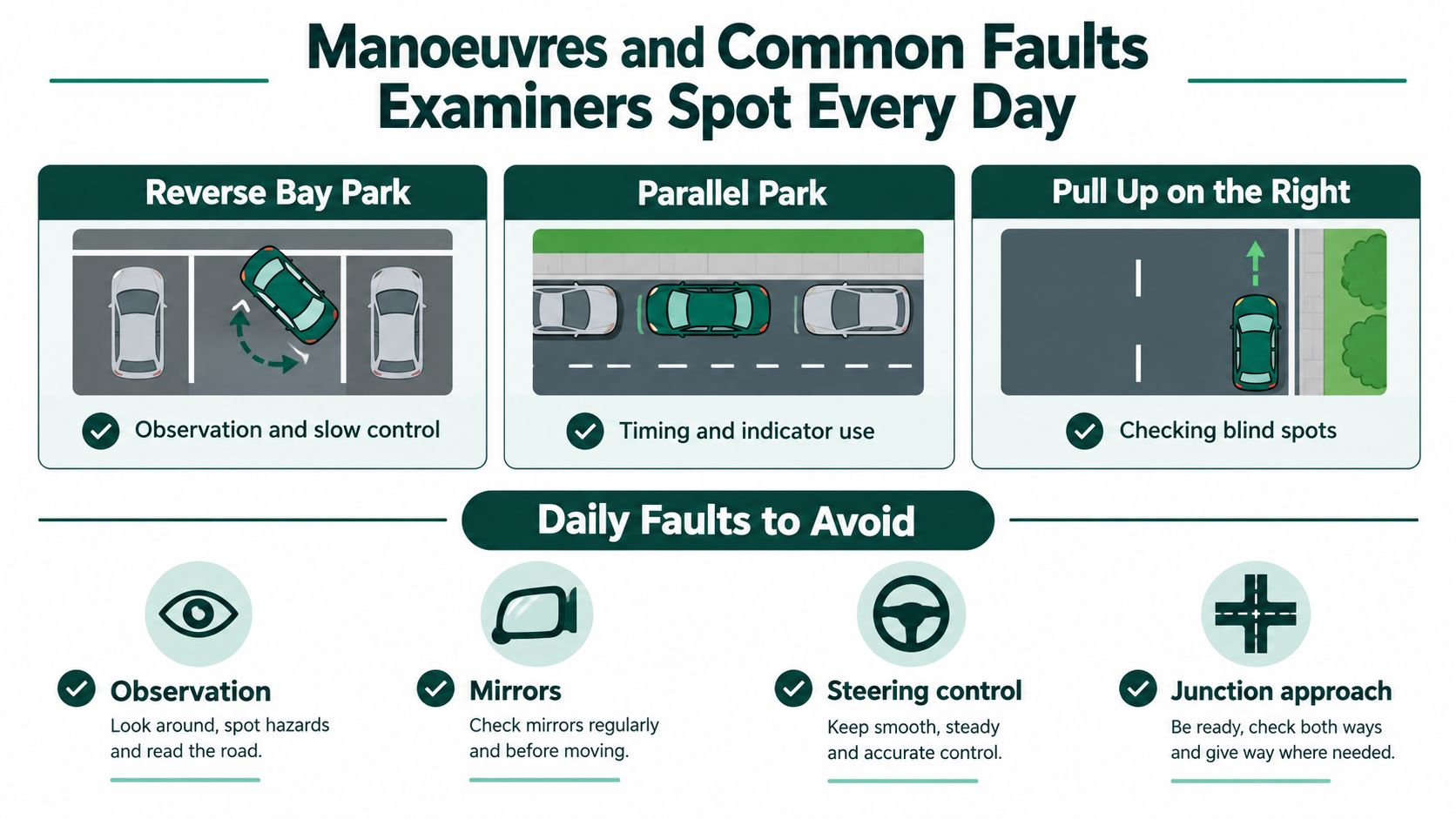
What safe manoeuvre practice looks like
For a reverse bay park, set up with enough space to maintain control, then reverse slowly while checking all relevant areas. Don't stare at one reference point. Move your observation between the direction of travel, mirrors, blind spots and the wider environment.
Forward bay parking tests the same fundamentals with a different entry. Approach at a controlled speed, choose a position that leaves room for steering, and check the bay and surrounding road users before committing. If the car ends up poorly positioned, correct it safely rather than trying to preserve a perfect-looking first attempt.
Pulling up on the right demands particular care because you're crossing the path of traffic. Check the road behind and ahead, choose a safe location and use appropriate observations before moving back. Once stationary, reverse in a straight line while continuing to watch for hazards. The examiner is assessing control and safety, not whether you follow a decorative line on the pavement.
Faults that turn competence into a fail
Some errors arise because learners treat routines as optional when the road looks quiet. Others happen because they focus so intensely on steering that they stop scanning the environment.
| Area | What the examiner needs to see | Practical correction |
|---|---|---|
| Mirrors | Checks before changing speed, direction or position | Build mirror checks into the decision sequence, not as an afterthought |
| Junctions | Appropriate speed, observation and positioning | Reduce speed early enough to assess the full junction |
| Steering | Smooth control without mounting kerbs or drifting | Slow the car and look where you want it to go |
| Signals | Signals that help, rather than confuse, other road users | Signal only when it accurately communicates your intention |
| Manoeuvres | Continuous observation and safe correction | Stop if necessary, reassess and move only when safe |
The examiner isn't looking for a theatrical performance. They're looking for evidence that you can make safe decisions without being prompted.
A repeated routine fault often matters more than one untidy moment. Practise the same skill in different contexts, then ask your instructor to stay quiet for a period so you can prove that the habit works without reminders.
Your Complete Test Day Checklist and Final Preparation
Good test-day preparation removes decisions that don't belong in the drive. The final phase should bring together booking logistics, vehicle readiness, route awareness, theory knowledge and calm execution.
A fortnight before the test, review your instructor's fault pattern rather than attempting to learn everything again. Book or schedule realistic mock practice, check the route area around the centre and decide how you'll maintain readiness if the date is still some way away.
The final preparation routine
Use this sequence as a practical checklist:
- Review the test details: Confirm the date, time, centre and meeting point. Check what documents you need and make sure your provisional licence is available.
- Check the car: The vehicle must meet the test requirements, with suitable visibility, controls and general condition. Ask your instructor to confirm the arrangements rather than relying on assumptions.
- Practise the difficult situations: Prioritise recurring junctions, roundabouts, meeting traffic, independent driving and all manoeuvre categories.
- Protect your concentration: Avoid turning the day before into a marathon lesson. A short, purposeful drive is more useful than arriving mentally exhausted.
- Prepare your route to the centre: Allow enough time for traffic and parking, but don't arrive so early that anxiety has hours to build.
- Pack what you need: Bring your licence, any required glasses and the information you need for the appointment. Keep your phone away once the test begins.
- Plan for a mistake: If you take a wrong turn, miss a direction or feel tense, slow the situation down and continue safely. One error doesn't decide the whole drive.
Your theory preparation should remain active until the practical test. The car theory pass rate fell to 44.8% in 2025–26, compared with 65.4% in 2007–08, according to analysis of DVSA-linked data published by Drivings. That wider result reinforces the value of treating hazard perception and road knowledge as part of practical readiness, not as an exam you can forget immediately afterwards.
On the morning, eat something familiar, avoid experimenting with caffeine and use slow breathing before you set off. During the test, listen to the instruction, create time around hazards and keep your attention on the next safe decision. If the examiner is quiet, that isn't a signal that you're failing. They're allowing you to drive.
The national results show that first-time success is challenging but normal for a well-prepared candidate. You don't need to impress the examiner. You need to demonstrate safe, independent habits for the length of the test.
Fast Track Driving Lessons matches learners with DVSA-approved instructors for intensive and semi-intensive manual or automatic tuition, with mock tests near the chosen centre and practical support for monitoring DVSA test alerts. Visit Fast Track Driving Lessons to compare a structured lesson plan with your availability and prepare for the long wait between booking and test day.
Written by Fast Track editorial team.