
You've just left the test centre after failing your theory test for the third time. The result feels worse than the first two because you've already spent money, time and emotional energy, yet the finish line still seems to move. You may be wondering whether you're not cut out for driving.
You are not facing a three-strikes ban, and three failures don't prove you lack the ability to learn. They do prove that your current preparation method isn't producing a pass. The answer isn't to book another test immediately and repeat the same revision routine. Treat the result as an operational problem, find the weak point, then change the system.
Table of Contents
- Why Three Consecutive Theory Test Failures Happen
- Understanding the DVSA Retake Rules and Hidden Costs
- What National Pass Rates Reveal About Your Preparation
- How to Audit Your DVSA Feedback Letter
- Building a Targeted Revision Plan with the Learner Hub
- When to Seek Professional Theory Training and Tuition
- Your Step-by-Step Recovery Checklist for the Next Attempt
Why Three Consecutive Theory Test Failures Happen
A learner I'd be concerned about isn't the person who fails once. It's the person who fails three times, feels embarrassed, then opens the same app and starts tapping through the same questions again. That approach feels productive because the screen shows activity, but repeated exposure to familiar questions can create recognition without reliable recall.
The learner may remember that an answer “looks right” without understanding why it's right. That distinction matters in the test, where the wording changes and several options can appear plausible. Reading the Highway Code from cover to cover has the same weakness if you never close it and test yourself.
Instructor's view: Three failures usually signal a preparation fault, not an intelligence fault.
The common traps
- Passive revision: Highlighting rules, watching videos and rereading explanations can feel reassuring, but they don't prove you can retrieve the information under pressure.
- Question memorisation: Repeating one bank of questions teaches patterns. It doesn't necessarily teach the rule behind the answer.
- Unreliable resources: Unofficial or outdated apps may use poor wording, old material or explanations that don't match current DVSA expectations.
- Section neglect: A learner can work hard on multiple-choice questions while avoiding hazard perception because it feels less predictable.
- Test anxiety: Some candidates know the material at home but rush, overthink or change correct answers in the test centre.
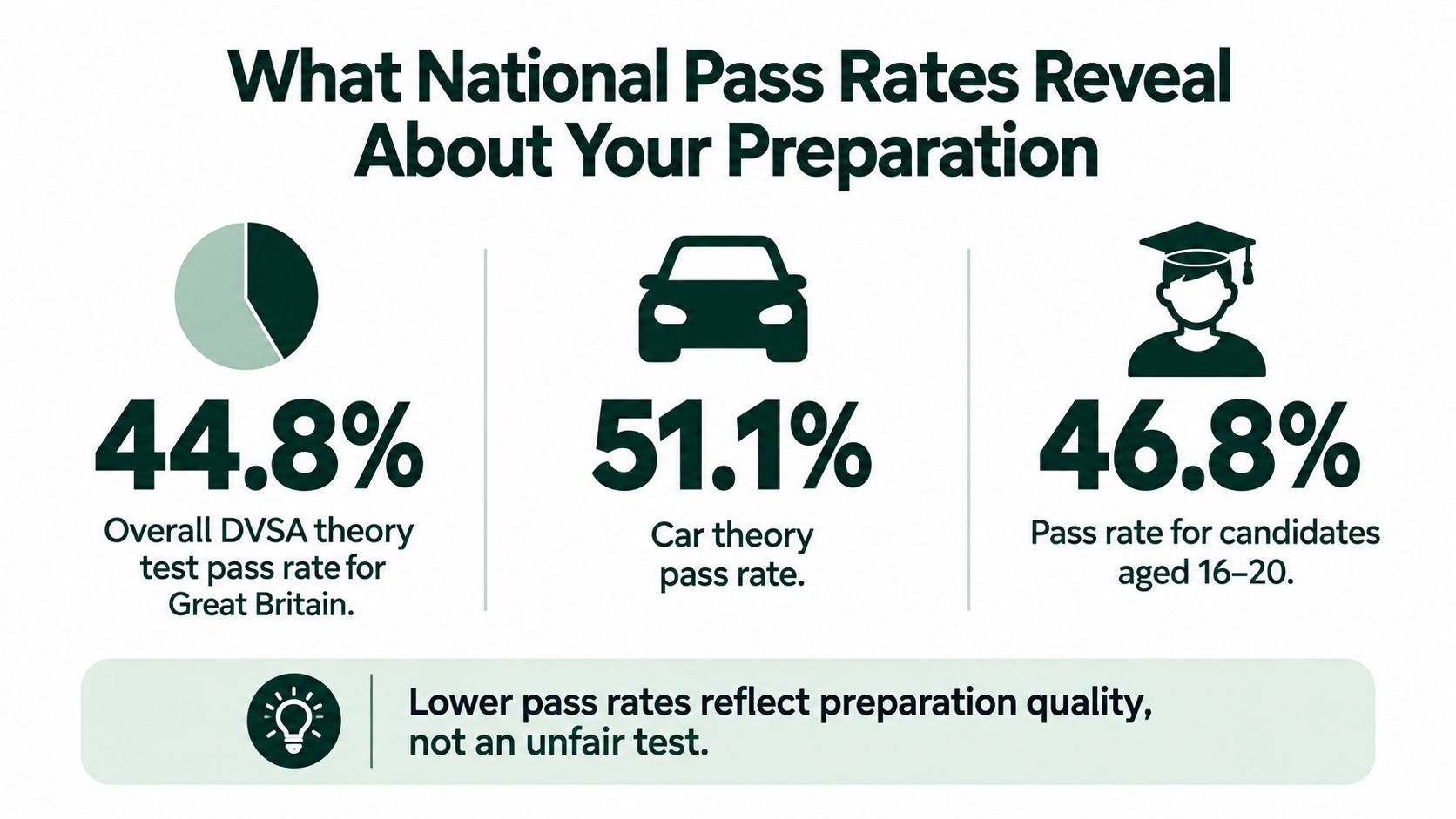
The national result also puts your experience into context. The car theory test pass rate was 44.8% in 2025/26, according to DVSA's official theory-test statistics. Repeated failure is not unusual, but normalising it isn't a strategy.
Stop guessing and start diagnosing
Write down what happened in each attempt while you still remember it. Did you run out of concentration during the multiple-choice section? Did hazard clips catch you by surprise? Were road signs easy but vehicle loading, stopping distances or safety checks weak? Did panic start before the test, or only after a difficult question?
Your next booking should follow evidence, not hope. Three failures mean you need a different method, cleaner feedback analysis and a deliberate plan for both parts of the exam.
Understanding the DVSA Retake Rules and Hidden Costs
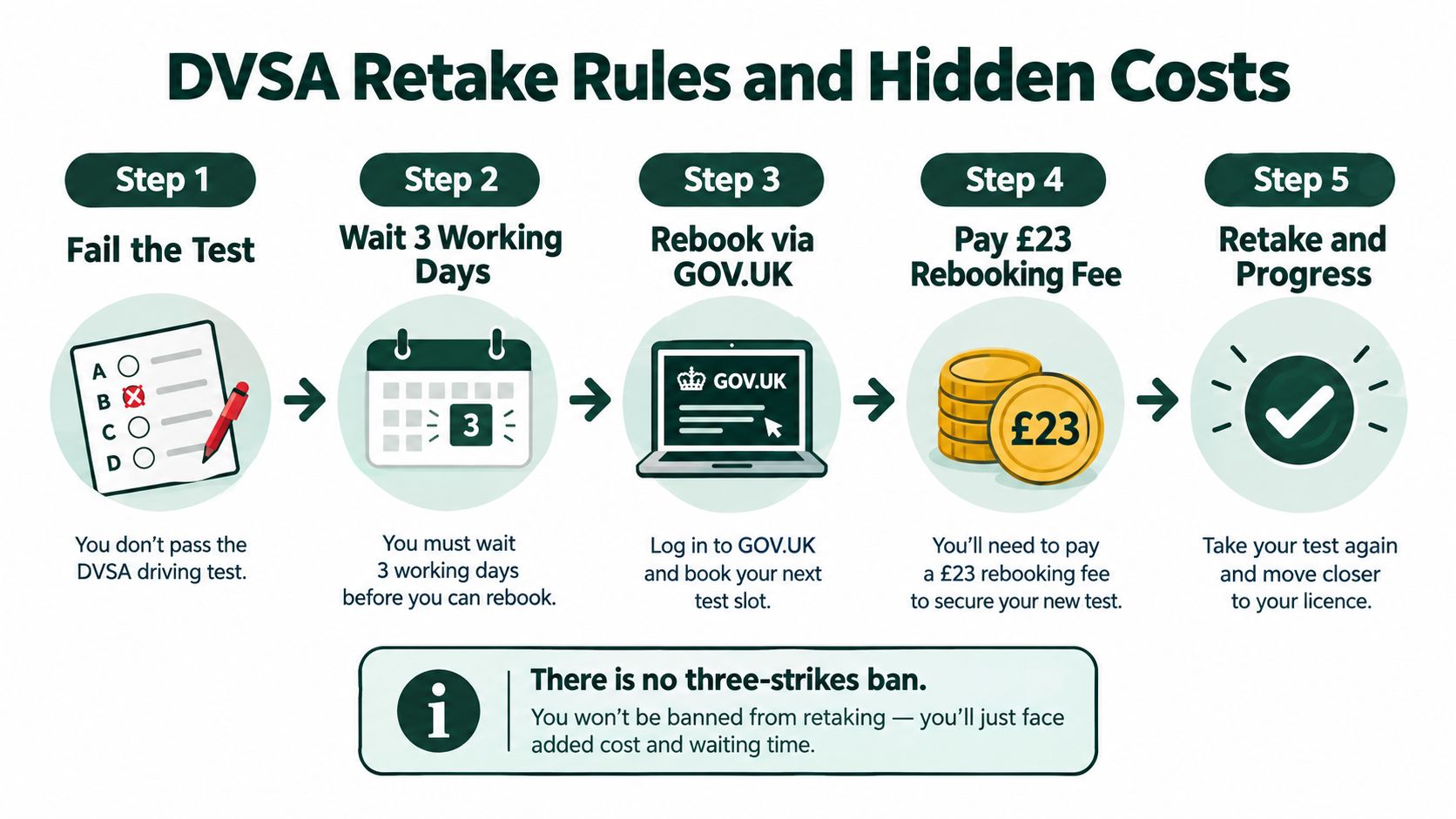
Failing the car theory test doesn't trigger a fixed three-attempt limit. GOV.UK theory-test guidance confirms that you can rebook after a failure, but you must wait at least 3 working days before sitting it again. You also retake the full two-part test. Failing either the multiple-choice section or hazard perception means you don't carry one passed section forward.
The pass thresholds are 43 out of 50 for multiple-choice questions and 44 out of 75 for hazard perception, and both sections must be passed in the same sitting, as set out in the official DVSA data and guidance. That makes a near miss useful only if you use it to identify the precise weakness. It doesn't reduce the work required for the next booking.
The cost of rushing
The theory-test fee is paid again after a failure. At £23 per booking, three failed attempts mean £69 spent on test bookings alone, before travel, time away from work, revision subscriptions or tuition. A fourth attempt adds another £23, so booking before correcting the cause is a poor financial decision.
You also need to account for cancellation rules. DVSA kept theory-test cancellations at 3 full working days' notice in 2025, according to the official pass-mark and result guidance. If your preparation collapses shortly before the appointment, you may have limited flexibility to avoid wasting the booking.
Your pass certificate, once earned, lasts 2 years. That matters because the theory test must come before the practical test for provisional licence holders. A learner who delays practical preparation after passing can face the certificate expiring before the practical test is passed.
Plan the next attempt like this:
- Audit first. Read your result and identify the failed categories.
- Revise the categories. Use official material and targeted practice, not random question tapping.
- Set a readiness threshold. Book only when your scores are stable and you can explain the answers.
- Check the calendar. Leave enough time for the required waiting period and any cancellation restrictions.
- Budget. Keep the next booking fee separate from coaching or study costs.
If you need help maintaining focus during revision, an exam-focused tool such as Ivory Mind exam assistant can sit alongside your driving resources. For the booking mechanics and current fee information, use this UK theory-test booking and fees guide, then confirm the live details on GOV.UK before paying.
What National Pass Rates Reveal About Your Preparation
A failed theory test doesn't automatically mean the test was unfair or that you're bad at driving. It may mean your preparation hasn't matched the demands of the exam. The official figures show why a simple national average isn't enough to explain an individual result.
DVSA's latest full nation breakdown records car theory-test pass rates of around 48.9% in Scotland, 46.0% in England and 42.3% in Wales, with figures published in the official theory-test statistics tables. Those differences don't prove that one area has an easier test. They do show that outcomes vary by location, candidate group and preparation conditions.
Use local data as a prompt, not an excuse
DVSA publishes results by nation and test centre. That gives you a useful comparison point, but don't turn a lower local pass rate into a reason to blame the centre. You still need to separate factors you can control from factors you can't.
Ask yourself:
| Question | What it may reveal |
|---|---|
| Did your feedback show the same categories each time? | A knowledge gap that you haven't addressed |
| Did you pass one section but fail the other? | An imbalance in revision |
| Did your performance drop sharply in the test centre? | Anxiety, timing or concentration problems |
| Are your practice results strong only on familiar questions? | Recognition replacing genuine recall |
| Have you changed resources since the first attempt? | Whether your method has actually evolved |
The latest published data also makes clear that centre-level results are available across reported Great Britain centres. Use that information to understand the local context, but don't chase a supposedly easier location. A different centre won't repair weak hazard perception or uncertain road-rule knowledge.
The useful question isn't “Was my test centre hard?” It's “What evidence says my preparation is ready for any centre?”
If your third attempt produced the same pattern as the first two, you have a repeatable weakness. If the categories changed but the result stayed below the threshold, the bigger problem may be test technique or anxiety. Either way, the next step is an audit, not another blind booking.
How to Audit Your DVSA Feedback Letter
Your result feedback is more valuable than the pass or fail headline. Official guidance says the theory-test result includes feedback on the specific areas that need improvement, so you can target revision before a retake, as explained in the official guidance on taking the theory test.
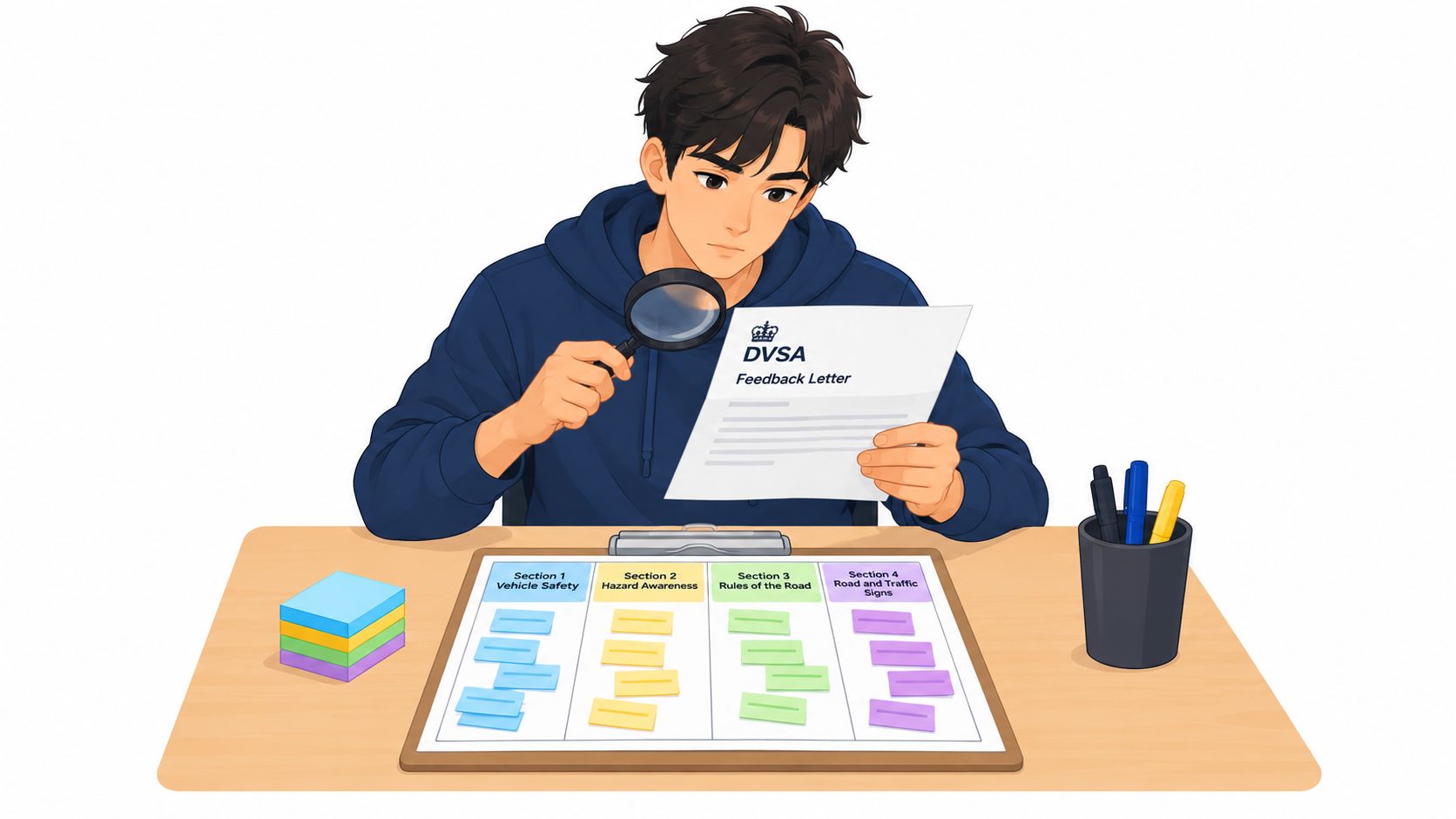
Don't glance at the categories and put the letter away. Turn it into a revision brief that tells you what to study, how to test it and when to revisit it.
Build your weak-topic map
Start by copying every feedback category into a notebook or spreadsheet. Divide the list into multiple-choice knowledge and hazard perception performance, then mark each category as strong, uncertain or weak based on your actual experience.
For multiple-choice topics, connect each weak category to the relevant section of the official Highway Code and your approved learning material. Don't settle for reading the paragraph once. Write a question in your own words, hide the answer and explain the rule aloud.
A road-sign weakness needs a different response from a vehicle-safety weakness. For signs, practise recognition, meaning and the action required. For safety and vehicle topics, explain the reason behind the rule and how it affects a driver in a real situation.
Diagnose hazard perception properly
Hazard perception isn't a test of clicking as quickly as possible. You need to recognise developing hazards and respond at the appropriate point. Clicking repeatedly or randomly can work against you, so use practice clips that teach timing and ask yourself what changed in the scene.
After every clip, record:
- The developing hazard: What changed, and why did it matter?
- Your first recognition: When did you notice the risk?
- Your response: Did you identify it at the developing stage?
- Your timing error: Were you late, too early or clicking without a clear reason?
Then review your next practice result against the same categories. If the feedback repeatedly points to hazard perception, reading more road-sign theory won't solve the problem. If multiple-choice topics remain weak, more clips won't fill the knowledge gap.
For a focused explanation of the result and retake process, use this guide to what happens after failing the theory test. Your aim is to leave the audit with a short hit list, not a vague instruction to “revise everything”.
Building a Targeted Revision Plan with the Learner Hub
Passive reading has reached its limit by the third failure. Your replacement is active recall, deliberate practice and regular testing under conditions that resemble the actual exam.
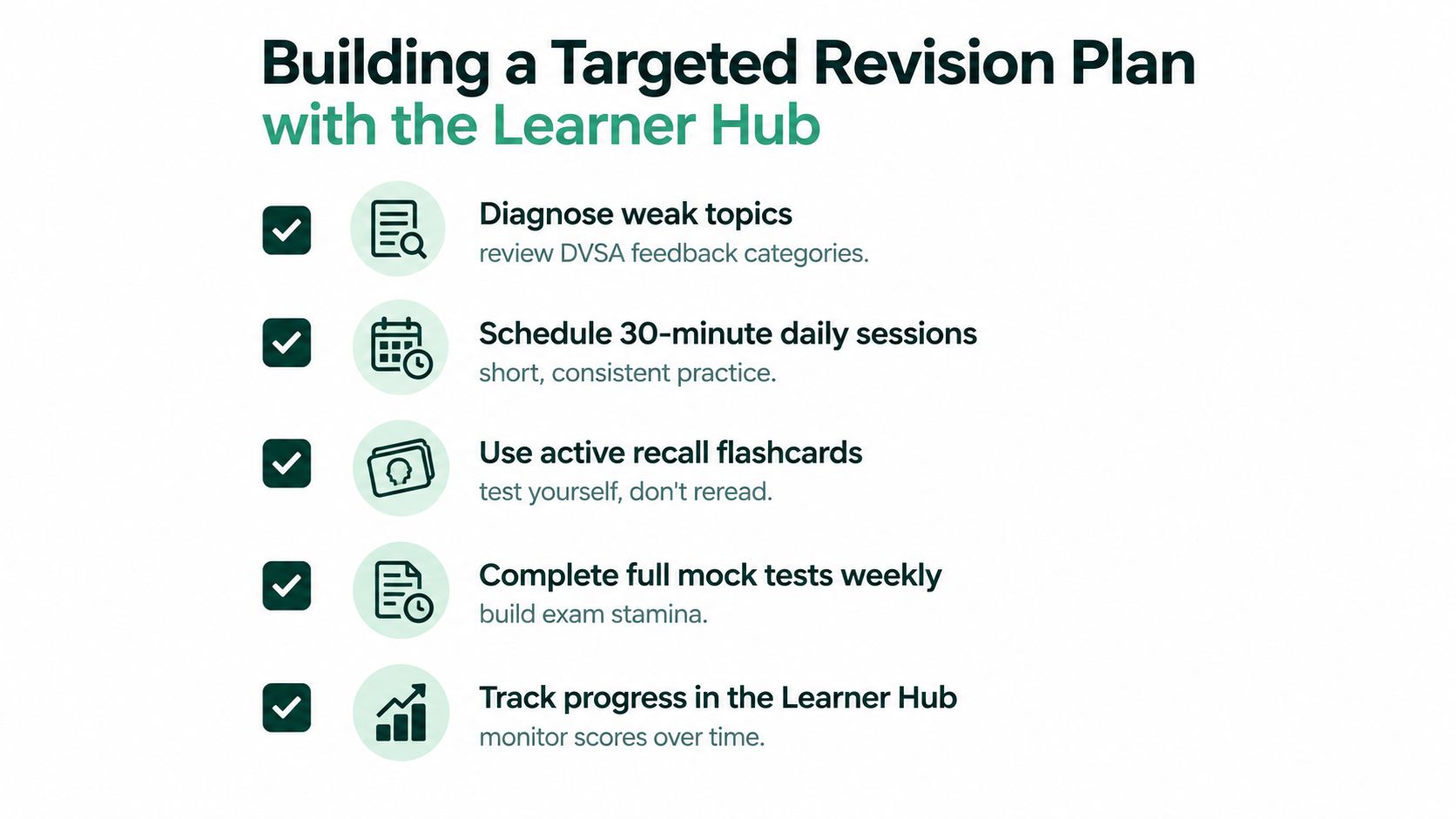
The free Learner Hub from Fast Track Driving Lessons provides DVSA-style theory questions and step-by-step driving guides. Use it as a structured practice environment, not as a button-clicking routine. The useful work happens when you answer before viewing the explanation, justify your choice and record the topic when you get it wrong.
Use a repeatable study cycle
A practical three-to-four-week plan should contain short sessions rather than exhausting cramming. Begin each session by recalling yesterday's rules without opening your notes. Then study one weak category, complete targeted questions and finish by writing down the mistakes that need another look.
| Revision stage | Your task |
|---|---|
| Diagnose | Sort the DVSA feedback into topics and sections |
| Learn | Read the relevant rule and explain it in plain English |
| Retrieve | Answer unfamiliar questions without looking at the explanation |
| Apply | Practise hazard clips and describe developing risks |
| Verify | Complete mocks and review every wrong answer |
Schedule 30-minute daily sessions when possible. One session might focus on signs and markings, another on vulnerable road users, and another on vehicle safety. Keep hazard perception in the routine rather than leaving it until the final days.
Build exam stamina gradually
Use shorter drills early in the plan, then introduce full mock tests weekly. The official car theory test contains a 50-question multiple-choice section and 14 hazard perception clips, according to the official theory-test guidance. Practising only isolated questions doesn't prepare you for maintaining attention across the complete assessment.
Before each mock, remove distractions and use a timer. Afterward, don't only record the score. Review every uncertain answer, including answers you guessed correctly. A lucky correct answer is still a knowledge gap.
Use the Learner Hub to track the topic behind each mistake. If the same category keeps returning, stop taking full mocks and repair that category directly. If your scores are strong in practice but collapse under timed conditions, add breathing control, slower reading and simulated test-centre routines.
The theory-test revision plan can help you organise the work into a clearer sequence. Your booking date should be the result of this evidence. Don't use the appointment to motivate yourself into studying. Study first, then book when the evidence supports it.
The following video can also help you think about the preparation process and how to approach revision with more structure.
When to Seek Professional Theory Training and Tuition
After three failures, paying for another isolated test while refusing targeted help is often false economy. You don't need professional tuition because failing is shameful. You may need it because an outside observer can identify a pattern you can't see, especially when anxiety and repeated disappointment have narrowed your study habits.
Professional theory training should cover the full process, not just a bank of questions. Ask whether the tutor works through both multiple-choice rules and hazard perception, uses mock testing, reviews your feedback categories and adapts the sessions to your actual errors.
Choose support for the problem you have
If your knowledge is weak, you need clear explanations and guided retrieval. If you understand the rules but panic in assessments, you need timed practice, calmer routines and someone who can challenge rushed decisions. If hazard perception is the issue, you need clip-by-clip review rather than more reading.
A DVSA-approved instructor can also connect theory to real driving. Road positioning, observation, speed choice, vulnerable road users and developing hazards become easier to understand when you discuss them during practical lessons. The theory stops being a disconnected quiz and starts describing decisions you'll make on the road.
Consider structured tuition when:
- Your feedback repeats the same categories: You haven't repaired the underlying knowledge gap.
- Your practice scores fluctuate sharply: You need diagnosis, not more random tests.
- You pass at home but fail in the centre: Anxiety or exam technique may be blocking recall.
- You struggle with reading, concentration or processing: Ask for support that matches your learning needs rather than hiding the difficulty.
- You keep postponing revision: External appointments create accountability that an app can't provide.
Don't buy a large package just because you're frustrated. Ask for an initial assessment, a clear learning plan and an explanation of how progress will be measured. A competent instructor should be able to tell you whether your next priority is knowledge, hazard perception, anxiety management or a combination.
Professional help won't remove the need to study. It should stop you spending another booking fee to discover the same weakness.
Your Step-by-Step Recovery Checklist for the Next Attempt
Treat the day after your third failure as the start of a controlled recovery, not a referendum on your future as a driver. You need a sequence that protects your money, uses the feedback and makes the next attempt materially different.
The first stage is emotional and practical
Give yourself a short reset, then write down what happened before memory softens the details. Record the sections that felt difficult, the point when anxiety appeared and whether you rushed or changed answers. Put the next booking fee into your budget, but don't pay it until your revision evidence supports the date.
Keep the result feedback accessible. It is the document that tells you where to begin, so don't replace it with a generic “revise everything” plan.
The audit stage
Create two lists, one for multiple-choice categories and one for hazard perception. Rank each topic by weakness and confidence. Use official material to check the rule, then test recall without looking at the answer.
Your checklist should include:
- Feedback review: Identify every improvement category on the result.
- Topic repair: Study the weakest areas first and explain each rule aloud.
- Hazard review: Practise recognising developing hazards and analyse timing errors.
- Daily practice: Complete focused sessions consistently rather than cramming.
- Mistake tracking: Record why each answer was wrong, not just the correct option.
- Mock testing: Use full simulations to test concentration and timing.
- Readiness check: Book only when results are stable and explanations are reliable.
The final preparation
In the final days, stop chasing obscure questions. Review your mistake log, complete a realistic mock and protect your sleep and travel plan. Confirm the appointment details, arrive early and read each question carefully. You don't gain marks by rushing.
If anxiety rises, slow your breathing and return to the question in front of you. You have already identified the failure points. The fourth attempt should be an assessment of repaired weaknesses, not another experiment.
Your target isn't confidence before revision. Your target is evidence that you can perform despite nerves.
You don't need to feel certain every second. You do need to know why your answers are correct, recognise developing hazards and trust a preparation process that has changed since the third attempt.
Fast Track Driving Lessons offers a free Learner Hub with DVSA-style theory practice, step-by-step driving guides and access to DVSA-approved instructor support for learners who need structured tuition. Visit Fast Track Driving Lessons to review the theory resources, find suitable training and build a more controlled plan for your next attempt.
Written by Fast Track editorial team.