
The short version
- Check which part you failed: multiple choice, hazard perception, or both.
- Do not rebook for the earliest slot unless your practice scores are already safe.
- Use official-style questions, but learn the reason behind each answer.
- Practise hazard clips daily and click once for the developing hazard, not repeatedly.
- Keep driving lessons going so road signs, rules and hazards make sense in real traffic.
First, do not turn one fail into a bigger problem
Failing the theory test is frustrating, but it is common enough that instructors deal with it every week. What matters now is not the word “failed”; it is the score sheet. The theory test is two separate parts: the multiple-choice questions and the hazard perception test. For a car theory test, the usual pass marks are 43 out of 50 for multiple choice and 44 out of 75 for hazard perception. You must pass both parts in the same sitting.
The first thing I ask a pupil is, “Which bit failed, and by how much?” A learner who scores 42 on multiple choice needs a different plan from someone who scores 28 on hazard perception. Do not guess. Look at the categories on your result and use them to guide your next week of revision.
You can usually book another theory test after a minimum waiting period of 3 working days. The car theory test fee was £23 at the time of writing, but fees can change, so check GOV.UK when you book. Only use the official GOV.UK booking service; third-party sites can charge extra for doing the same booking.
Read your result properly
The result is not there to embarrass you; it is your lesson plan. In my experience, learners often walk out saying, “I only just failed,” but then cannot tell me whether they lost marks on road signs, attitude, vulnerable road users or alertness. That is like failing a mock driving test and ignoring whether it was observations, junctions or speed control.
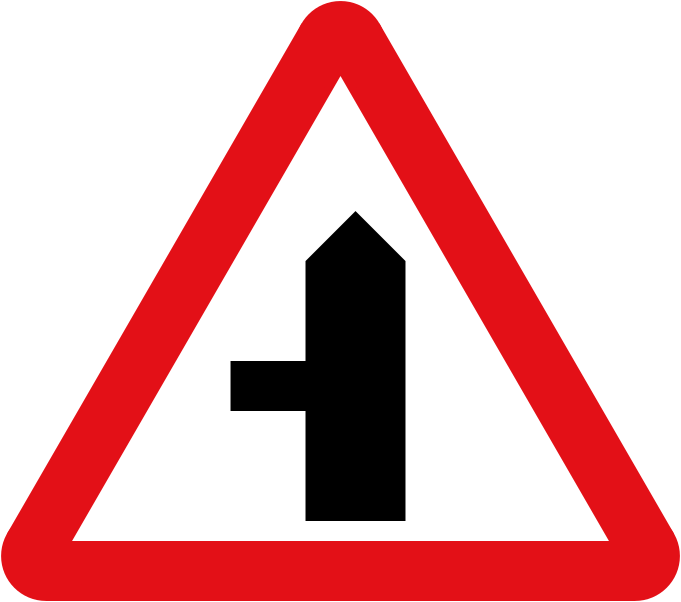
For multiple choice, identify the topic areas where you dropped marks. For hazard perception, think about whether you clicked too late, clicked too often, or did not recognise the developing hazard early enough. A developing hazard is something that would make you change speed or direction, such as a pedestrian stepping towards the road, a car emerging from a side road, or a cyclist moving out around a parked vehicle.
- If you failed multiple choice by a few marks, target weak topics rather than reading everything from page one.
- If you failed hazard perception, practise timing and scanning, not memorising clips.
- If you failed both parts, split revision into short blocks so you do not rush one section.
- If you passed one part comfortably, keep it ticking over, but put most time into the failed part.
Do not just memorise answers
Question banks are useful, but memorising answer patterns is a weak strategy. The real test questions may be worded differently, and the point of the test is whether you understand safe driving, not whether you recognise a sentence. The learners I see struggle most are the ones who can answer app questions at home but cannot explain the rule in the car.
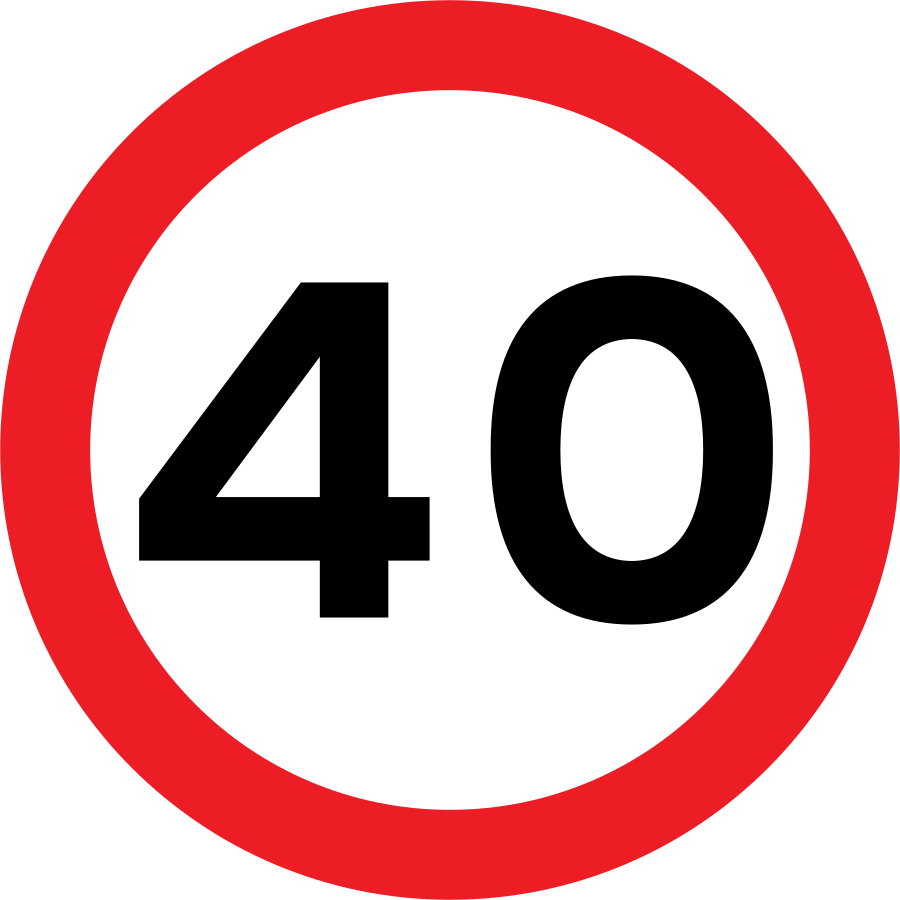
For example, it is not enough to know that stopping distances increase in the wet. You need to understand that the Highway Code says stopping distances will be at least double on wet roads, and much greater on icy roads. That matters when you are driving at 40 mph behind traffic on a damp dual carriageway, not just when you are choosing an answer on a screen.
This is where lessons help. In the car, I will ask a learner, “What sign did we just pass?” or “Why am I holding back from that cyclist?” Not to catch them out, but to connect theory with what is happening through the windscreen. That connection makes the next test easier because the rules become real.
A 7-day retake plan that actually works
You do not need to spend five hours a night revising. Most learners do better with short, focused sessions, especially if they have school, work or lessons. The aim is to build reliable scores before you rebook, not to panic-revise the evening before.
Use official DVSA materials or a reputable theory app with up-to-date Highway Code content. Fast Track Driving Lessons also provides free theory test practice at /theory, which is useful for checking your level and spotting weak areas.
- 1Day 1: Read your score sheet and write down the weak categories. Do one untimed multiple-choice session so you can think properly.
- 2Day 2: Revise road signs and vulnerable road users. These come up constantly in real driving, especially around schools, buses, cyclists and pedestrian crossings.
- 3Day 3: Practise hazard perception clips. Watch the whole road scene, not just the vehicle in front. Click when the hazard starts to develop, not when it is already obvious.
- 4Day 4: Do a timed multiple-choice mock test. Review every wrong answer and write the reason in one sentence.
- 5Day 5: Ask your instructor to include theory questions during the lesson: speed limits, lane choice, signs, crossings and meeting traffic.
- 6Day 6: Do another full mock test and a set of hazard clips. You want scores comfortably above the pass marks, not scraping by.
- 7Day 7: If your scores are stable, book your retake through GOV.UK. If they are not, wait a few more days and fix the weak area first.
How to fix hazard perception
Hazard perception is where I see the most confusion. Learners often think they must click on everything that moves. That can lead to a zero score on a clip if the system detects an unacceptable clicking pattern. You are not being tested on nervous clicking; you are being tested on spotting a developing hazard early.
In a lesson, I drill this by asking the pupil to say what they can see: “parked cars on the left, child near the kerb, van waiting to emerge, cyclist ahead.” Then I ask, “Which one is developing?” If the child is simply standing still, that is a potential hazard. If the child starts moving towards the road, it becomes a developing hazard. That is the moment your click should happen in the test.
What does not matter is knowing the exact location of a hazard from a practice clip. The live test uses a range of clips, including one CGI clip, and you cannot rely on memory. What matters is scanning early, looking well ahead, and recognising when another road user may force you to slow, stop or steer.
- Click once when you first see the hazard developing.
- You can click again if the situation develops further, but do not machine-gun the mouse.
- Look for pedestrians, cyclists, animals, vehicles emerging, brake lights, and vehicles changing position.
- Practise when calm. Tired, rushed hazard practice often teaches bad clicking habits.
Should you keep driving lessons before the retake?
Usually, yes. If you have already started driving, stopping lessons until the theory is passed can slow everything down. The practical test cannot be taken until the theory test is passed, but your driving lessons can continue, and they often make the theory easier to understand.
For intensive learners, timing matters. Fast Track Driving Lessons offers courses from 10 to 40 hours at £61.23 per hour, and the best course length depends on your current standard, not just whether you have a theory pass. If you have failed the theory test, tell the office and your instructor so the course plan is realistic.
In the car, a good instructor will not turn the lesson into a classroom lecture. We might spend thirty seconds at a parked position discussing a sign, or use the last five minutes to review pedestrian crossings, speed limits and hazard planning. That is enough to make theory stick without wasting paid driving time.
When to rebook, and what to take with you
Book the retake when your practice results are consistently above the pass marks. I like to see a learner getting at least mid-to-high 40s on multiple choice mocks and comfortable hazard scores before spending another test fee. Passing one lucky mock is not enough evidence.
You must take your UK photocard driving licence to the test centre. If you do not take the correct licence, you will not be allowed to sit the test and you normally will not get your fee back. Arrive in good time, follow the staff instructions, and do not take revision notes into the test room.
If you pass, your theory test pass certificate is valid for 2 years. You must pass your practical driving test within that time, otherwise you will need to pass the theory test again. If you fail again, it is not the end of the road, but it is a sign to change the method rather than simply do more of the same.
Common questions
How soon can I retake the theory test after failing?
You can usually retake it after at least 3 working days. Availability depends on local test centres, so check GOV.UK for live dates. Do not book the earliest slot if your practice scores are still weak.
Do I have to pass both parts again if I only failed one?
Yes. The multiple-choice section and hazard perception section must be passed in the same test appointment. If you fail either part, you need to retake the whole theory test.
What is the pass mark for the car theory test?
For the car theory test, the pass mark is 43 out of 50 for multiple choice and 44 out of 75 for hazard perception. These are DVSA pass marks, but always check GOV.UK for current test information before booking.
Can I take driving lessons if I have not passed my theory test?
Yes. You can take lessons with a provisional licence before passing the theory test, provided you meet the legal requirements for learning to drive. You cannot book or take the practical driving test until the theory test is passed.
Why did I get zero on a hazard perception clip?
A zero can happen if you do not click in the scoring window, or if the system detects an unacceptable clicking pattern. The usual fix is to click when the hazard develops, then possibly once more if it continues to develop, rather than clicking repeatedly at everything.
Does the theory test include questions about the Show Me, Tell Me practical test?
Not in the same format. The theory test checks your knowledge of rules, signs, safety, attitude and hazard awareness. The Show Me, Tell Me questions are part of the practical driving test and are prepared separately.
Practise theory free
Reading about it only gets you so far. Our instructors drill this with you in the car, on the roads around your test centre.