
A UK car driving theory test pass certificate is valid for exactly two years from the day you pass the exam, not from the day you book your practical test. If you haven't passed the practical test by the expiry date, you'll have to take the theory test again.
You may have passed your theory test, started lessons and finally found an intensive course that fits your diary. Then you discover that the practical test you need isn't available when you need it. That situation is frustrating, but the answer isn't to hope the expiry rule changes. Your theory pass has a fixed deadline, so your lessons, test booking and preparation must work backwards from that date.
Table of Contents
- The Exact Validity Period for UK Car Theory Tests
- Why the Two-Year Rule Exists and Cannot Be Extended
- Theory Test Validity Across Different Vehicle Categories
- Aligning Intensive Driving Courses with Theory Expiry
- What to Do If Your Theory Certificate Lapses
- Common Questions About Theory Test Expiry Dates
The Exact Validity Period for UK Car Theory Tests
Pass the car theory test today and your certificate is valid for exactly two years from the date you pass. The clock starts on the day you receive the pass result, not when you book lessons, start practical tuition or reserve a driving test. GOV.UK guidance confirms the two-year validity rule.
This start date controls your whole plan. If you pass early, then spend months arranging lessons or waiting for a suitable practical appointment, that lost time still counts. Booking a practical test does not pause the clock, and changing the appointment does not reset the certificate.
Practical rule: Record the theory pass date in your calendar immediately. Set another reminder well before the same date two years later.
Your theory certificate must remain valid on the day you pass the practical driving test. If it expires first, it no longer supports that test, even if you have completed extensive tuition or already hold an appointment. You must pass another theory test before completing the licensing process.
The rule applies to every learner who passes the car theory test from age 17 onward. The validity period begins as soon as an eligible learner passes, not when they first take a driving lesson or sit behind the wheel.
Treat the expiry date as a firm deadline. Check practical test availability before committing to an intensive course, and schedule concentrated lessons early enough to leave time for the test itself. Aim to pass comfortably before the certificate expires, with room for a failed attempt, a cancelled appointment or a shortage of suitable dates. This approach aligns your course with the two-year window instead of risking money and preparation on a theory pass that runs out first.
Why the Two-Year Rule Exists and Cannot Be Extended
The two-year limit isn't presented as a casual recommendation. UK government material links the validity period to keeping hazard-perception and road-safety knowledge current, which is the strongest reason not to treat an old theory pass as permanently useful. The practical test assesses your driving, but the theory pass confirms that your underpinning knowledge remains current enough for the licensing process.
That reasoning matters when practical test availability is poor. Learners understandably ask why the government can't add an extension when they have already paid for lessons and are waiting for a suitable appointment. The difficulty is that an extension would weaken a fixed standard designed around the currency of safety knowledge, rather than correcting an appointment problem.
A ministerial response reported that the period is fixed in legislation and that there was no current plan to extend it. The government consultation material explains the fixed validity framework and the absence of a planned extension.
What that means for your planning
You can't build your plan around a future concession. Instead, use the expiry date to decide when to book the practical test and when to begin concentrated tuition.
Good theory preparation still matters because a pass obtained too early can leave a long period before you're ready to drive independently. Use reliable revision resources, practise hazard perception properly and make sure you understand the rules rather than memorising answers. These theory revision tools can support that preparation.
The practical response is straightforward:
- Book early: Start looking for a practical appointment while your training plan is still flexible.
- Allow breathing space: Don't schedule your first serious practical attempt on the final part of the validity window.
- Monitor availability: Check official availability and legitimate cancellation services instead of waiting passively.
- Keep learning current: Continue revising road signs, priorities and hazard awareness while taking practical lessons.
An extension would be useful to many learners, but you can't plan around one. The legislation and current government position give you one workable approach: pass the practical test before the certificate expires.
Theory Test Validity Across Different Vehicle Categories
The familiar two-year rule relates most directly to the standard car theory test, but you shouldn't assume that every driving category follows exactly the same progression requirements. Motorcycle upgrades, lorry and bus routes, and Approved Driving Instructor qualifications can involve additional conditions even where the two-year framework appears.
| Vehicle Category | Standard Validity | Specific Conditions |
|---|---|---|
| Car | Two years from the pass date | The practical car test must be passed before the certificate expires. |
| Motorcycle | Two-year framework often applies | An upgrade or category change can involve separate progression requirements. |
| Lorry | Two-year framework often applies | Driver Certificate of Professional Competence, or CPC, modules may create additional conditions. |
| Bus | Two-year framework often applies | CPC and category-specific progression rules can apply alongside the theory pass. |
| ADI Part 1 | Two-year framework | Further qualification stages and progression limits affect how the pass can be used. |
The table gives you the useful baseline, not a substitute for checking the route that applies to you. A car learner usually needs to focus on one theory pass and one practical test. A career changer working towards lorry, bus or instructor qualifications may need to coordinate several requirements, and the theory pass may not be the only deadline that matters.
Don't transfer car rules blindly
A motorcycle learner moving through an upgrade route should check whether the existing licence category changes the tests required. Someone pursuing lorry or bus entitlement should look at CPC obligations as well as the practical test. An aspiring instructor must consider ADI Part 1 alongside the later stages of the qualification.
Specialist guidance on theory test expiry highlights why category-specific checking matters. The two-year baseline is common, but the conditions attached to using the pass can differ.
The safest approach is to identify your exact licence category before booking. Check the relevant GOV.UK route, confirm which theory certificate you need and record every associated deadline. If you're switching from car learning to a vocational route, don't assume your existing certificate automatically carries across. Category rules can make that assumption expensive.
Aligning Intensive Driving Courses with Theory Expiry
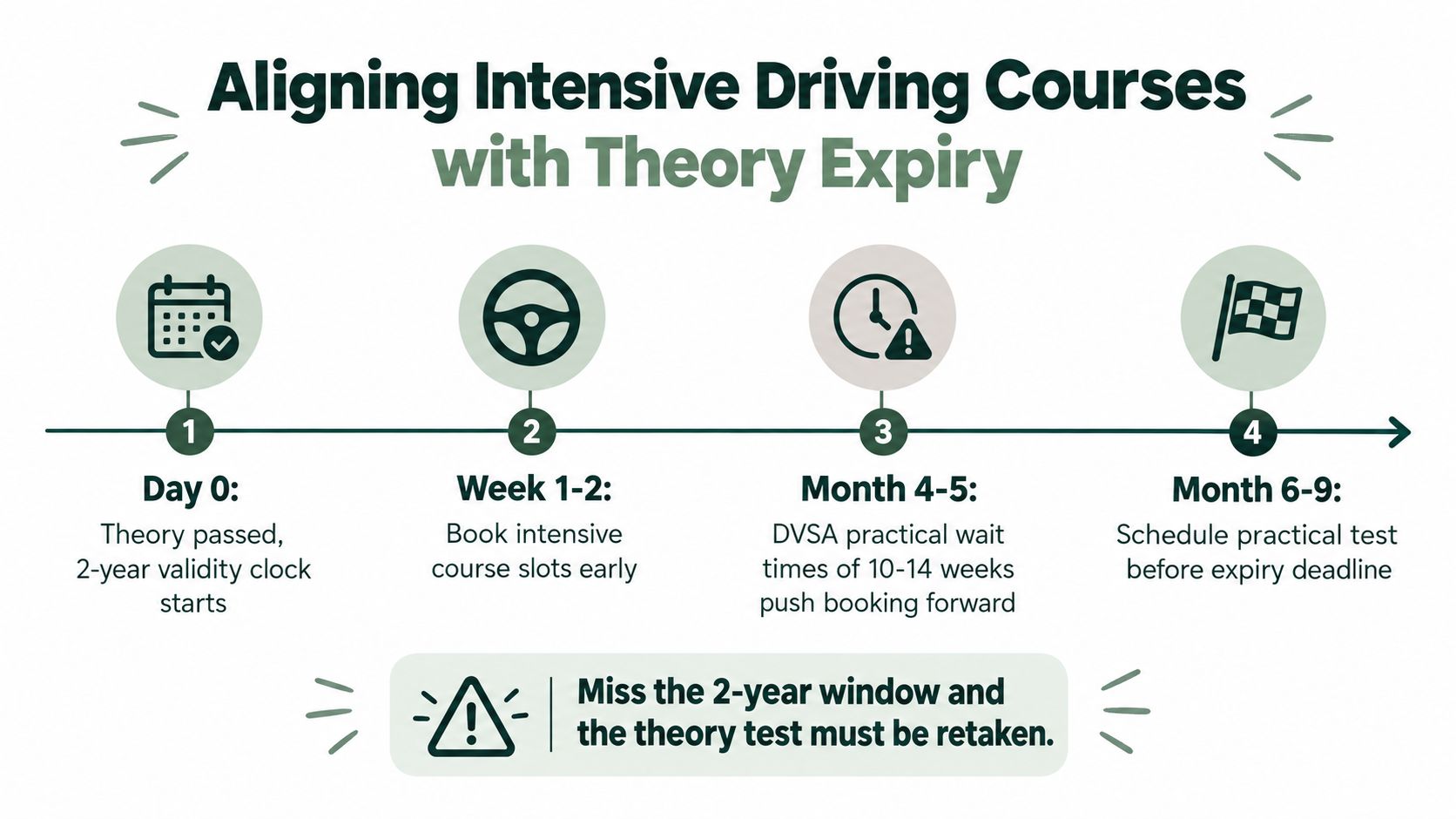
An intensive course only works if the practical test plan is realistic. Concentrating lessons into a short period can build consistency, but it can't remove the need to find a suitable DVSA appointment. If you book tuition first and think about the test afterwards, you may finish your course without a date that fits your theory certificate.
Start with your theory pass date and work backwards. Your plan should include the course itself, route practice, manoeuvres, mock tests and enough time to respond if your first appointment is cancelled or you aren't ready on the day.
Build the course around the appointment
Fast Track Driving Lessons offers intensive and semi-intensive courses from 10 to 40 hours, with plans that can be arranged around manual or automatic tuition. The right choice depends on your current standard, not on a tempting promise of speed. A complete beginner needs a different structure from a learner who only needs polishing before a test.
Use this sequence:
- Confirm the expiry date: Record the exact theory pass date and the final valid date.
- Check local availability: Look at the test centre you intend to use and nearby centres where a suitable appointment may be available.
- Reserve lesson capacity: Arrange enough consecutive or semi-intensive slots for learning, practice and assessment.
- Book or monitor the practical test: Don't wait until the course is complete if appointments are already scarce.
- Use mock tests before committing: Your instructor should assess independent driving, manoeuvres, meeting situations and examiner-marked faults.
- Keep a contingency: Leave time for extra lessons or a replacement appointment before the theory deadline.
This comparison of intensive and weekly lessons can help you decide whether concentrated tuition suits your availability and starting point.
Instructor's advice: An intensive course should compress learning, not compress judgement. If your instructor says you aren't ready, changing the booking is safer than forcing a test because the date is inconvenient.
Cancellation monitoring can help when the original appointment is too far away. A legitimate alert service may notify you when earlier dates appear, but you still need to check that the new appointment works with your lessons, vehicle and instructor. Never assume that finding an earlier slot automatically means you're test-ready.
The key decision is timing. Begin serious practical planning early enough that a booking delay doesn't consume the useful part of your certificate. Your instructor can then adjust the course around a real test date rather than trying to guess when one might appear.
What to Do If Your Theory Certificate Lapses
If the certificate expires before you pass the practical test, the old pass can't be revived. You must take and pass a new theory test before completing the practical test route. There isn't a routine grace period just because you had already booked lessons or held a practical appointment.
Take these steps:
- Check the dates: Confirm that the theory certificate has expired or identify how close the deadline is.
- Book a new theory test: Arrange a fresh examination through the official booking route and pay the applicable test fee.
- Revise the weak areas: Review missed question topics, road signs and hazard perception rather than repeating practice questions mechanically.
- Tell your instructor: Explain the new position so your practical lessons can be adjusted around the retake.
- Protect your driving standard: Keep some targeted tuition in place if a long gap would affect your independent driving, manoeuvres or local-route familiarity.
A retake doesn't erase the practical skill you've developed, but an interruption can damage your rhythm. If you're already close to practical standard, a small amount of semi-intensive refresher tuition may be more sensible than stopping completely while you prepare for the theory exam.
This guidance on failing the theory test can help you organise revision after an unsuccessful attempt. Focus on understanding the reason for each error, then return to practical training once your theory preparation is under control.
Don't book another practical test until the replacement theory pass is secure and you have checked the new validity date. The previous certificate's deadline doesn't move, but a new pass creates a new period for the next stage. Write that new date down immediately and rebuild your practical plan around it.
Common Questions About Theory Test Expiry Dates
Does booking the practical test stop the clock?
No. The validity period continues from the original theory pass date. Booking a practical test doesn't extend, freeze or reset the certificate, and moving the appointment doesn't change the expiry date.
What if the DVSA cancels my practical test?
Contact the DVSA and follow its instructions, keeping records of the cancellation and any replacement arrangements. Don't assume that a cancellation automatically extends your theory certificate. The validity rule remains a fixed deadline, so contact the relevant official service promptly if a cancellation leaves you close to expiry.
Can I book a practical test close to expiry?
You may be able to book one while the certificate is valid, but the important outcome is passing the practical test before the theory pass expires. A booking alone isn't enough protection. Choose an appointment with enough time for sensible preparation and unexpected disruption.
Do I need the physical certificate?
The pass certificate number is used as part of the practical test booking process, and the number itself is only valid for the same two-year period. Learner guidance explains that the certificate number expires with the theory pass.
What should I do if my date is unclear?
Check your theory result and official booking records rather than relying on memory. The relevant date is the day you passed, not the day you received a lesson package, started driving or booked the practical test.
A learner who records the date early has control over the situation. A learner who waits until the final weeks is dependent on availability, cancellations and luck. Treat the date as part of your training plan from the moment you pass.
Fast Track Driving Lessons can match you with a DVSA-approved instructor for manual or automatic intensive and semi-intensive tuition, with practical test support and local mock-test preparation. Visit Fast Track Driving Lessons to plan your lessons around your theory expiry date and find a route towards the practical test before the deadline.
Written by Fast Track editorial team.