
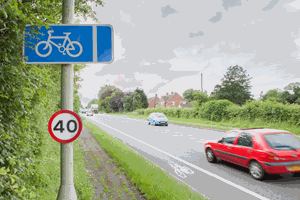
The answer options
- They may park in the lane
- They may drive in the lane at any time
- They must not drive along the laneCorrect
- They may use the lane whenever they want
Why the other options are wrong
- “They may park in the lane” is a distractor. It does not meet the standard the question is testing, which they must not drive along the lane does. Picking it in the real test costs a mark you cannot get back, and with a pass mark of 43 out of 50 you only have seven to spare.
- “They may drive in the lane at any time” is a distractor. It does not meet the standard the question is testing, which they must not drive along the lane does. Picking it in the real test costs a mark you cannot get back, and with a pass mark of 43 out of 50 you only have seven to spare.
- “They may use the lane whenever they want” is a distractor. It does not meet the standard the question is testing, which they must not drive along the lane does. Picking it in the real test costs a mark you cannot get back, and with a pass mark of 43 out of 50 you only have seven to spare.
Why that is the answer
A solid white line marks a mandatory cycle lane. Under the Highway Code, motorists must not drive or park in this lane during its operational hours. This provides cyclists with a safe, protected space on the road. Do not confuse this with a cycle lane bounded by a broken white line, which drivers should not enter unless it is unavoidable. With a solid line, entry is strictly prohibited.
What rules of the road covers
- · National speed limits for cars, cars towing, and built-up areas
- · Priority at crossroads, roundabouts and unmarked junctions
- · Where waiting, loading and stopping are prohibited
- · One-way streets, bus lanes and contraflow systems
Mistakes learners repeat on this topic
- · Assuming street lighting always means 30mph without checking for repeater signs
- · Forgetting the reduced limits when towing on dual carriageways and motorways
- · Believing a roundabout always gives priority to the right regardless of markings
- · Parking within 10 metres of a junction because there were no yellow lines
Instructor tip: When a limit question names a vehicle type, answer for that vehicle — the trap is applying the car limit to everything.
How this comes up in the real test
Questions from rules of the road appear throughout the 50-question multiple-choice section, and the wording changes between versions. Learn the rule rather than the sentence: the DVSA can ask the same point from the opposite direction, and a memorised answer falls over the moment the phrasing moves.
The pass mark is 43 out of 50, so seven wrong answers is your entire margin. If a whole category is shaky, run the topic practice below until you are getting every question right for the right reason, then go back to full mocks under the clock.
More rules of the road questions
- A single carriageway road has this sign. What’s the maximum permitted speed for a car towing a trailer?
- At a roundabout, how should you signal that you're going straight ahead?
- At an un-marked crossroads, who has priority?
- How else can you indicate to other drivers besides using direction indicators?
- How far are you allowed to reverse?
- How should you park at night on a road with a 40mph speed limit?