
The short version
- Leave at least 1.5 metres when overtaking cyclists at up to 30mph.
- If you cannot pass with proper clearance, wait behind until it is safe.
- Do not cut across cyclists when turning left or changing lane.
- Expect cyclists to move out for potholes, drains, parked cars and side winds.
- On test, a close pass or poorly timed overtake can become a serious fault.
Driving around cyclists safely: the short answer
To drive around cyclists safely, you must give them enough space, reduce speed where needed, and only overtake when you can move out and pass as if you were overtaking a small vehicle. The key point for learners is this: a cyclist is not an obstacle to nip round. They are a road user who may wobble, move out, slow suddenly or need extra room because the road surface near the kerb is poor.
The Highway Code places drivers of larger or faster vehicles under greater responsibility to reduce danger to more vulnerable road users. That is the Hierarchy of Road Users in Rule H1. Rule 211 also tells drivers to look out for cyclists and give them plenty of room, especially children, older riders and those who may be unsteady. This is exactly what examiners want to see: early mirrors, sensible speed, good position and a decision that does not pressure the cyclist.
This is general guidance, not legal advice. The Highway Code can be updated, and police or courts decide individual cases. For learner drivers, the practical skill is simple but not always easy: spot the cyclist early, ask whether there is a safe legal gap, and be prepared to wait without creeping too close.
How much room should you leave when overtaking cyclists?
Highway Code Rule 163 gives the clearest everyday rule. When overtaking cyclists at speeds of up to 30mph, leave at least 1.5 metres. At higher speeds, give more space. The wording matters because learners often think a painted centre line decides whether they can go. It does not. The question is whether you can pass with enough lateral clearance and without forcing the cyclist to alter course.
In the passenger seat, I often see a learner do the right mirror check, signal, move a little, then pass with only half a lane of space because an oncoming car appears. That is the classic close-pass fault. The safe answer is to hold back before you commit, not to squeeze through once you have started. If the road is not wide enough, treat it like overtaking a slow car: stay back, match the cyclist's speed and wait.
Do not rely on a quick flick round the cyclist. Your car's left mirror, door mirror housing and rear wheel still need clearance, and the cyclist may drift slightly as you pass. Wind from larger vehicles can unsettle cyclists too. Even in a small training car, I teach learners to think of an invisible safety bubble around the rider rather than aiming for the smallest gap they can get away with.
- Minimum at up to 30mph: at least 1.5 metres, according to Highway Code Rule 163.
- Higher speeds: give more space than 1.5 metres and reduce speed if the road is narrow.
- If there is oncoming traffic and you cannot keep the gap, wait behind.
- Move out early and smoothly, rather than swerving late around the cyclist.
- Do not pull back in until the cyclist is clearly behind in your mirrors.
When you should not overtake a cyclist
The safest pass is sometimes no pass at all. Learners lose marks when they become impatient behind a cyclist and overtake near a traffic island, pinch point, parked vehicles, bend, brow of a hill or junction. Rule 167 warns against overtaking where you might come into conflict with other road users, including near junctions, bends and places where the road narrows. With cyclists, those situations close down quickly.
I teach pupils to ask one question: where will I be if something appears? If the answer is alongside the cyclist with nowhere to go, you should not start the overtake. A pedestrian refuge is a common example. The road looks wide for a moment, the learner accelerates, then the island arrives and the cyclist is squeezed. Examiners see that as poor planning, not bad luck.
Holding back does not mean sitting on the cyclist's back wheel. Stay far enough away to see the road ahead and to avoid making the rider feel bullied. If you are in a 20mph street and the cyclist is doing 15 to 18mph, the time saved by forcing a pass is tiny, but the risk and test consequences are large.
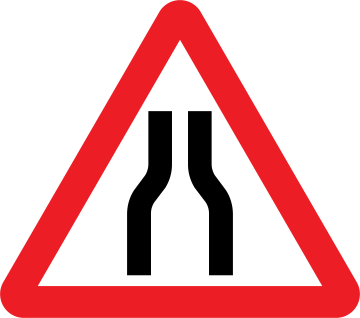
- Do not overtake on the approach to a central island or road narrowing.
- Do not overtake if you would need to cross solid white lines, unless a specific legal exception applies and it is safe.
- Do not overtake just before turning left, as you may cut across the cyclist.
- Do not overtake where parked cars leave no escape room for the rider.
- Do not overtake if an oncoming vehicle would make you pull in early.
Cyclists at junctions, left turns and roundabouts
Junctions are where many serious learner mistakes happen. Highway Code Rule H3 says drivers should not cut across cyclists, horse riders or horse-drawn vehicles going ahead when you are turning into or out of a junction, changing direction or lane, or entering or leaving a roundabout. If a cyclist is on your left and you want to turn left, slow down and let them clear the junction first.
The fault I see most often is a learner checking the left mirror too late. They signal left, slow down, then suddenly discover a cyclist in the nearside mirror. At that point they either brake sharply or, worse, continue turning across the rider. The correct routine is mirrors early, signal if safe, position without blocking the cyclist, then turn only when you know your nearside is clear.
Roundabouts need the same patience. Cyclists may keep to the left around a roundabout even when turning right, and the Highway Code advises drivers to give them plenty of room. Do not assume their lane position tells you their exit. Look for signals, road position and speed, but still allow for the fact that the rider may be avoiding traffic pressure or a poor road surface.
- 1Check interior and left mirror early before any left turn.
- 2Look for cyclists filtering up the inside, including in cycle lanes.
- 3If a cyclist is alongside or approaching the junction on your left, hold back.
- 4Let the cyclist go ahead before you turn across their path.
- 5Before moving off again, recheck mirrors and blind spot if needed.
- 6Make the turn smoothly without accelerating hard past the cyclist.
Cycle lanes, advanced stop lines and shared road markings
Cycle lanes are not decorative paint. Under Highway Code Rule 140, you must not drive or park in a mandatory cycle lane marked by a solid white line during its hours of operation. Advisory cycle lanes, usually marked with broken white lines, should not be driven in unless it is unavoidable and safe. For learners, the practical point is to read the road early so you do not wander into a cycle lane because you noticed it late.
Advanced stop lines, covered in Rule 178, are another common test trap. If there is a cyclist box at traffic lights, stop at the first white line when the lights require you to stop. If the lights change after you have already crossed the first line, you should stop before the second line where possible. Do not deliberately roll into the cycle box because you misjudged the stop.
Shared road markings and cycle symbols should make you more alert, not less. On some roads, a cyclist may legally choose the centre of the lane to discourage unsafe overtaking. That can feel frustrating to a new driver, but it is often safer than riding in the gutter. Your job is not to push them left; it is to wait until the road gives you a safe chance to pass.
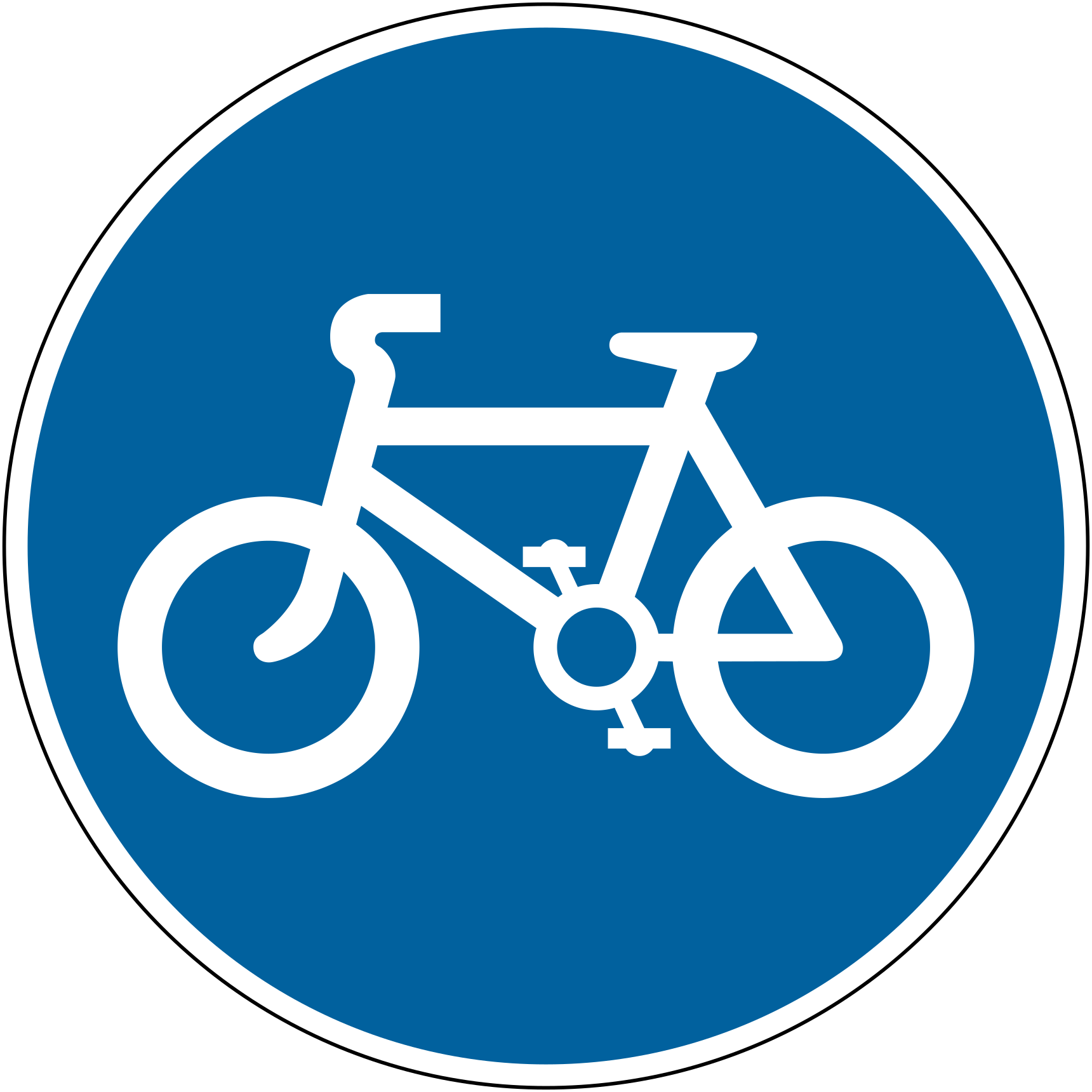

- Solid white cycle lane: do not enter during its operating times, except where permitted in specific circumstances.
- Broken white cycle lane: avoid driving in it unless necessary and safe.
- Cycle box at lights: stop at the first stop line when required.
- Bus lanes may allow cyclists, so check signs and mirrors before entering or crossing.
- Do not use a cycle lane as extra space to squeeze past another vehicle.
Reading what a cyclist might do next
A cyclist's line is affected by things drivers hardly notice: drain covers, potholes, wet leaves, diesel spills, loose gravel, sunken repairs and car doors. I warn learners before they pass a row of parked cars that the cyclist may move out by a metre or more. That is not the cyclist being awkward; it is self-preservation.
Children and less experienced cyclists may wobble when starting off, looking behind or climbing a hill. E-bikes can be quicker away from lights than learners expect, and delivery riders may appear from side roads or between queues. None of this means you should be nervous around cyclists. It means you should give yourself more time to observe before deciding.
Look at the rider's head movements, hands and road position. A glance over the shoulder can mean they are about to move out. A cyclist riding away from the kerb may be avoiding a hazard you cannot yet see. On lessons, I ask pupils to say out loud, 'Why are they there?' It turns irritation into observation, and observation is what keeps the situation calm.
- Parked cars: expect doors to open and cyclists to ride outside the door zone.
- Poor surfaces: expect sudden movement around potholes, drains and debris.
- Hills: expect wobbling or slower speed on climbs.
- Side roads: expect cyclists to appear from both directions, especially near schools and shops.
- Bad weather: give extra space in wind, rain and low sun.
Speed, following distance and meeting oncoming traffic
Your speed decides how much time you have. If you rush up behind a cyclist at 30mph and then brake late, you create pressure and reduce your view. Ease off early instead. A smooth reduction of speed tells the examiner you have seen the hazard and are planning, not reacting in a panic.
Following distance behind a cyclist is not just about stopping. It is about vision. If you sit too close, you cannot see the oncoming gap properly and you are more likely to make a poor overtake. I normally coach learners to hang back where they can see past the cyclist without intimidating them, then make a clear decision: pass properly or wait.
When meeting oncoming traffic, remember that the cyclist still needs space. If an approaching vehicle means you cannot leave the Rule 163 clearance, you slow and stay behind. The moment that costs people on test is when they start the overtake, see the oncoming car, and then tuck back in towards the cyclist. That is avoidable if you only go when the whole manoeuvre is available.
- 1Spot the cyclist early and come off the gas.
- 2Check mirrors to understand traffic behind you.
- 3Hold a safe following position with a good view ahead.
- 4Assess the full overtake, including oncoming traffic and road narrowing.
- 5Move out only when you can keep safe clearance all the way past.
- 6Return to your lane gradually after the cyclist is well behind.
Test faults and a learner driver's safety checklist
DVSA examiners do not have a special box called cyclist fault, but they will mark what your driving shows: clearance to obstructions, mirrors, judgement, meeting traffic, positioning, signals and awareness and planning. A close pass can be recorded as a serious or dangerous fault if it creates real risk or makes the cyclist take avoiding action. Even if it is not serious, repeated poor planning around cyclists can build up driver faults.
Police may also deal with unsafe overtaking as careless or inconsiderate driving. GOV.UK publishes penalty information, and a fixed penalty for careless driving is commonly listed as £100 and 3 penalty points, while court outcomes can be higher depending on the case. Figures and enforcement options can change, so always check current official sources.
Use this checklist on lessons until it becomes automatic. If you can talk through these points calmly while driving, you are far less likely to rush a pass.
- 1See the cyclist early.
- 2Ease off and check mirrors.
- 3Ask whether there is at least the required clearance for the whole pass.
- 4Check for junctions, islands, bends, parked cars and oncoming traffic.
- 5Signal only if it helps and will not mislead.
- 6Pass smoothly with space, or wait patiently.
- 7Recheck mirrors before returning fully to your lane.
- Close pass: not leaving enough side clearance, especially near islands or parked cars.
- Late decision: moving out before you know whether the full overtake is safe.
- Left-turn conflict: overtaking a cyclist and then turning across them.
- Mirror fault: failing to check left mirror before turning or right mirror before moving out.
- Cycle box fault: stopping in an advanced stop area when you should have stopped at the first line.
- Pressure fault: following too closely and making the cyclist feel squeezed.
Common questions
How much space must I give a cyclist when overtaking in the UK?
Highway Code Rule 163 says to leave at least 1.5 metres when overtaking cyclists at speeds up to 30mph, and to give more space at higher speeds. If the road is too narrow to give that clearance, wait behind until it is safe.
Can I cross the centre line to overtake a cyclist?
Yes, if it is safe, legal and necessary to give proper clearance. You must consider oncoming traffic, bends, junctions, road markings and whether you can return safely without cutting in.
What should I do if a cyclist is in the middle of the lane?
Do not intimidate them or try to force them left. Cyclists may ride centrally to avoid hazards or prevent an unsafe overtake, so hold back and pass only when you can leave enough room.
Can I turn left if a cyclist is coming up on my inside?
You should not turn across a cyclist going ahead. Check your left mirror early, let the cyclist clear the junction if they are alongside or close behind, then turn when it is safe.
Will I fail my driving test for passing a cyclist too closely?
You can fail if the pass is unsafe, forces the cyclist to change course, or creates a serious risk. Examiners commonly mark these situations under clearance, judgement, mirrors, positioning or awareness and planning.
Am I allowed to drive in a cycle lane to get past traffic?
Usually no. Rule 140 says you must not drive in a mandatory cycle lane marked by a solid white line during its hours of operation, and you should not drive in an advisory lane unless unavoidable and safe.
Find a course near you
Reading about it only gets you so far. Our instructors drill this with you in the car, on the roads around your test centre.