
The short version
- Undue hesitation is marked when you wait unnecessarily despite a safe opportunity.
- There is no set number of hesitations that automatically causes a fail.
- Examiners look at safety, opportunity, timing and effect on other road users.
- Roundabouts, right turns and emerging from junctions are the most common places I see it.
- A clear routine helps you decide, commit and move without rushing.
What undue hesitation means on the driving test
Undue hesitation means waiting too long when it is safe and reasonable to go. On a UK practical driving test, it is usually marked under progress, not because you are being careful, but because you are failing to make normal progress with the traffic. The key point is that caution is expected, but unnecessary delay is not.
This is one of the most misunderstood test faults I see as an instructor. Learners often say, "I thought it was better to be safe than sorry." That is true, up to a point. The examiner does not want you to gamble into a gap, but they do expect you to recognise a safe gap and use it. If you repeatedly sit still when the situation is clear, or if your delay affects traffic behind you, it can become more than a minor issue.
The DVSA driving test report has progress as one of the assessed areas, including undue hesitation. A single short pause will not normally ruin a test. A serious fault can be recorded if the hesitation is significant, causes another road user to slow, stop or become confused, or shows you cannot judge when to proceed safely. There is no published rule that says a certain number of hesitations automatically means a fail.
Cautious driving versus unnecessary waiting
Good driving is not fast driving. Good driving is safe, legal, planned and decisive. The Highway Code expects drivers to take care at junctions, crossings and roundabouts, and to drive with consideration for others. This is general guidance, not legal advice. On test, the examiner is looking for balanced judgement: you slow, look properly, assess the risk, then act when the opportunity is there.
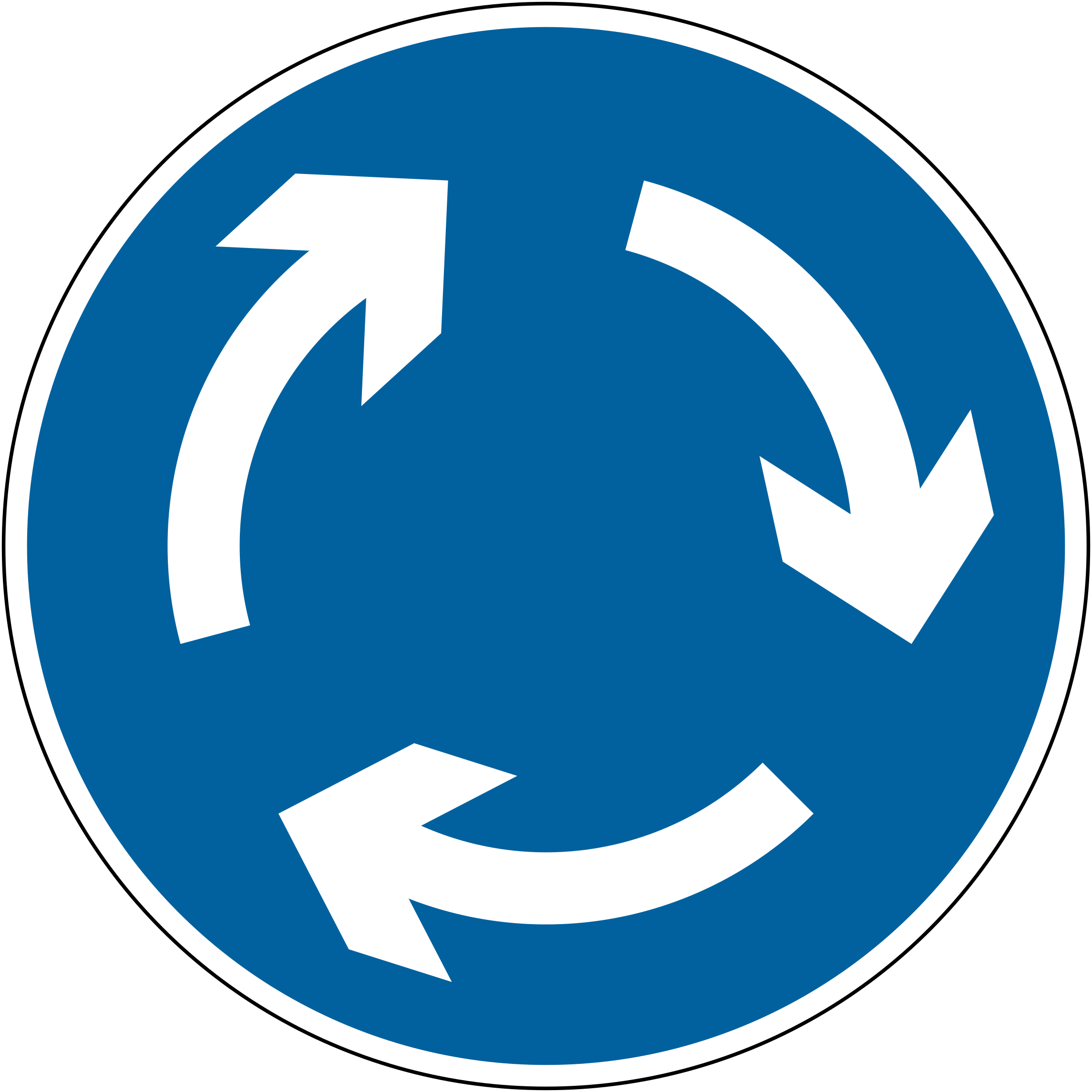
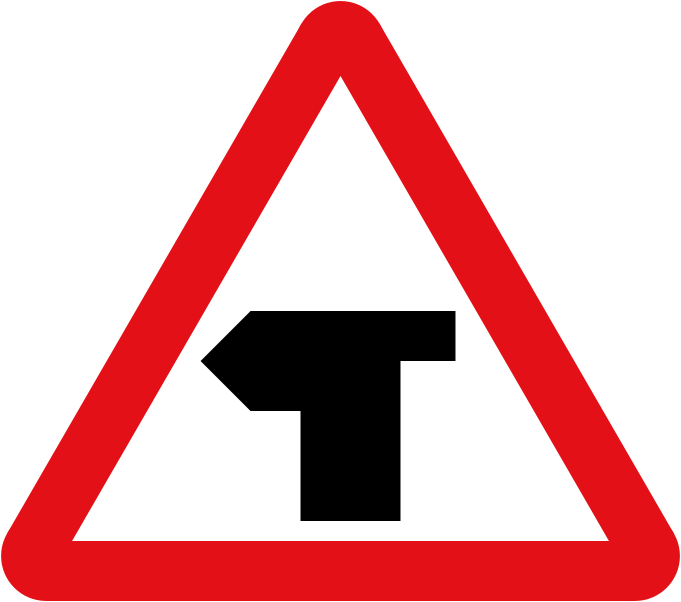
The problem starts when a learner treats every situation as if danger is definitely coming. I often see pupils stop at an empty mini-roundabout, wait at a green light because there might be a pedestrian somewhere, or refuse a wide gap at a T-junction because a vehicle is visible in the distance. Visibility does not automatically mean danger. The question is whether that vehicle is close enough and fast enough to affect you.
Examiners are not marking you for being brave. They are marking whether your decision fits the situation. If you wait because your view is blocked, because a pedestrian is stepping out, or because an approaching driver has priority and is too close, that is sensible. If you wait with a clear view, no priority conflict and a safe gap, the delay may be marked as undue hesitation.

- Safe caution: pausing because your view is restricted by parked vehicles or buildings.
- Safe caution: waiting because a pedestrian is near or on a crossing.
- Safe caution: holding back because a vehicle with priority is too close.
- Undue hesitation: remaining stopped after the road has clearly opened up.
- Undue hesitation: missing several safe gaps at a roundabout or junction.
Where learners most often pick up the fault
The most common place I see undue hesitation is at roundabouts. A learner approaches well, selects a suitable gear, then freezes. They look right, see a car that is not yet on the roundabout, and decide to wait. By the time that car passes, another one appears, and the same thing happens again. The test fault is not the waiting itself. It is the missed safe opportunity before the traffic arrived.
Right turns across oncoming traffic are another hotspot. Learners often roll to the turning point, position correctly, then sit through a gap that was clearly large enough. This is especially noticeable if traffic behind is held up or if the delay causes uncertainty for the oncoming driver. The examiner is asking: did the candidate understand priority and judge the closing speed accurately?
Emerging from side roads, especially at T-junctions, is also a classic area. The learner looks both ways but does not commit when the road is clear. Sometimes the issue is clutch control, sometimes it is fear of stalling, and sometimes it is not looking early enough. If you only start making a decision after the gap has arrived, you will usually be too late to use it.
- Roundabouts: waiting for traffic that is too far away to affect you.
- T-junctions: not emerging when both directions are clear.
- Right turns: missing clear gaps across oncoming traffic.
- Traffic lights: failing to move on a green light or green filter arrow when safe.
- Meeting traffic: stopping unnecessarily when there is enough room to continue safely.
- Moving off: delaying after checking mirrors and blind spot with no approaching hazard.
What examiners actually look for
In the car, examiners do not mark hesitation just because they feel impatient. They observe the situation as a driver would. Was there a safe gap? Did the candidate have time to see it? Would a competent driver normally have gone? Did the delay affect anyone? Those questions matter more than how long the pause felt in seconds.
A driving fault may be recorded if you are slightly late to take an opportunity but it has little effect. A serious fault may be recorded if the hesitation is substantial, repeated, or causes another road user to slow, stop, overtake unnecessarily or become unsure what you are doing. A dangerous fault would involve actual danger, but with hesitation the usual test risk is that a minor-looking delay becomes serious because of the effect around you.
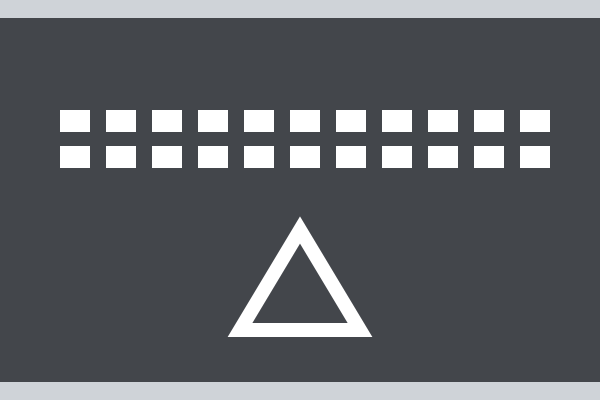
One specific fault that costs people is stopping at a roundabout give way line when there is no traffic from the right and no pedestrian risk. If the road is open and your approach speed allowed you to continue, stopping dead can make the vehicle behind react. Another is sitting at a junction while a following driver expects you to go, then finally moving just as the safe gap has gone. That creates the worst of both worlds: delay followed by a rushed decision.
How to judge a safe gap without gambling
Gap judgement improves when you stop asking, "Can I make it?" and start asking, "Can I go without making anyone change speed or direction sharply?" That is closer to what the examiner is assessing. If another road user has priority, your move should not force them to brake, swerve or hesitate because of you.
At roundabouts, use your approach to build the decision early. Check mirrors, reduce speed, choose the correct lane and gear, then look right and ahead before the give way line. If the right side is clear and your path is clear, keep the car moving. If you arrive too fast, you will not have time to decide. If you arrive too slowly with no plan, you create hesitation even when the gap is good.
At junctions, separate looking from moving. Look early, look again as you arrive, and be ready with the biting point if you are in a manual car. In an automatic, have controlled brake release rather than a sudden lunge. The decision should feel like a smooth continuation: observe, decide, go. It should not feel like sit, panic, leap.
- Ask whether your move will affect the priority vehicle, not simply whether you can squeeze in.
- Judge speed as well as distance. A far vehicle travelling quickly may be less suitable than a nearer slow one.
- Keep scanning. Do not stare only to the right at roundabouts and miss what is in front.
- Prepare the car before the gap arrives, especially in a manual.
- If the safe gap has gone, wait for the next one rather than rushing late.
A practical routine to stop freezing
Most undue hesitation is not really about bravery. It is about late planning. When learners are unsure of priority, position or gear, they use waiting as a safety blanket. The cure is a repeatable routine that gives your brain less to process at the last second.
Practise this first in quiet areas with your instructor or supervising driver, then build up to busier junctions. The aim is not to force yourself out. The aim is to arrive prepared, know what you are looking for, and move when the situation matches your plan.
- 1Identify the hazard early: junction, roundabout, crossing, meeting situation or traffic lights.
- 2Check mirrors before changing speed or position, especially the interior and relevant side mirror.
- 3Set the car up early with the correct lane, position, speed and gear.
- 4Look for priority traffic, pedestrians, cyclists and road markings before you reach the decision point.
- 5Decide whether the gap is safe before the car has fully stopped, where possible.
- 6Commit smoothly once you decide to go, using positive steering and acceleration.
- 7If the situation changes, cancel the move and wait, but do not punish yourself for a correct safety decision.
Common faults and how to fix them
A useful way to deal with hesitation is to identify the exact behaviour. "I hesitate" is too vague. Are you late with observations? Are you unsure who has priority? Are you worried about stalling? Each cause needs a different fix.
In lessons, I will often pull up after a junction and ask the pupil to describe the gap they rejected. If they cannot remember the speed, distance or road position of the approaching vehicle, the problem was observation. If they saw everything but still did not move, it may be confidence or vehicle control. Good feedback should be that specific.
- Fault: stopping at every give way line. Fix: approach slower and look earlier so you can continue if it is open.
- Fault: looking only one way. Fix: use a left-right-left or right-left-right scan depending on the junction layout.
- Fault: missing gaps due to clutch worries. Fix: practise finding the biting point quickly on gentle slopes and level roads.
- Fault: waiting for a completely empty road. Fix: learn to judge whether priority traffic will actually be affected.
- Fault: rushing after waiting too long. Fix: let the lost gap go and take the next safe one calmly.
- Fault: relying on the car behind to be patient. Fix: remember that your progress and effect on others are part of the assessment.
Building test-ready confidence
Confidence for the practical test comes from evidence, not positive thinking alone. You need repeated experience of making correct decisions in real traffic. That means practising the same type of junction several times, discussing which gaps were safe, and understanding why. Over time, your brain recognises the pattern before you reach the line.
Ask your instructor to include commentary driving when working on hesitation. At first, they can talk through what they see: "blue car too close, silver car slowing, after the van there is a usable gap." Then you take over and say what you are seeing. If your commentary matches the road, your decision-making usually improves quickly.
On test day, do not try to prove you are decisive by forcing gaps. Examiners would rather see one sensible wait than one risky move. The skill is balance. If the road is not safe, wait. If the road is safe, prepared and legal, go with purpose.
Common questions
Can you fail your driving test for undue hesitation?
Yes, you can fail if the hesitation is serious enough. A small delay may be marked as a driving fault, but repeated or significant missed opportunities can become a serious fault, especially if other road users are affected.
How many times can you hesitate before you fail?
There is no fixed DVSA number that automatically means a fail for undue hesitation. The examiner looks at the situation, whether the opportunity was safe, how long you waited, whether it was repeated, and whether it affected others.
Is it better to wait if I am not sure during the test?
If you are genuinely not sure it is safe, you should wait. The problem is waiting when the road is clearly safe and you have enough time to proceed without affecting priority traffic. Safe caution is good driving, but unnecessary waiting can be marked.
Does stopping at every roundabout count as undue hesitation?
It can do if you stop when the roundabout is open and it would have been safe to continue. You must give way to traffic from the right where required, but you should not automatically stop if there is no conflict and your view is clear.
Can undue hesitation happen in an automatic car?
Yes. Automatic learners can still hesitate at junctions, roundabouts, traffic lights and meeting situations. The cause is less likely to be clutch control, but it may be late observation, poor gap judgement or lack of confidence.
How do I practise gap judgement safely as a learner?
Practise with an approved instructor or suitable supervising driver, starting on quieter junctions before building up. Talk through what you see, judge whether priority traffic would need to slow or change direction, and review any missed opportunities after the event.
See our pass guarantee
Reading about it only gets you so far. Our instructors drill this with you in the car, on the roads around your test centre.