
The short version
- Zero minors means no recorded driving faults on the test report.
- You do not need zero minors to pass the UK practical driving test.
- Most clean test drives come from calm routines, not perfect luck.
- Examiners mark risk, control and decision-making, not style.
- Chasing zero faults can make learners tense and more likely to make errors.
Can you really pass your driving test with zero minors?
Yes, you can pass your UK practical driving test with zero minors, but it is better to understand what that actually means. “Minors” is the old learner shorthand for what DVSA now calls driving faults. A zero-minor pass means the examiner did not need to record any driving faults, serious faults or dangerous faults during the drive.
The search question usually comes from learners who want to know whether a perfect pass is possible and how to get one. My honest answer as an instructor is this: it is possible, but trying to force a zero-minor result is often the wrong mindset. The pupils who drive cleanly tend to focus on safety, planning and routines. They are not sitting there thinking, “I must not get a minor.”
DVSA says you pass the practical test if you make no serious or dangerous faults and no more than 15 driving faults. That is the published standard at the time of writing, but DVSA rules and fees can change, so always check GOV.UK for current information. This article is general driving guidance, not legal advice.
- A driving fault is something not potentially dangerous on its own, but still below test standard.
- A serious fault is something that could be potentially dangerous.
- A dangerous fault involves actual danger to you, the examiner, the public or property.
- Repeated driving faults in the same area can become serious.
- Zero minors is excellent, but a safe pass with a few driving faults is still a proper pass.
What examiners actually mark on a clean test drive
Examiners are not looking for racing-driver smoothness or advanced-driver perfection. They are assessing whether you meet the national driving standard and can drive without prompting, safely and legally, in normal traffic. If your decision is safe, timely and under control, it is unlikely to be marked just because it was not pretty.
In the car, I see learners lose possible zero-minor drives through tiny lapses in routine. A missed mirror before changing speed, a late signal at a mini-roundabout, a slightly harsh stop because they spotted traffic too late, or a hesitation where they had a clear opportunity to go. None of these are dramatic, but they are exactly the sort of things that turn a clean sheet into one or two driving faults.
The important point is that examiners mark what happened, not what you meant to do. If you check the mirror after you have already moved position, the examiner cannot give you credit for planning. If you signal after the following driver has already reacted, it is late. If you creep into a junction without being able to see, you have created risk even if nothing came.
- Mirror use: was it early enough to affect your decision?
- Signals: were they necessary, clear and not misleading?
- Position: did your road position help others understand you?
- Speed: was it legal and suitable for the conditions?
- Control: did you steer, brake, accelerate and change gear smoothly?
- Judgement: did you take safe gaps without making others slow suddenly?
The mindset that gives you the best chance of zero faults
A zero-minor drive usually feels boring from inside the car. That is a good thing. There are no last-second decisions, no rushed lane changes, no dramatic braking and no “I hope this is okay” moments. You are simply reading the road early, doing the correct routine and making ordinary decisions at the right time.
One common mistake is trying to drive “extra carefully” on test. Learners then sit at junctions with clear gaps, brake too early for every parked car, or drive well below the limit when the road is clear. The examiner may mark undue hesitation or inappropriate speed if your caution starts affecting progress. Highway Code rule 169 says do not hold up a long queue of traffic unnecessarily, and rule 125 reminds drivers that the speed limit is the absolute maximum, not a target.
The best mindset is: safe, legal, smooth, and making normal progress. If you make a small error, let it go immediately. I have sat next to learners who made one minor fault in the first five minutes, then failed because they spent the next ten minutes thinking about it. Examiners do not want perfection; they want a driver who deals with real roads.
- 1Drive the situation in front of you, not the result you want on the sheet.
- 2Use your routines even when the road looks quiet.
- 3Make decisions early enough that you never need to rush.
- 4If you make a mistake, correct it safely and move on.
- 5Aim for a safe pass, and let zero minors be a possible bonus.
Mirror, signal, manoeuvre: where clean sheets are often lost
The mirror, signal, manoeuvre routine sounds basic, but it is one of the biggest differences between an average test drive and a clean one. Highway Code rule 159 tells drivers to use mirrors before signalling or changing direction or speed. On test, the examiner wants to see that you know what is around you before you act.
The most common mirror fault I see is checking too late. For example, a learner approaches a parked van, steers out, then glances at the right mirror halfway through the move. That tells the examiner the decision to move was made before the observation. Another common one is braking for a hazard without checking the interior mirror first. If there is a van close behind, your braking plan may need to be more gradual.
Signals also cost clean sheets. A signal should help someone, not confuse them. If you signal left too early before a side road, another driver might think you are turning sooner. If you signal right to pass parked cars when there is nobody to benefit, it may not be a fault, but learners sometimes use unnecessary signals as a substitute for proper observation.
- Before slowing: check the interior mirror, then brake progressively.
- Before changing lane or position: check interior and relevant door mirror, with blind spot where needed.
- Before signalling: ask whether the signal helps or could mislead.
- Before pulling away: use all-round observation, including the blind spots.
- Before opening a new gap or moving around parked vehicles: check mirrors early and plan your line.
Junctions, roundabouts and meeting traffic
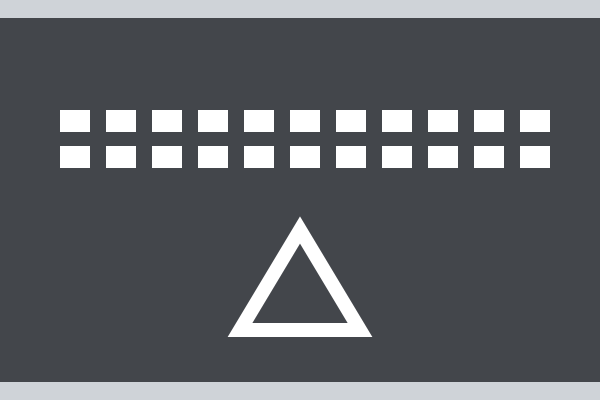
If a learner asks me where zero minors are usually lost, I think immediately of junctions and roundabouts. Not because learners do not know the rules, but because the timing has to be right. You need the correct approach speed, the correct position, effective observations and a decision that does not make another road user change speed or direction sharply.
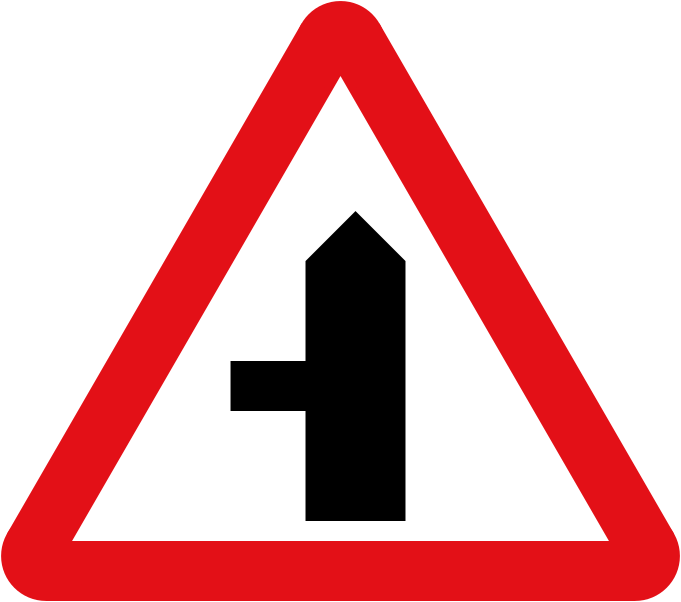
Highway Code rules 170 to 172 cover junctions, including watching for pedestrians crossing the road into which you are turning. This is an area where new drivers are often surprised on test. If a pedestrian is already crossing, or has started to cross the side road, they have priority and you must give way. A rushed turn with poor observation can quickly become a serious fault.
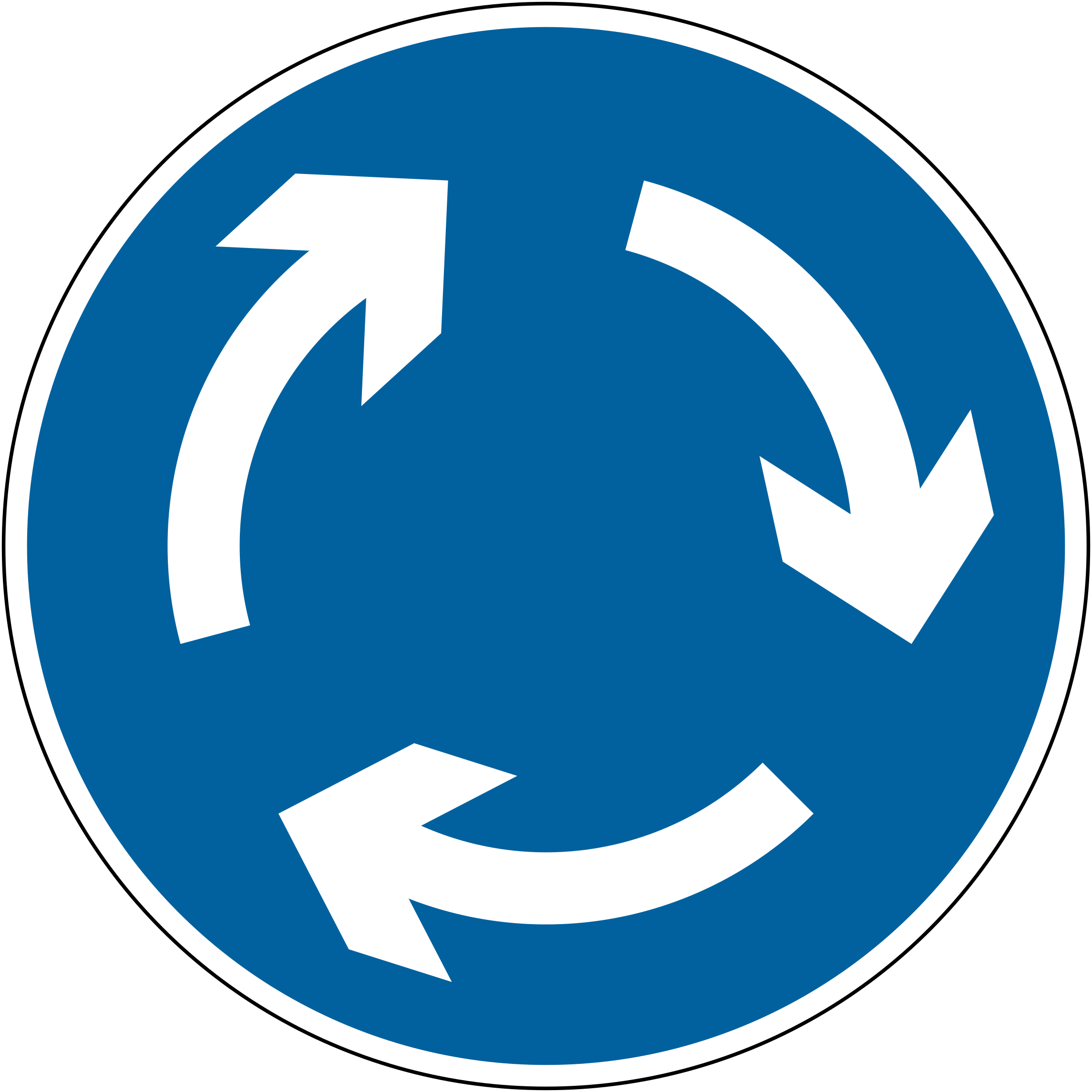
Roundabouts are another clean-sheet breaker. Highway Code rules 184 to 190 explain the approach, lane choice, signals and priority. On test, the classic faults are approaching too fast, entering when a vehicle from the right is too close, signalling left too early, or drifting lanes while looking at the exit instead of steering accurately.
Meeting traffic on narrow roads also shows your judgement. If the obstruction is on your side, you usually give way. But the examiner is watching the whole picture: who arrived first, how much room there is, what speed everyone is doing and whether your decision is clear. Hesitating when you clearly have priority can be marked, just as forcing your way through can be marked.
Manoeuvres and independent driving without a fault
The reversing exercise is not about making the car look perfectly lined up in one movement. It is about control, observation and safety. You are allowed to correct the car if you do it safely. I would rather see a learner pause, observe properly and take a small correction than continue reversing badly because they are frightened of looking imperfect.
The usual test manoeuvres include bay parking, parallel parking, pulling up on the right and reversing, or forward bay parking, depending on what the examiner asks. You may also be asked to do an emergency stop. For a clean drive, treat the manoeuvre as part of the road, not a separate trick. Keep checking around, especially before the car changes direction or swings out.
Independent driving can be by sat nav or traffic signs. A wrong turning is not automatically a fault if you deal with it safely. I have seen learners panic because they missed an instruction and then make a serious lane error trying to fix it. If you are unsure, ask the examiner to repeat the direction. If you end up in the wrong lane, follow the lane safely rather than swerving across.
- Move slowly enough that you can stop if someone appears.
- Look in the direction of travel, but keep all-round checks going.
- Pause before crossing a pavement edge, lane line or path of traffic.
- Correct calmly if the car is not where you want it.
- During independent driving, prioritise road signs and lane markings over panic.
Speed, spacing and control: the quiet skills behind zero minors
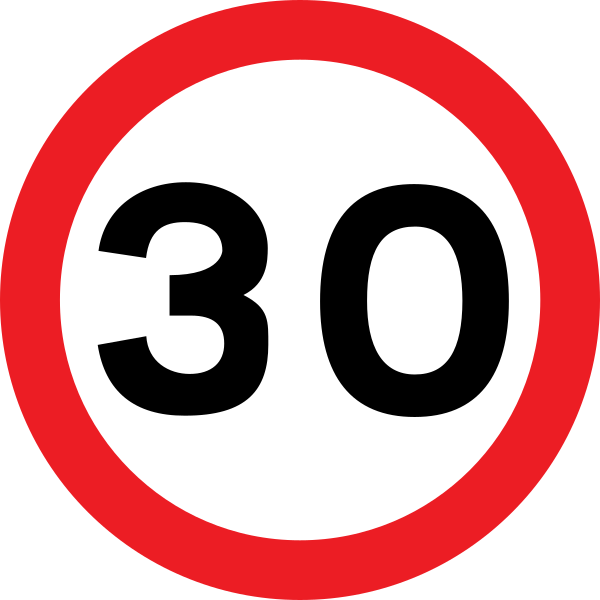
Clean test drives normally have excellent speed control. That does not mean crawling. It means matching the speed to the road, weather, traffic, visibility and legal limit. Highway Code rule 124 lists national speed limits, including 30 mph on roads with street lights unless signs show otherwise, 60 mph on single carriageways and 70 mph on dual carriageways and motorways for cars, subject to signs and conditions.
Following distance matters just as much. Highway Code rule 126 gives the well-known two-second rule in dry conditions and says to allow at least double the distance on wet roads. Learners often know this in theory but close up behind traffic when they are concentrating on directions. On test, following too closely can be a driving fault and, if it creates real risk, worse.
Control faults tend to creep in when the brain is overloaded. Harsh braking, coasting too long with the clutch down, rolling back on a hill start, steering too late around parked cars, or choosing the wrong gear for the speed can all spoil a clean sheet. In lessons, I work on making these automatic so the learner has spare attention for hazards.
Electric and automatic cars remove gear changes, but they do not remove control. You still need smooth acceleration, correct braking pressure, good steering and sensible use of creep or regenerative braking if the vehicle has it. Examiners mark the outcome on the road, not the type of gearbox.
A zero-minor test preparation checklist
Preparation for a clean pass starts before test day. You should be able to drive unfamiliar roads, not just a memorised test route. Test centres use a range of roads because the examiner needs to see how you respond to real situations, including busy junctions, residential roads, dual carriageways where available, roundabouts and independent driving.
A useful standard is this: if your instructor went quiet for 40 minutes, would you still drive safely without help? If the answer is no, you are not ready to chase zero minors. Prompted driving in lessons often hides weaknesses. The test is independent, and the examiner will not coach you around developing hazards.
In the week before test, do not just practise what you are already good at. Put yourself under sensible pressure: different times of day, heavier traffic if appropriate, awkward right turns, hill starts, meeting traffic and manoeuvres in real car parks. The more ordinary these situations feel, the less likely you are to snatch at decisions on the day.
- Mirrors: every speed change, signal, lane change and position change is supported by early checks.
- Junctions: you approach at a speed that gives you time to look, decide and act.
- Roundabouts: lane choice, signals and exits are planned before you arrive.
- Manoeuvres: you move slowly, observe all around and correct safely if needed.
- Progress: you take safe opportunities without waiting unnecessarily.
- Recovery: if something unexpected happens, you slow down, reassess and stay legal.
Common questions
Is passing with zero minors better for insurance?
Insurers usually ask whether you have a full licence, your age, vehicle, address, occupation, claims and convictions. They do not normally price a policy based on how many driving faults were on your test report. A zero-minor pass is a personal achievement, but it is not a separate licence category.
Can I ask the examiner how many minors I have during the test?
No, you should not ask for a running score. The examiner will give the result and feedback at the end. During the drive, concentrate on the road rather than trying to work out what has or has not been marked.
Does one stall stop me getting zero minors?
Not always. A stall may be marked if it affects control, causes delay, or happens in a risky place, but a quick, safe recovery may not be serious. If you stall, secure the car if needed, restart calmly, observe properly and move off only when safe.
Are mirror checks exaggerated on a driving test?
They should not be exaggerated for show, but they must be clear enough for the examiner to know you have checked. Move your eyes and head naturally, and check early enough to influence your decision. A theatrical mirror glance after the manoeuvre has started is too late.
Can I still pass if I go the wrong way on independent driving?
Yes, taking a wrong route is not automatically a fault. The examiner is testing your driving, not your navigation. Stay safe, follow road markings and signs, and do not make a sudden lane change just to correct the route.
How many lessons do I need to pass with zero minors?
There is no reliable fixed number because learners start with different experience, confidence and practice outside lessons. What matters is whether you can drive independently and consistently without instructor prompts. If you only drive well on familiar roads, you are not yet at zero-minor standard.
See our pass guarantee
Reading about it only gets you so far. Our instructors drill this with you in the car, on the roads around your test centre.