
The short version
- Examiners mark risk, not nerves or personality.
- One serious or dangerous fault means a fail, even if the rest is good.
- Most test fails come from decisions at junctions, observations, speed and positioning.
- A small mistake can stay a driving fault if you spot it and recover safely.
- Drive the way you have been taught, not the way you think will impress the examiner.
What examiners are really looking for
On test day, the examiner is looking for one main thing: can you drive on your own, safely and legally, in normal road and traffic conditions? They are not expecting a perfect drive with no nerves, no hesitation and no tiny mistakes. They are assessing whether your decisions create risk, whether you keep control of the car, and whether other road users can understand what you are doing.
As an instructor, I see learners worry about the wrong things. They think the examiner is waiting for a smooth gear change, a textbook commentary or a perfectly parked car within two seconds. In reality, the examiner is watching your observations, positioning, speed choice, response to hazards, use of mirrors and judgement. A slightly clumsy clutch bite is rarely the issue. Pulling out when you have not properly checked, drifting towards a parked car, or arriving at a roundabout too fast is what costs people.
The practical car test, according to DVSA guidance on GOV.UK, lasts about 40 minutes and includes general driving, around 20 minutes of independent driving, one reversing manoeuvre and possibly an emergency stop. Test content and fees can change, so always check GOV.UK for the latest DVSA information. The structure matters, but the examiner’s core question stays the same throughout: are you safe enough to be given a full licence today?
How the examiner marks your drive
The marking system is often misunderstood. The examiner records faults using DVSA categories: a driving fault, a serious fault or a dangerous fault. You can pass with some driving faults, provided they are not repeated in a way that shows a pattern of unsafe driving. You cannot pass with a serious or dangerous fault.
DVSA says you must have no serious or dangerous faults and no more than 15 driving faults to pass the car practical test. That figure is published by DVSA and can change if the test rules change, although it has been in place for many years. A driving fault is something not potentially dangerous in that moment, such as a missed mirror check where no one is affected. A serious fault is something potentially dangerous. A dangerous fault involves actual danger to you, the examiner, the public or property.
Here is the part learners often miss: the same action can be marked differently depending on what is around you. If you forget a mirror check before signalling on an empty road, it may be a driving fault. If you do it while a cyclist is close behind or a motorcyclist is overtaking, it may become serious because your action could put someone at risk. Examiners mark the effect and the risk, not just the movement of your hands and feet.
- Driving fault: a minor lapse that does not create immediate danger.
- Repeated driving fault: the same weakness happening often enough to show poor control or judgement.
- Serious fault: a potentially dangerous action or lack of action.
- Dangerous fault: actual danger, often where the examiner or another road user has to react.
- Result: one serious or dangerous fault means the test is unsuccessful.
Observations: the fault I see most often before test
If I had to pick one area that changes a test result, it would be observations. Not just looking, but looking at the right time, in the right place, and acting on what you see. Examiners do not give marks for head movement alone. A big theatrical mirror check is useless if you then move into the path of a cyclist, miss a pedestrian stepping out, or fail to re-check a blind spot before changing direction.
The classic learner error is checking too early and then treating that check as if it still counts. For example, you check the right mirror before moving off, wait ten seconds while a van passes, then move without checking again. The road has changed. Another common one is at roundabouts: learners look right once, focus only on the car ahead, and miss a vehicle already established from the right.
Examiners are looking for an effective routine. Mirrors before changing speed or direction, blind spots where needed, forward planning all the time, and proper all-round observation during manoeuvres. The most important word is effective. If your observation does not influence your decision, it is not doing its job.
- Moving off: check mirrors and blind spots immediately before you move.
- Changing lanes: mirror, signal if needed, blind spot if appropriate, then steer smoothly.
- Turning left: check for cyclists, pedestrians and anyone close to the kerb.
- Reversing: keep looking all around, not just in the mirrors or camera.
- Emerging: do not go unless you can see and judge that it is safe.
Junctions, roundabouts and the decisions that matter
Junctions and roundabouts are where examiners see whether you can combine control, observation and judgement. The fault that costs people is not usually being a bit slow. It is committing to a decision without enough information. I have watched good learners fail because they rolled over a give way line while still looking the wrong way, or entered a roundabout because the car in front went, not because they had checked for themselves.
At junctions, the examiner wants a safe approach speed, correct position, clear observation and a decision that matches the view. If the view is closed, creep and peep. If the view is open and the road is clear, go without unnecessary delay. Hesitation can become a fault if you miss clear safe gaps repeatedly, but taking time because you genuinely cannot see is sensible driving.
At roundabouts, your lane discipline and signalling must help others understand you. Highway Code Rule 185 gives the basic approach: give priority to traffic approaching from your right unless signs, road markings or traffic lights indicate otherwise. In test terms, the examiner is watching whether you select the correct lane, keep your position, avoid cutting across others, and update your observations as the situation changes.
- Do not follow the car in front blindly. Make your own checks.
- Approach give way lines at a speed that lets you stop smoothly.
- If you cannot see, creep forward under control until you can.
- On roundabouts, keep checking the lane you are moving into, not just the entry.
- If you take the wrong lane, follow it safely rather than swerving late.
Speed, progress and legal responsibility
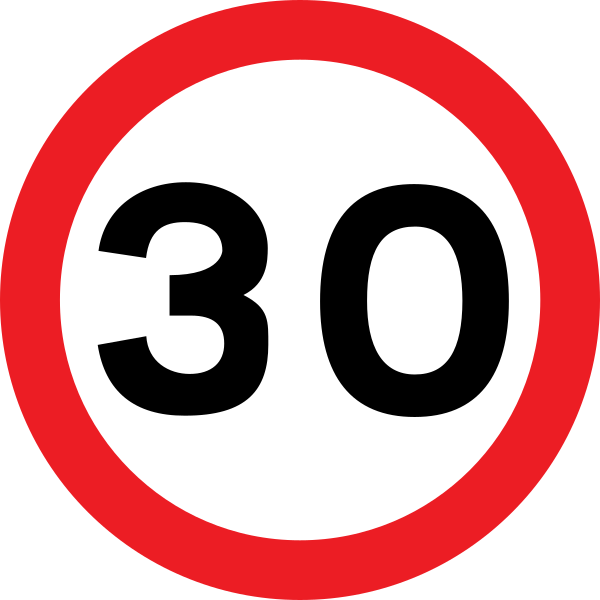
This is general guidance, not legal advice. On test, you are expected to obey speed limits and choose a safe speed for the conditions. Highway Code Rule 124 sets out national speed limits, and Rule 125 reminds drivers that the speed limit is the absolute maximum, not a target. The examiner will not be impressed by speed for its own sake. They want safe progress, which means keeping up with conditions when it is appropriate and holding back when risk increases.
Two opposite faults appear regularly. The first is driving too fast into hazards: approaching parked cars, junctions, bends or crossings as if the posted limit guarantees safety. The second is being unnecessarily slow where the road is clear, which can frustrate traffic and show you are not reading the road. A learner doing 22 mph in a clear 30 mph road for no reason may not feel dangerous, but if it is persistent it can be marked.
What examiners really like to see is a driver who changes speed early and smoothly. You spot the school crossing patrol, the bus indicating out, the narrowing road, the wet bend or the pedestrian near the kerb, then you adjust before the problem arrives. That is mature driving. Late braking, harsh acceleration and last-second decisions make the car feel out of control, even if you technically stay within the limit.
- Use the limit as a ceiling, then choose a speed for the road, weather and visibility.
- Slow down early for hazards rather than braking sharply at the last moment.
- Make normal progress when it is safe, especially on clear main roads.
- Look for changes in limits, including repeater signs and road layout clues.
- Never speed to please following traffic. The examiner will not expect it.
Independent driving: why it is not a memory test
The independent driving section worries many learners because they think one wrong turn means a fail. It does not. DVSA guidance says this part lasts around 20 minutes and may involve following a sat nav or traffic signs. The examiner is not testing your local knowledge or your ability to memorise a route. They are testing whether you can keep driving safely while making your own route decisions.
If you go the wrong way safely, that is normally fine. I have had learners take a wrong exit, stay calm, and still drive at test standard. The problem comes when a learner realises late and tries to rescue it by braking sharply, cutting lanes, signalling at the last second or arguing with the sat nav. The examiner would much rather you say, calmly, that you are in the wrong lane and continue safely.
Treat the sat nav or signs as information, not commands. Your first job is still mirrors, speed, position and safety. If the sat nav says turn right but the right lane is closed, follow the road safely. If you miss the sign for a destination, the examiner will redirect you.
- 1Listen to the instruction, then check the road ahead before acting.
- 2Plan your lane early using signs, markings and mirrors.
- 3If you are unsure, ask the examiner to repeat the direction.
- 4If you are in the wrong lane, stay in that lane unless it is safe to change.
- 5Signal only when it will help others and after checking mirrors.
- 6If you go the wrong way, drive on safely and let the examiner redirect you.
Manoeuvres and the emergency stop
The reversing manoeuvre is not marked as a parking competition. Examiners are looking for control, accuracy and observation. You need to finish in a reasonable position, but you are allowed to make corrections if you do so safely. What causes serious faults is usually poor observation: reversing towards a pedestrian, failing to notice a vehicle approaching, or continuing when someone is close behind.
Use slow car control. In lessons, I often tell learners that reversing should feel boringly slow. If the car is crawling, you have time to steer, observe and correct. If you rush, your eyes drop to the kerb or camera, your hands get busy, and you stop noticing the real road around you. Cameras and parking sensors can help if fitted, but they do not replace direct observation.
The emergency stop, if used, is about promptness and control. DVSA says about one in three tests includes an emergency stop, though procedures can change, so check current GOV.UK guidance. When the examiner gives the signal, brake firmly, keep control, stop safely, secure the car if needed, and carry out proper observations before moving off again.
- Parallel park: keep the car slow and check all around before the front swings out.
- Bay park: watch for pedestrians, trolleys and vehicles moving in the car park.
- Pull up on the right and reverse: make excellent all-round checks before crossing back.
- Forward bay park: control the approach speed and avoid cutting across marked bays carelessly.
- Emergency stop: stop promptly, then check mirrors and blind spots before moving away.
The test-day mindset examiners notice
Examiners know you are nervous. They see nervous learners every working day. A shaky left leg, a missed gear that you quickly sort out, or asking for an instruction to be repeated will not automatically fail you. What matters is whether nerves make you unsafe. The best test mindset is not confidence for show. It is calm recovery.
If you make a mistake, do not decide you have failed. I see learners throw away a perfectly passable drive because they assume one stall or one wrong lane has ended it. They then stop checking properly or start rushing. Until the examiner tells you the result at the end, keep driving to standard. A small fault can stay small if the recovery is safe.
Speak if it helps, but do not talk yourself into trouble. It is fine to say, for example, that you are waiting because your view is blocked, or to ask for a direction again. You do not need to explain every action. The examiner is trained to assess what you do, and safe driving is clearer than any speech.
- Before moving off, check the car is ready: seat, mirrors, belt, doors and handbrake or parking brake.
- At every new road, ask yourself: what is the limit, what is the hazard, who could be affected?
- After any mistake, return to mirrors, position, speed and space.
- Do not rush because a vehicle is close behind. Let them be impatient.
- If you are unsure of a direction, ask. If you are unsure of a gap, wait.
- Drive to the road in front of you, not to the result you are hoping for.
Common questions
Do driving examiners try to trick you on the practical test?
No. Examiners give directions and assess your driving against DVSA standards. They will not ask you to do anything illegal, and if you misunderstand a direction you can ask for it to be repeated.
Can I pass my driving test if I go the wrong way?
Yes, if you go the wrong way safely. A wrong turn is usually only a problem if you react unsafely, such as cutting lanes late, braking harshly or ignoring road signs and markings.
What is the most common thing learners fail for on test day?
DVSA publishes common reasons for failing, and observation at junctions, mirrors, control and response to signs and signals often feature. In the car, the pattern I see most is learners making a decision before they have fully checked it is safe.
Will I fail for stalling on my driving test?
Not automatically. A stall is usually only serious if it happens in a dangerous place, causes risk, or you recover without proper observations. Secure the car, restart calmly, check again, then move off when safe.
How many minor faults are allowed in a UK driving test?
DVSA uses the term driving faults rather than minor faults. Current DVSA guidance says you can pass with up to 15 driving faults, provided you have no serious or dangerous faults. Always check GOV.UK because test rules can change.
Does the examiner care if I use a reversing camera?
You may use fitted aids such as cameras and sensors, but they do not replace proper observation. The examiner needs to see that you are checking all around and responding to pedestrians, vehicles and other hazards.
See our pass guarantee
Reading about it only gets you so far. Our instructors drill this with you in the car, on the roads around your test centre.